
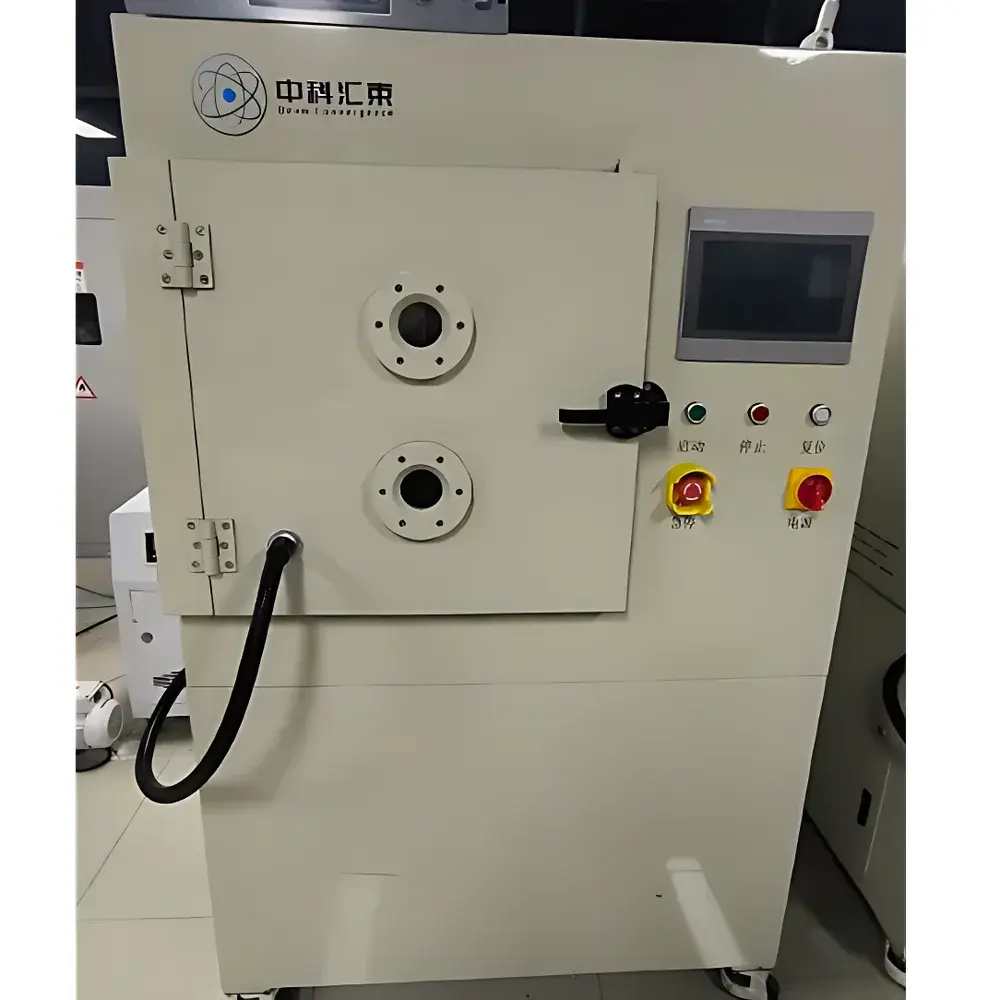
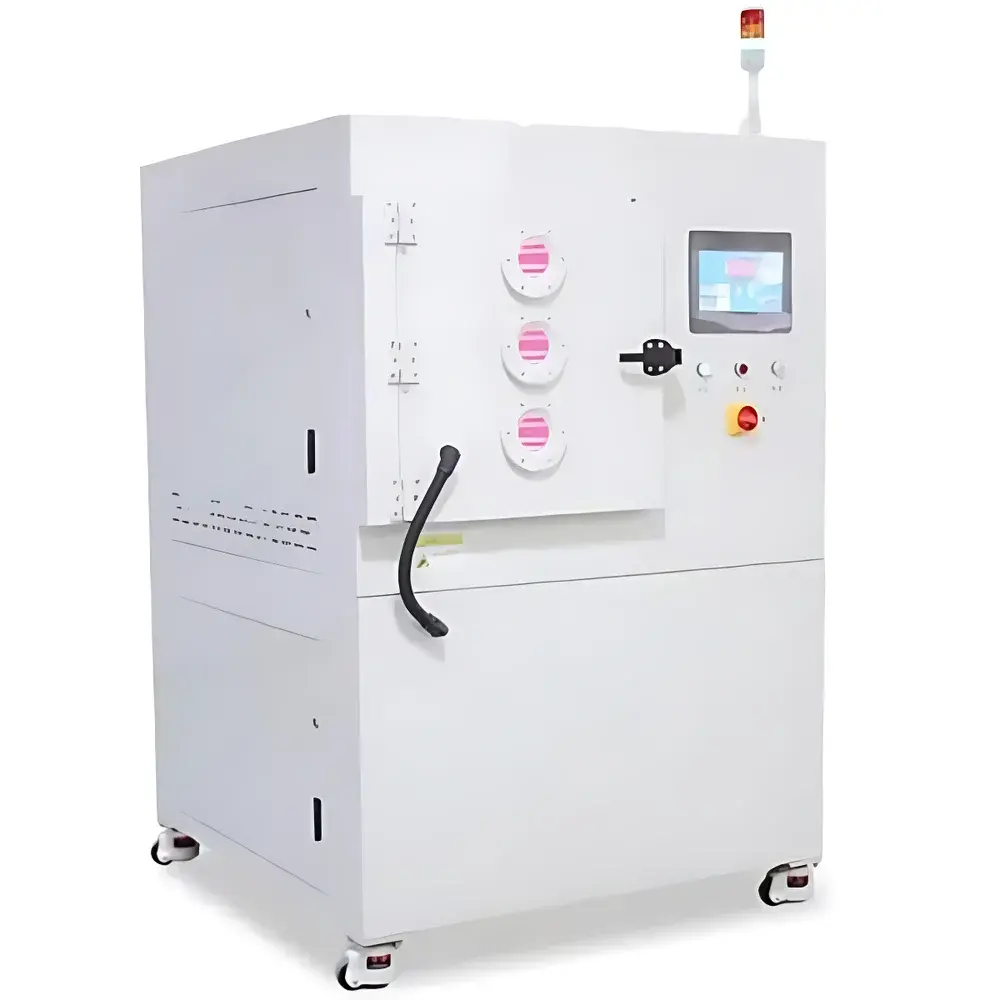
Beam Convergence TSPL200MA Vacuum Plasma Cleaner
| Brand | Beam Convergence |
|---|---|
| Origin | Shenzhen, China |
| Manufacturer Type | Original Equipment Manufacturer (OEM) |
| Product Category | Domestic Plasma Surface Treater |
| Model | TSPL200MA |
| RF Frequency | 13.56 MHz |
| Maximum RF Power | 1000 W |
| Chamber Volume | 200 L |
| External Dimensions (W×D×H) | 1250 × 1250 × 1850 mm (excl. tri-color indicator light) |
| Chamber Tray Material | Stainless Steel |
| Gas Inlets | 2 independent mass flow-controlled channels |
| Control System | Fully Automated PLC-based Interface with Programmable Process Sequencing |
Overview
The Beam Convergence TSPL200MA Vacuum Plasma Cleaner is an industrial-grade, bench-to-production-scale plasma surface treatment system engineered for precision surface activation, organic contaminant removal, and controlled etching under low-pressure conditions. It operates on the principle of capacitively coupled radiofrequency (RF) plasma generation at 13.56 MHz — a frequency allocated internationally for industrial, scientific, and medical (ISM) applications due to its optimal balance between plasma density, electron energy distribution, and process reproducibility. Within a vacuum chamber evacuated to 0.15–0.3 mbar, process gases (e.g., O₂, Ar, N₂, NH₃, or gas mixtures) are ionized by the RF field, generating a non-thermal plasma composed of energetic electrons (1–10 eV), reactive neutral species (atomic oxygen, hydroxyl radicals), and low-energy ions (< 20 eV). This plasma interacts with material surfaces via three synergistic mechanisms: (i) physical sputtering by inert-gas ions (e.g., Ar⁺), (ii) bond scission and radical recombination driven by electron impact, and (iii) surface oxidation, nitridation, or functionalization via reactive species diffusion. Unlike thermal or wet chemical methods, this cold plasma process achieves sub-micron-level cleaning and functionalization at temperatures ≤50 °C — preserving dimensional stability and integrity of thermally sensitive substrates including polymers, thin-film coatings, flexible electronics, and biomedical devices.
Key Features
- High-power 13.56 MHz RF generator delivering up to 1000 W output with real-time impedance matching for stable plasma ignition and uniform discharge across complex 3D geometries.
- 200 L stainless-steel vacuum chamber with integrated stainless-steel sample tray, enabling batch processing of large-area or high-volume components while maintaining ultra-low outgassing characteristics.
- Dual independent mass-flow-controlled gas inlets supporting precise mixing and sequential dosing of reactive (O₂, NH₃) and inert (Ar, N₂) gases — critical for process repeatability in GMP-compliant environments.
- Automated PLC-based control system with pre-programmable recipes, vacuum ramp profiling, power ramping, and real-time monitoring of chamber pressure, forward/reflected RF power, and process time.
- Cold plasma operation (≤50 °C surface temperature rise) validated per ASTM F2624–21 for polymer substrate compatibility, eliminating thermal warping, degradation, or delamination risks.
- Compliance-ready architecture: Supports audit trails, user access levels, and electronic signature logging — aligning with FDA 21 CFR Part 11 requirements when integrated with validated software platforms.
Sample Compatibility & Compliance
The TSPL200MA demonstrates broad substrate compatibility across metallic alloys (Al, Ti, stainless steel), engineering thermoplastics (PET, PP, PC, PTFE), ceramics (Al₂O₃, Si₃N₄), silicon wafers, glass, and composite laminates. Its isotropic plasma distribution ensures uniform treatment inside blind holes, microchannels, threaded features, and porous scaffolds — a key requirement for ISO 13485-certified medical device manufacturing and IPC-A-600J-compliant PCB cleaning. The system meets CE electromagnetic compatibility (EMC) directives and conforms to IEC 61000-6-3/6-4 emission standards. All process gases are handled in accordance with CGA G-1.1 safety guidelines; exhaust effluent consists exclusively of CO₂, H₂O vapor, and trace nitrogen oxides — fully compliant with RoHS 2011/65/EU and REACH Annex XVII restrictions on hazardous substances.
Software & Data Management
While the base unit employs a deterministic embedded PLC controller, optional integration with Beam Convergence’s proprietary PlasmaControl™ software enables advanced data acquisition, statistical process control (SPC), and full traceability. The software logs timestamped records of vacuum cycle profiles, gas flow rates, RF power delivery history, and endpoint detection signals (via optical emission spectroscopy interface). Audit trail functionality supports GLP/GMP validation protocols, including electronic signatures, role-based permissions, and 21 CFR Part 11-compliant data archiving. Export formats include CSV, PDF reports, and XML-compatible datasets for LIMS or MES interoperability.
Applications
- Semiconductor packaging: Removal of photoresist residues and native oxide layers prior to wire bonding or die attach.
- Medical device manufacturing: Activation of polymeric catheters, syringes, and implant housings to enhance adhesion of antimicrobial coatings and silicone lubricants.
- Automotive composites: Surface preparation of CFRP and thermoplastic laminates before structural adhesive bonding — replacing solvent-based primers per VDA 270 and ASTM D4541 pull-off testing standards.
- Optical assembly: Cleaning of lens mounts and sensor windows without micro-scratching or residue redeposition.
- Research & development: Controlled surface grafting of biomolecules (e.g., collagen, fibronectin) onto tissue culture plates for improved cell attachment kinetics per ISO 10993-5 cytotoxicity assessments.
FAQ
What vacuum level is required for stable plasma ignition?
Stable plasma discharge is achieved within the operational range of 0.15–0.3 mbar, maintained via a two-stage rotary vane pump with integrated oil mist filter.
Can the system handle oxygen and argon simultaneously?
Yes — dual independent MFCs allow simultaneous or sequential introduction of up to two gases, with programmable switching logic to enable multi-step processes such as Ar sputter + O₂ functionalization.
Is remote monitoring supported?
Standard Ethernet (TCP/IP) and RS-485 interfaces enable integration into facility SCADA systems; optional OPC UA server module available for Industry 4.0 deployment.
What maintenance intervals are recommended?
RF matching network calibration every 6 months; chamber O-ring inspection and replacement annually; vacuum pump oil change every 2000 operating hours.
Does the system comply with cleanroom Class 1000 requirements?
When installed with HEPA-filtered exhaust and located in ISO Class 7 or better environments, the TSPL200MA contributes zero particulate or VOC emissions to the ambient space — verified per ISO 14644-1 particle counting protocols.



