
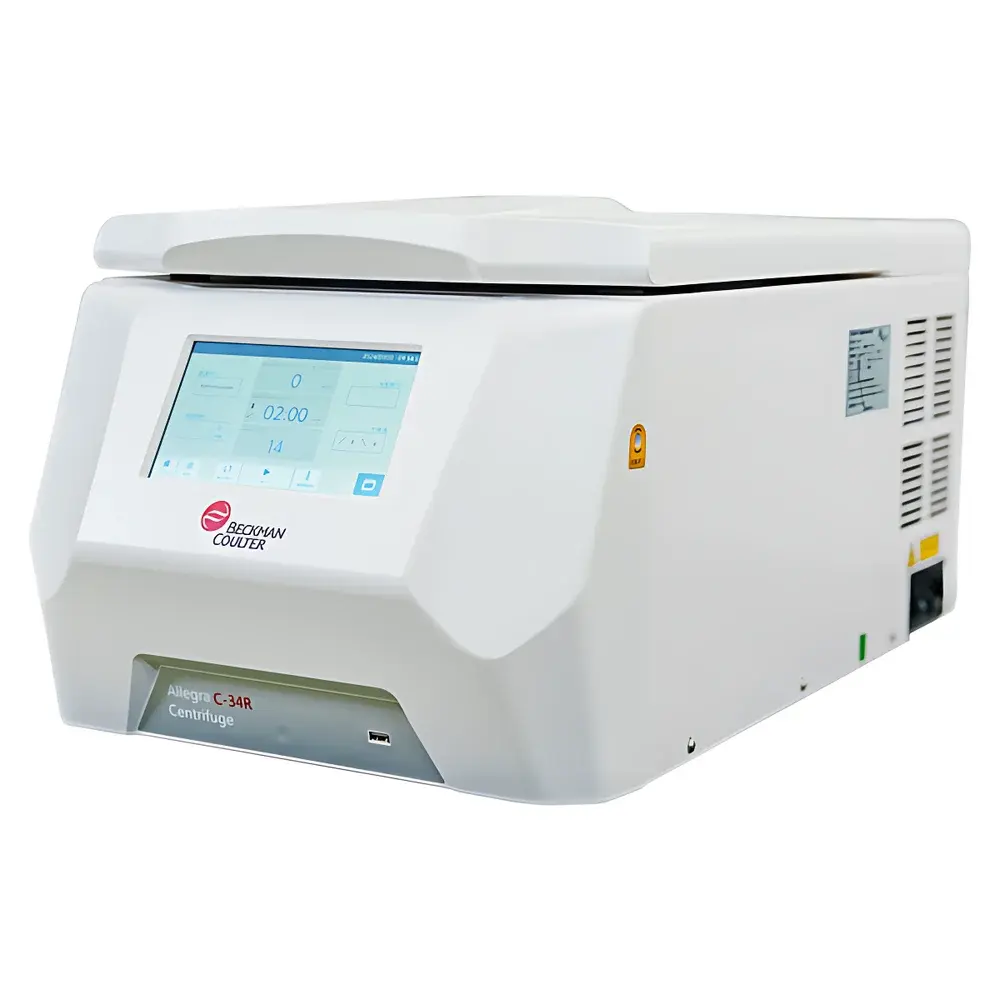
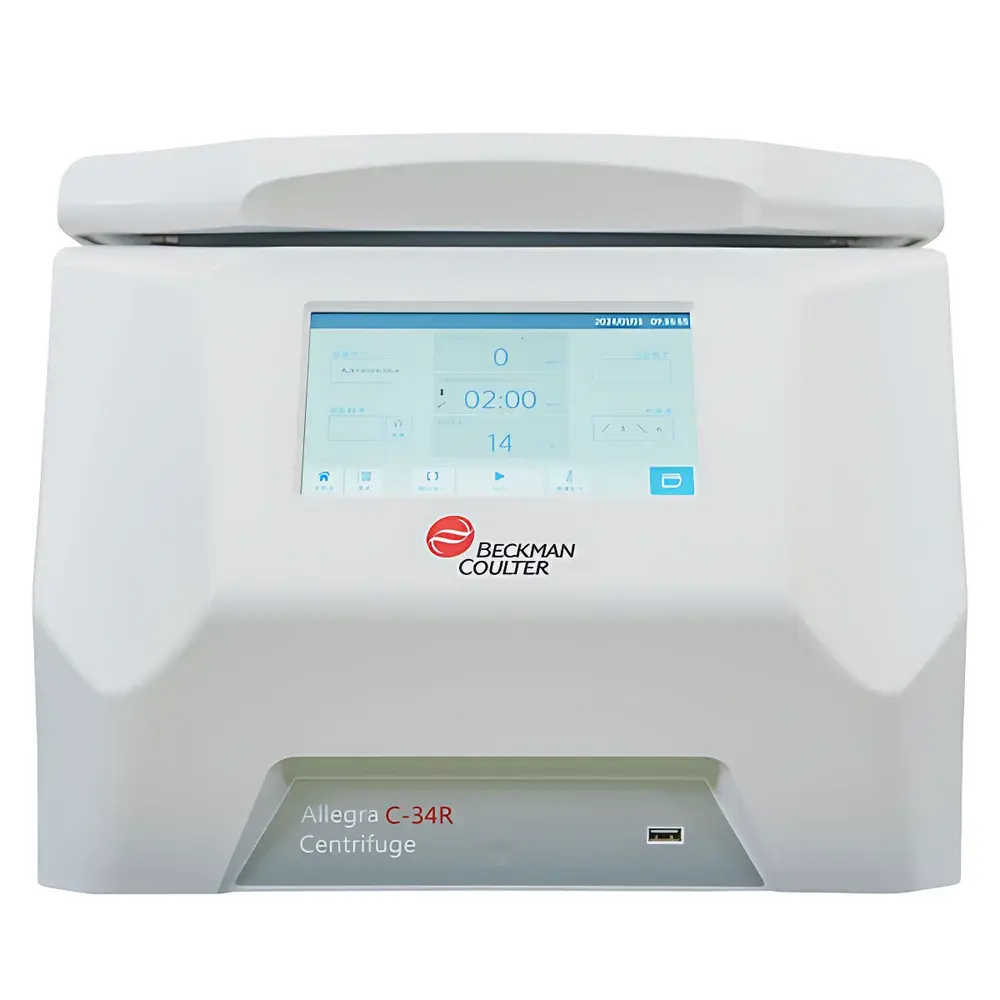
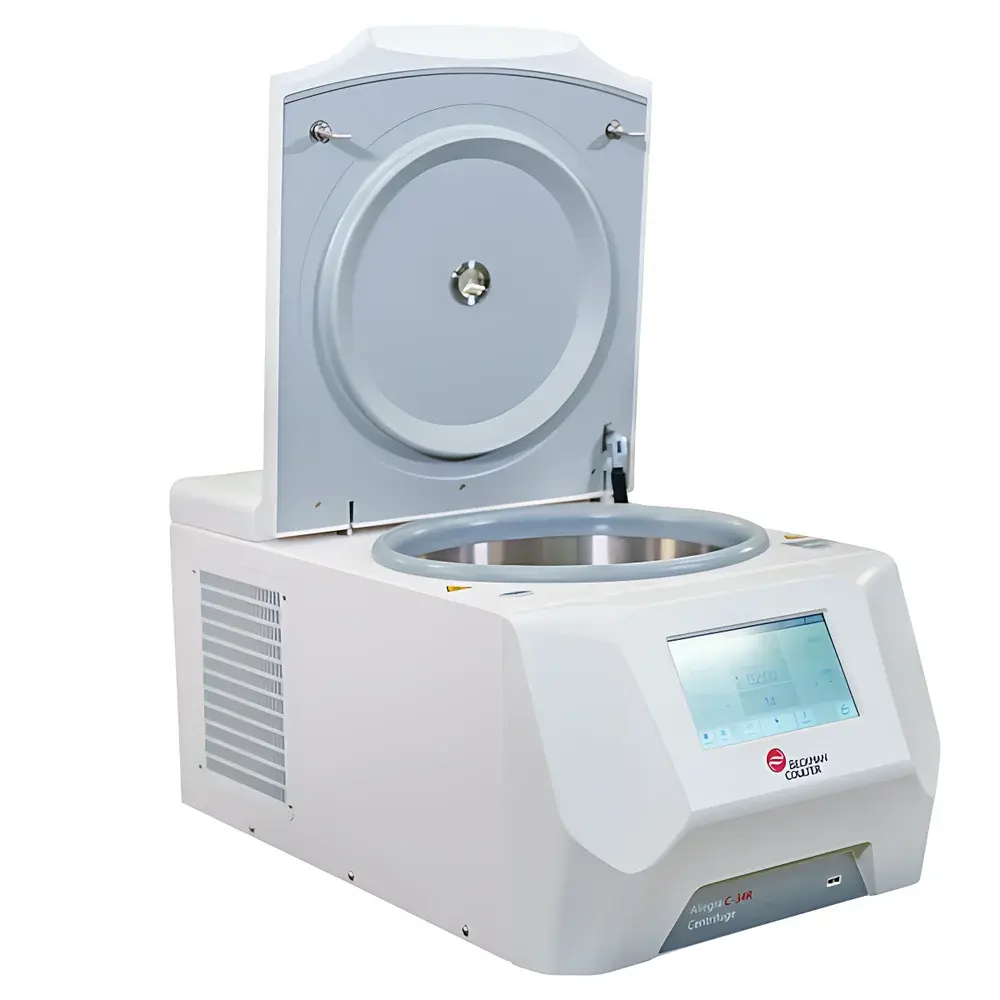
Beckman Coulter Allegra C-34R Benchtop High-Speed Refrigerated Centrifuge
| Brand | Beckman Coulter |
|---|---|
| Origin | Jiangsu, China |
| Manufacturer Type | Original Equipment Manufacturer (OEM) |
| Product Category | Domestic |
| Model | Allegra C-34R |
| Instrument Type | Benchtop Centrifuge |
| Speed Range | High-Speed (10,000–30,000 rpm) |
| Function | Refrigerated Centrifuge |
| Separation Class | Cellular & Bacterial |
| Maximum Capacity | 600 mL |
| Maximum Speed | 22,500 rpm |
| Maximum RCF | 34,020 × g |
| Dimensions (W×D×H) | 38.0 × 68.0 × 33.5 cm |
| Open Lid Height | 38.0 × 68.0 × 73.0 cm |
Overview
The Beckman Coulter Allegra C-34R is a high-performance benchtop refrigerated centrifuge engineered for precision separation of biological samples in academic research, clinical diagnostics, and biopharmaceutical development laboratories. Utilizing fixed-angle and swinging-bucket rotor configurations, it operates on the principle of sedimentation under controlled gravitational force (RCF), enabling efficient pelleting, clarification, and density-gradient separations. With a maximum speed of 22,500 rpm and a peak relative centrifugal force of 34,020 × g, the C-34R delivers robust performance for routine and demanding applications—including bacterial cell harvesting, subcellular fractionation, nucleic acid isolation, and viral particle concentration. Its integrated refrigeration system maintains precise temperature control from –10 °C to +40 °C during operation, minimizing thermal degradation of thermolabile biomolecules. Designed and manufactured in Jiangsu, China under Beckman Coulter’s global quality assurance framework, the instrument meets international engineering standards while supporting localized service responsiveness and supply chain continuity.
Key Features
- 11 interchangeable rotor options—including fixed-angle, swing-bucket, and biocontainment-capable rotors—supporting tubes from 0.2 mL microcentrifuge tubes to 100 mL conical bottles (max. 600 mL total capacity per run)
- Intelligent rotor recognition system automatically detects installed rotor type and enforces safe operating limits based on certified speed/RCF profiles
- Three-tier user access management (Administrator, Supervisor, Operator) with individual username/password authentication (up to 1,000 accounts)
- Comprehensive audit trail functionality compliant with GLP and GMP requirements: full timestamped logs of all run parameters, user actions, error events, and system status changes
- Ergonomic design features including auto-suction door latch, one-touch lid closure, tool-free rotor cover engagement, and integrated condensate drainage channels
- Energy-efficient refrigeration using environmentally compliant R452A refrigerant (zero ozone depletion potential, low global warming potential), certified per China RoHS Directive
- 7-inch resistive touchscreen interface with intuitive icon-based navigation, real-time graphical display of speed, temperature, time, and RCF, and on-screen trend plotting during active runs
- Pre-cooling acceleration mode (Fast Temp) reduces chamber cooldown time by up to 40%; ECO mode dynamically adjusts compressor output during idle periods to reduce power consumption
Sample Compatibility & Compliance
The Allegra C-34R accommodates standard laboratory consumables—including polypropylene, polycarbonate, and stainless-steel centrifuge tubes—as well as sealed biosafety rotors meeting IEC 61010-2-020:2017 requirements for containment of infectious agents. All rotors are validated per ISO 15195:2019 for calibration traceability and undergo lifetime cycle counting with automatic wear compensation. The system complies with electromagnetic compatibility (EMC) and safety directives EN 61010-1:2010+A1:2019, EN 61010-2-020:2017, and EN IEC 61010-2-101:2022. It supports 21 CFR Part 11–compliant electronic signatures when exporting run reports to PDF via USB storage.
Software & Data Management
Data integrity is ensured through persistent internal logging of all operational sequences, including rotor ID, setpoints, deviations, alarms, and operator credentials. Run history is stored locally with automatic overwrite protection for critical audit records. Exported PDF reports include embedded electronic signatures, digital timestamps, and checksum-verified metadata. No cloud dependency or proprietary software installation is required—the interface operates natively on embedded firmware with firmware update capability via secure USB transfer.
Applications
- Cell biology: Mammalian and bacterial cell pellet recovery, organelle isolation (mitochondria, nuclei), and exosome enrichment
- Molecular biology: Plasmid DNA purification, RNA precipitation, and PCR product cleanup
- Genomics & proteomics: Chromatin immunoprecipitation (ChIP) sample preparation, protein complex co-sedimentation, and lysate clarification
- Microbiology: Pathogen concentration from environmental or clinical matrices, phage purification
- Biopharmaceutical development: Antibody purification intermediates, CGT vector processing (e.g., AAV, lentivirus), and formulation stability assessment
- Biochemistry: Enzyme assay sample preparation, lipoprotein fractionation, and membrane protein solubilization
FAQ
Does the Allegra C-34R support FDA 21 CFR Part 11 compliance?
Yes—when configured with electronic signature-enabled PDF export and user-authenticated access, it fulfills core requirements for electronic records and signatures in regulated environments.
Can the instrument operate without refrigeration?
Yes—the temperature setpoint can be configured from –10 °C to +40 °C, including ambient (e.g., 25 °C) operation for heat-stable samples.
Is rotor calibration traceable to national standards?
All rotors are supplied with calibration certificates traceable to ISO/IEC 17025-accredited laboratories per ISO 15195:2019.
What safety mechanisms prevent unbalanced operation?
Real-time imbalance detection triggers immediate deceleration and audible/visual alerts; mechanical imbalance cutoff is enforced prior to acceleration.
How many programs can be saved internally?
Up to 1,000 user-defined protocols can be stored, each with independent speed, temperature, time, acceleration/deceleration ramp, and hold settings.
Related Products



