
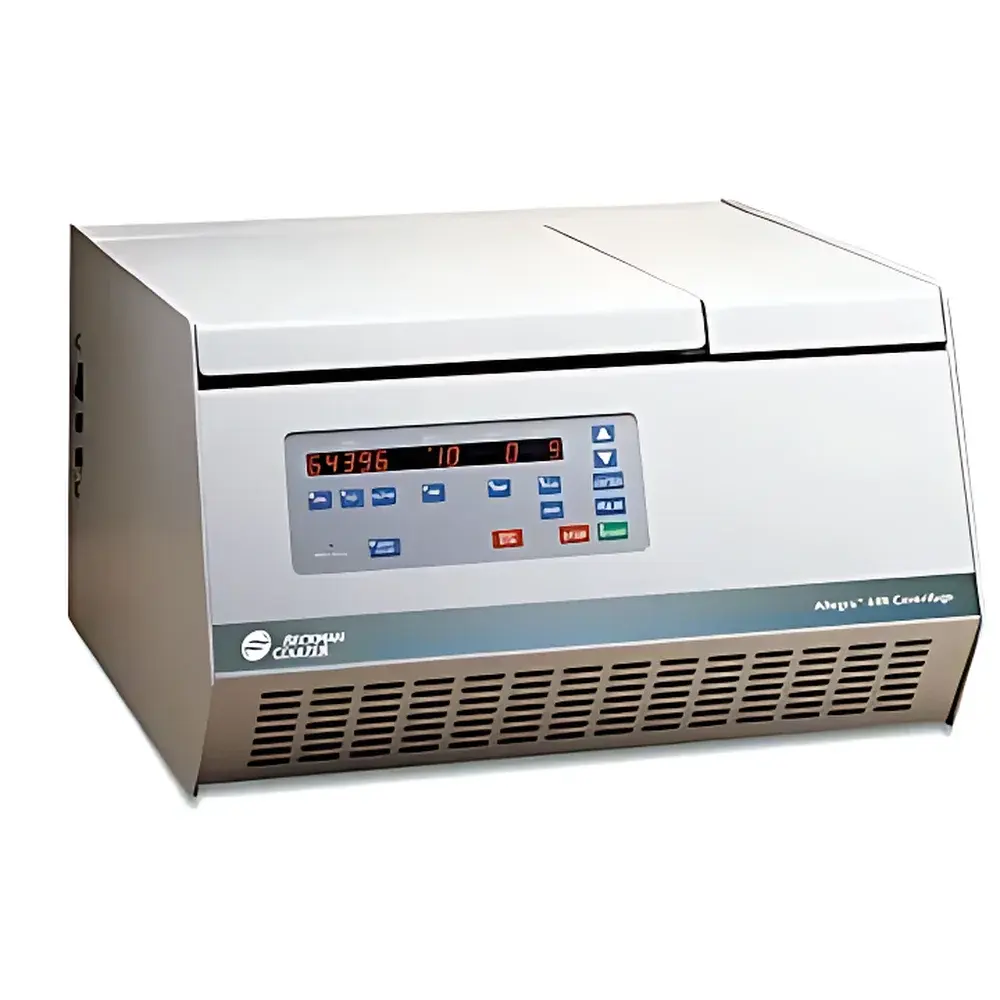
Beckman Coulter Allegra 64R Benchtop High-Speed Refrigerated Centrifuge
| Brand | Beckman Coulter |
|---|---|
| Origin | USA |
| Manufacturer | Beckman Coulter, Inc. |
| Product Type | Benchtop Centrifuge |
| Classification | High-Speed Refrigerated Centrifuge (10,000–30,000 rpm) |
| Configuration | Fixed-Angle Rotor Centrifuge |
| Separation Class | Cellular & Subcellular (Bacteria, Organelles, Viruses, Proteins) |
| Maximum Capacity | 6 × 85 mL |
| Maximum Speed | 30,000 rpm |
| Maximum RCF | 64,400 × g |
| Dimensions (W×D×H) | 38 × 61 × 66 cm |
| Temperature Range | –20 °C to +40 °C |
| Cooling Medium | Eco-friendly refrigerant (R-134a compliant) |
| Rotor Compatibility | 13 interchangeable rotors (11 fixed-angle, 2 swing-bucket) |
| Rotor Identification | Automatic RFID-based rotor recognition |
| Drive System | Brushless DC inverter motor |
| Control Interface | Microprocessor-controlled digital display with touch-sensitive keypad |
| Acceleration/Deceleration Profiles | 10 programmable rates |
| Timer Range | 1 minute to 9 hours 59 minutes, continuous, or short-spin mode |
| Speed Increment | 100 rpm |
| Safety Features | Automatic door lock, imbalance detection, overspeed protection, overtemperature shutdown, biosafety-certified sealed swing-bucket rotors (e.g., SX4750) |
| Certifications | Compliant with IEC 61010-2-020, UL 61010-2-020, and ISO 13485 (for in vitro diagnostic use where applicable) |
Overview
The Beckman Coulter Allegra 64R is a high-performance benchtop refrigerated centrifuge engineered for precision subcellular separation in demanding research and quality control environments. Utilizing advanced brushless DC inverter motor technology and optimized aerodynamic rotor design, it delivers a maximum relative centrifugal force (RCF) of 64,400 × g at 30,000 rpm—performance historically reserved for floor-standing ultracentrifuges. This capability enables efficient isolation of mitochondria, lysosomes, microsomes, ribosomal subunits, viral particles, and soluble protein complexes directly on the laboratory bench. Its compact footprint (0.23 m²) eliminates space constraints without compromising thermal stability: the integrated refrigeration system maintains sample temperature at 4 °C even under maximum load and RCF conditions, using an environmentally compliant R-134a refrigerant that meets current EPA SNAP and EU F-Gas Regulation requirements.
Key Features
- High-force benchtop operation: Achieves up to 64,400 × g, enabling subcellular fractionation workflows previously requiring larger instrumentation.
- Intelligent rotor management: RFID-based automatic rotor identification ensures correct speed/RCF limits and prevents mismatched rotor operation.
- Precision temperature control: Dual-stage compressor cooling maintains setpoint accuracy within ±1 °C across the full operating range (–20 °C to +40 °C), with active pre-cool function.
- Programmable kinetics: Ten independent acceleration and deceleration profiles support gentle pelleting of fragile organelles or rapid sedimentation of dense particles.
- Real-time parameter monitoring: Simultaneous digital display of RPM, RCF, elapsed time, remaining time, and temperature—with instantaneous unit conversion between rotational speed and g-force.
- Biosafety-integrated design: Optional BioSafety-certified swing-bucket rotors (e.g., SX4750) feature hermetic sealing and validated containment per ANSI/ASSE Z9.10 and ISO 22174 standards.
- Robust safety architecture: Includes automatic imbalance detection (±5 g mass differential), overspeed cutoff, thermal runaway protection, and electromechanical door interlock compliant with IEC 61010-2-020.
Sample Compatibility & Compliance
The Allegra 64R supports a broad spectrum of sample formats—from 250 µL microcentrifuge tubes to 85 mL conical bottles—via 13 validated rotor configurations. Fixed-angle rotors (e.g., F2402, F15-8x50cy) optimize pelleting efficiency for nucleic acid purification and bacterial harvesting, while swing-bucket options (e.g., SX4750, SX4750A) accommodate density gradient separations in iodixanol or sucrose media. All rotors are certified to ISO 21501-4 for dimensional traceability and undergo full fatigue testing per ASTM F2119. The system complies with GLP/GMP documentation requirements when used with optional audit-trail-enabled software modules and meets essential electrical safety and electromagnetic compatibility criteria per UL 61010-1 and EN 61326-1.
Software & Data Management
While the Allegra 64R operates via embedded microprocessor control without mandatory PC connectivity, it supports optional integration with Beckman Coulter’s CentriLog™ software (v3.2+) for protocol archiving, electronic lab notebook (ELN) synchronization, and 21 CFR Part 11-compliant user authentication, audit trail generation, and electronic signature validation. Protocol templates can be exported/imported as XML files, and instrument logs—including rotor usage history, maintenance alerts, and calibration timestamps—are exportable in CSV format for QA/QC review.
Applications
- Isolation of cellular organelles (mitochondria, peroxisomes, Golgi vesicles) from tissue homogenates.
- Ultracentrifugation-equivalent pelleting of exosomes and extracellular vesicles (100,000 × g equivalent via RCF optimization).
- Preparative purification of recombinant proteins and monoclonal antibodies from clarified mammalian cell culture supernatants.
- Virus concentration and purification for vaccine development and virology studies (e.g., influenza, AAV, lentivirus).
- Routine QC of biopharmaceutical intermediates including host cell protein removal and aggregate analysis.
- Density gradient centrifugation for lymphocyte separation (Ficoll-Paque™) and lipoprotein profiling (KBr gradients).
FAQ
What is the minimum and maximum sample volume per run?
Minimum volume is 250 µL (in microcentrifuge tubes with compatible fixed-angle rotors); maximum is 510 mL total (6 × 85 mL bottles with rotor F15-6x100y).
Does the Allegra 64R support gradient centrifugation?
Yes—swing-bucket rotors such as the SX4750 (4 × 75 mL) and SX4750A (4 × 85 mL) are validated for rate-zonal and isopycnic separations using sucrose, glycerol, or iodixanol gradients.
How is rotor lifetime tracked and managed?
Each rotor contains an embedded RFID tag storing manufacturing date, serial number, maximum rated speed, and cumulative run hours; the instrument logs all usage data and triggers service alerts at predefined thresholds.
Can the Allegra 64R be validated for GMP environments?
Yes—when configured with CentriLog™ software, password-protected access controls, and IQ/OQ documentation packages, it supports installation qualification, operational qualification, and routine performance verification per ASTM E2500 and Annex 11.
What refrigerant does the unit use, and is it compliant with international environmental regulations?
It uses R-134a, a zero-ozone-depletion-potential (ODP = 0) refrigerant with global warming potential (GWP) of 1,430—fully compliant with U.S. EPA SNAP Program listings and EU Regulation (EU) No 517/2014.



