
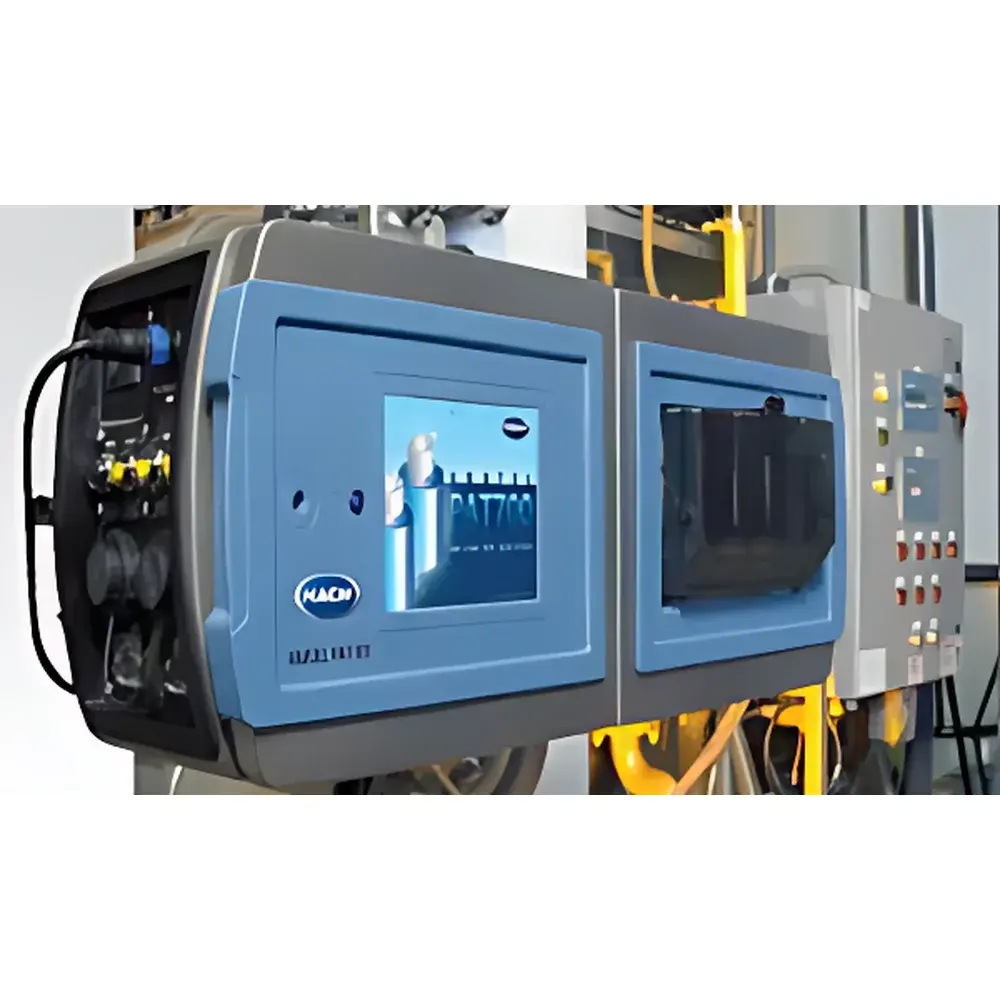
Beckman Coulter Anatel PAT700 Total Organic Carbon Analyzer
| Brand | Beckman Coulter |
|---|---|
| Origin | USA |
| Manufacturer | Beckman Coulter, Inc. |
| Product Type | Online TOC Analyzer |
| Detection Principle | Direct Conductivity Detection |
| Oxidation Method | Dual-UV (185 nm + 254 nm) Photolysis |
| Measurement Range | 1–1000 ppb C |
| Accuracy | ±5% of reading |
| Resolution | 0.1 ppb C |
| Detection Limit | 1 ppb C |
| Repeatability | ±1% RSD |
| Compliance | USP <643>, EP 2.2.44, JP 2.59, ASTM D5905, ISO 8245 |
Overview
The Beckman Coulter Anatel PAT700 Total Organic Carbon (TOC) Analyzer is an engineered solution for real-time, regulatory-compliant organic carbon monitoring in high-purity water systems—specifically designed for pharmaceutical, biotechnology, and medical device manufacturing environments. It operates on the principle of direct conductivity detection following complete oxidation of organic carbon species via dual-wavelength ultraviolet (UV) photolysis at 185 nm (for radical generation) and 254 nm (for enhanced photolytic efficiency). This method eliminates reliance on chemical oxidants or carrier gases, delivering a robust, low-maintenance architecture suitable for continuous online deployment in purified water (PW), water for injection (WFI), and clean steam condensate loops. The PAT700 meets the stringent performance and validation requirements outlined in USP , European Pharmacopoeia 2.2.44, Japanese Pharmacopoeia 2.59, and ASTM D5905, supporting process analytical technology (PAT) initiatives under FDA guidance and facilitating compliance with current Good Manufacturing Practice (cGMP) and ICH Q5C/Q7 frameworks.
Key Features
- Dual-UV lamp system (185/254 nm) ensures consistent, complete oxidation of refractory organics—including acetic acid, ethanolamine, and sucrose—without catalysts or persulfate reagents
- Integrated dual-sample capture mechanism: first sample undergoes routine analysis; second sample is retained for immediate confirmatory testing upon alarm event, enabling root-cause investigation without manual intervention
- Real-time offset alert functionality triggers automated diagnostic workflows when conductivity baseline deviation exceeds user-defined thresholds, reducing time-to-troubleshoot in water distribution systems
- Onboard Clean-in-Place (CIP) verification mode delivers simultaneous TOC and specific conductivity measurements during sanitization cycles, providing objective evidence of rinse completion and container cleanliness
- Zero-consumables operation: no carrier gas, no chemical oxidants, no catalysts—minimizing operational cost, safety hazards, and supply chain dependencies
- Modular design supports seamless integration into distributed control systems (DCS) or SCADA platforms via 4–20 mA analog output and Modbus TCP/IP protocol
Sample Compatibility & Compliance
The PAT700 is validated for use with ultrapure water streams meeting USP/EP/JP specifications for PW, WFI, and purified compressed gases. Its flow-through cell design accommodates sample temperatures from 5–40 °C and pressures up to 10 bar, with optional pressure regulation for low-flow applications. All firmware and calibration records are stored with full audit trail capability, satisfying FDA 21 CFR Part 11 requirements for electronic records and signatures. System qualification documentation—including IQ/OQ/PQ protocols, traceable calibration certificates (NIST-traceable standards), and risk assessments per ISO 14971—is available upon request. The analyzer conforms to electromagnetic compatibility (EMC) standards IEC 61326-1 and safety standard IEC 61010-1.
Software & Data Management
The PAT700 operates with Anatel’s embedded firmware v5.x, supporting secure data logging with configurable sampling intervals (1–60 minutes), automatic data archiving to internal flash memory (≥30 days of minute-level data), and export via USB or Ethernet. Optional Anatel Insight™ software provides centralized fleet management across multiple PAT700 units, including trend visualization, alarm history filtering, calibration tracking, and electronic signature-enabled report generation compliant with ALCOA+ principles (Attributable, Legible, Contemporaneous, Original, Accurate, Complete, Consistent, Enduring, Available). All calibration events—including span, zero, and system suitability tests—are timestamped, operator-identified, and immutable within the audit trail.
Applications
- Continuous TOC monitoring of PW/WFI distribution loops in sterile manufacturing facilities
- Real-time validation of CIP efficacy for stainless-steel storage tanks, piping networks, and filling lines
- Supporting FDA PAT initiatives through multivariate process understanding and control strategy development
- Monitoring TOC excursions during facility qualification (e.g., post-sanitization hold times, seasonal variability)
- Complementing conductivity-based purity assurance in final rinse validation for aseptic processing equipment
- Enabling rapid response to contamination events—reducing batch rejection risk and potential product recall exposure
FAQ
Does the PAT700 require daily calibration or frequent maintenance?
No. The PAT700 is designed for unattended operation over extended periods. System suitability testing is recommended prior to critical batches or after maintenance, but routine daily calibration is not required due to its stable UV source and temperature-compensated conductivity cell.
Can the PAT700 be used offline for laboratory analysis?
Yes. With optional ASX-7200 36-position autosampler, the PAT700 supports both online continuous monitoring and offline batch analysis—enabling lab-scale method transfer, troubleshooting, and cross-validation studies.
How does the PAT700 handle particulate or microbial interference?
The analyzer includes a 0.45 µm inline filter and flow-controlled sample introduction to minimize particulate carryover. While it does not measure microorganisms directly, sustained TOC elevation above baseline often correlates with biofilm shedding or cleaning agent residue—serving as an early indicator for microbiological review.
Is the dual-UV oxidation method validated against reference methods like persulfate UV?
Yes. Comparative studies per ASTM D5905 demonstrate equivalent recovery (>95%) for 27 certified TOC standards—including humic acid, glycine, and benzoquinone—confirming equivalence to high-temperature catalytic oxidation and persulfate UV methods.







