
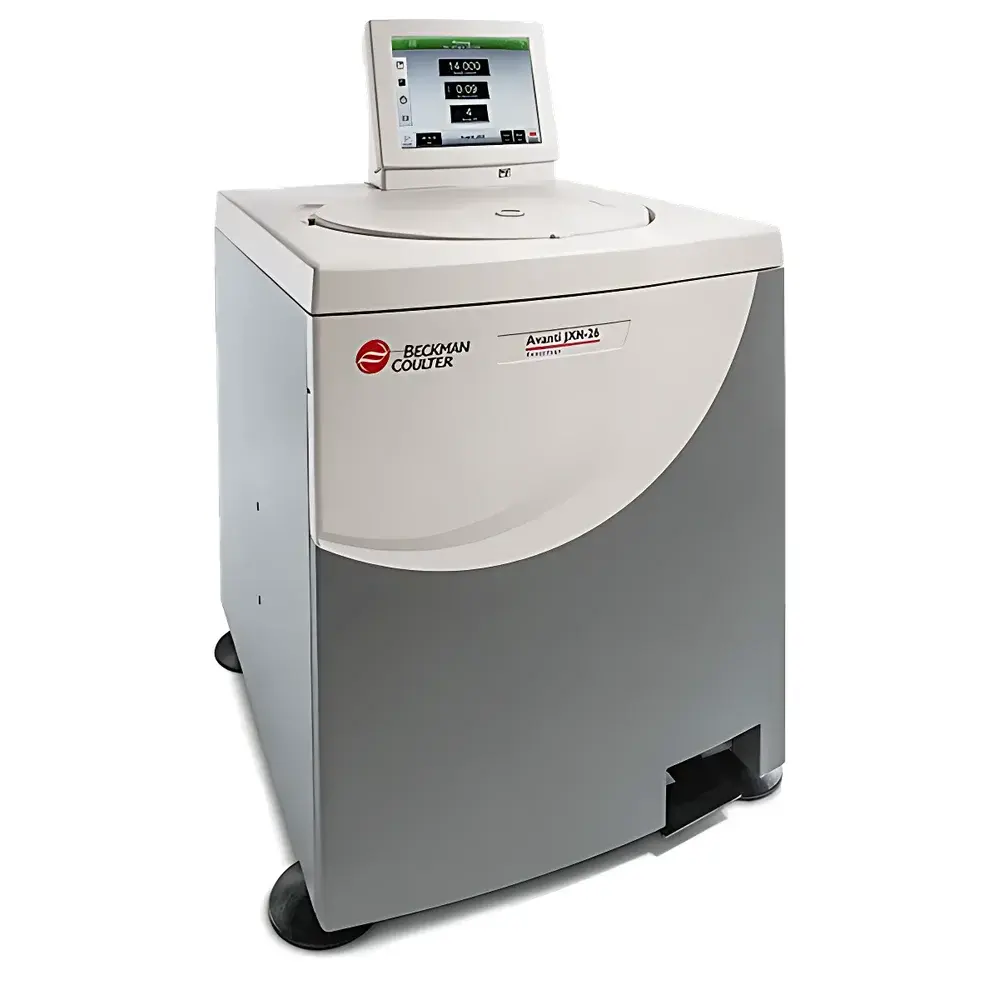
Beckman Coulter Avanti JXN-26 High-Speed Refrigerated Centrifuge
| Brand | Beckman Coulter |
|---|---|
| Origin | USA |
| Manufacturer Type | Original Equipment Manufacturer (OEM) |
| Product Category | Imported Instrument |
| Model | Avanti JXN-26 |
| Instrument Type | Benchtop Centrifuge |
| Speed Range | 10,000–30,000 rpm |
| Function | Refrigerated Centrifuge |
| Configuration | Fixed-Angle Rotor Centrifuge |
| Separation Level | Cellular & Bacterial |
| Maximum Capacity | 6 L |
| Maximum Speed | 26,000 rpm |
| Maximum RCF | 81,770 × g |
| Dimensions | 86 cm × 71 cm × 86 cm |
| Temperature Range | −10 °C to +40 °C (1 °C increments) |
| Temperature Uniformity | ±2 °C (at equilibrium) |
| Acceleration Profiles | 10 selectable curves |
| Deceleration Profiles | 11 selectable curves |
| Speed Accuracy | ±10 rpm or ±0.1%, whichever is greater |
| Run Time | Up to 99 h 59 min or continuous mode |
Overview
The Beckman Coulter Avanti JXN-26 High-Speed Refrigerated Centrifuge is an engineered benchtop platform designed for demanding preparative and analytical workflows requiring high RCF, precise temperature control, and operational robustness. Operating on the principle of sedimentation under controlled gravitational force (RCF), the instrument delivers reproducible separation of cellular organelles, bacteria, viruses, subcellular particles, and macromolecular complexes. Its refrigerated architecture maintains sample integrity during extended runs—critical for thermolabile biomolecules such as enzymes, nucleic acids, and membrane proteins. The system integrates a high-torque switched-reluctance (SR) motor, enabling rapid acceleration and deceleration while minimizing mechanical wear and energy consumption. With a maximum RCF of 81,770 × g and a 6-liter total capacity, the Avanti JXN-26 supports scalable processing across academic, clinical, and GMP-compliant environments.
Key Features
- Switched-reluctance (SR) drive system delivering high torque, low heat generation, and extended service life
- Dynamic Rotor Inertia Check (DRIC) and automatic rotor recognition for redundant safety validation—prevents operation beyond certified speed limits
- FRS™ (Friction Reduction System) minimizes air resistance in vacuum chamber, enhancing efficiency and reducing acoustic noise
- Intuitive touchscreen interface with real-time display of setpoints and actual parameters (speed, RCF, temperature, time, acceleration/deceleration profile)
- 10 programmable acceleration and 11 deceleration profiles—including soft-brake options for pelleted sample preservation
- Delay start function and continuous run mode (up to 99 h 59 min) for unattended overnight or multi-shift protocols
- Ergonomic design with front-access rotor chamber, integrated rotor storage, and low-profile footprint (86 × 71 × 86 cm)
- Energy-efficient thermal management with compressor-based cooling and optimized airflow distribution across the chamber
Sample Compatibility & Compliance
The Avanti JXN-26 accommodates a broad rotor library—including fixed-angle, swinging-bucket, and vertical rotors—enabling compatibility with standard centrifuge tubes (e.g., 13 × 100 mm, 16 × 100 mm, 25 × 95 mm), bottles (up to 1 L), and custom adapters. It meets IEC 61010-1 safety standards for laboratory equipment and complies with ISO 13485 requirements for medical device manufacturing environments. For regulated laboratories, the system supports audit-ready data traceability through timestamped event logs, user authentication, and protocol versioning—facilitating alignment with FDA 21 CFR Part 11, EU Annex 11, and GLP/GMP documentation expectations. Temperature uniformity of ±2 °C (at equilibrium) ensures consistent thermal conditions across all positions in the rotor chamber.
Software & Data Management
Data integrity is maintained via embedded firmware that records every operational parameter—including rotor ID, speed history, temperature profile, acceleration/deceleration curve selection, and user login credentials. Protocols can be named, saved, duplicated, and exported in CSV format for external analysis or LIMS integration. The system supports direct connection to local networks for remote monitoring and centralized fleet management using Beckman Coulter’s Centriware™ software suite. All changes to settings are logged with timestamps and operator IDs, fulfilling requirements for electronic record retention and change control in quality systems.
Applications
- Preparative isolation of mitochondria, lysosomes, and microsomes from tissue homogenates
- Bacterial cell harvesting and plasmid DNA purification workflows
- Virus concentration and purification for vaccine development and virology research
- Clarification of crude protein extracts prior to chromatography or electrophoresis
- Separation of lipid nanoparticles (LNPs) and extracellular vesicles (EVs)
- High-throughput sample preparation in core facilities serving multiple research groups
- Stability testing of biologics under controlled thermal conditions
FAQ
What is the maximum allowable rotor speed for the Avanti JXN-26?
The instrument’s maximum rated speed is 26,000 rpm, corresponding to a peak RCF of 81,770 × g. Actual operating speed is constrained by rotor-specific certification limits enforced via DRIC and automatic rotor ID recognition.
Does the Avanti JXN-26 support compliance with FDA 21 CFR Part 11?
Yes—when used with Centriware™ software and configured with user authentication, electronic signatures, and audit-trail logging, the system meets foundational requirements for electronic records and signatures in regulated environments.
Can the centrifuge operate continuously without time limit?
It offers two modes: timed operation (up to 99 h 59 min) and continuous run mode, which maintains operation until manually stopped or interrupted by safety events.
How does the FRS™ system improve performance?
FRS™ reduces aerodynamic drag inside the vacuum chamber by optimizing airflow dynamics around rotating components, resulting in lower power draw, reduced heat generation, and quieter operation—particularly beneficial during prolonged high-speed runs.
Is rotor calibration required before each use?
No—automatic rotor identification eliminates manual entry errors, and DRIC performs real-time inertia verification at startup to confirm mechanical integrity and speed rating compliance.



