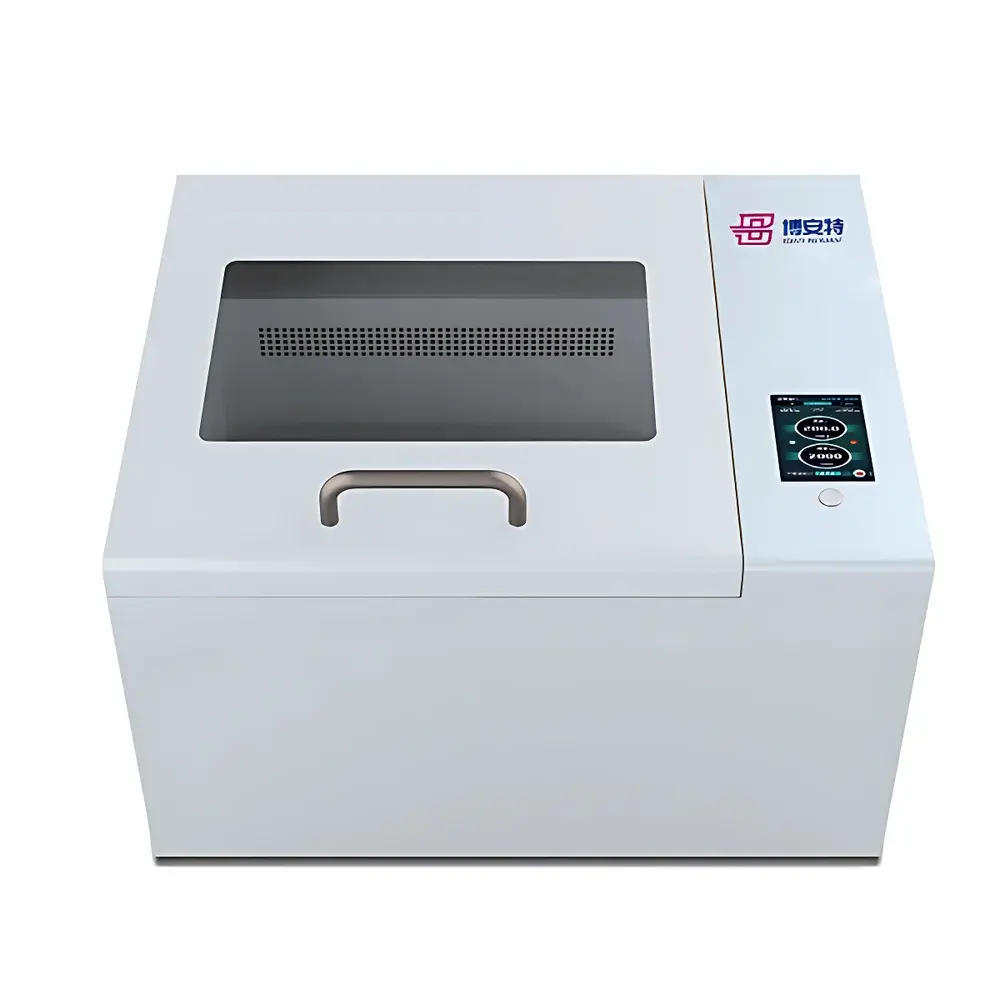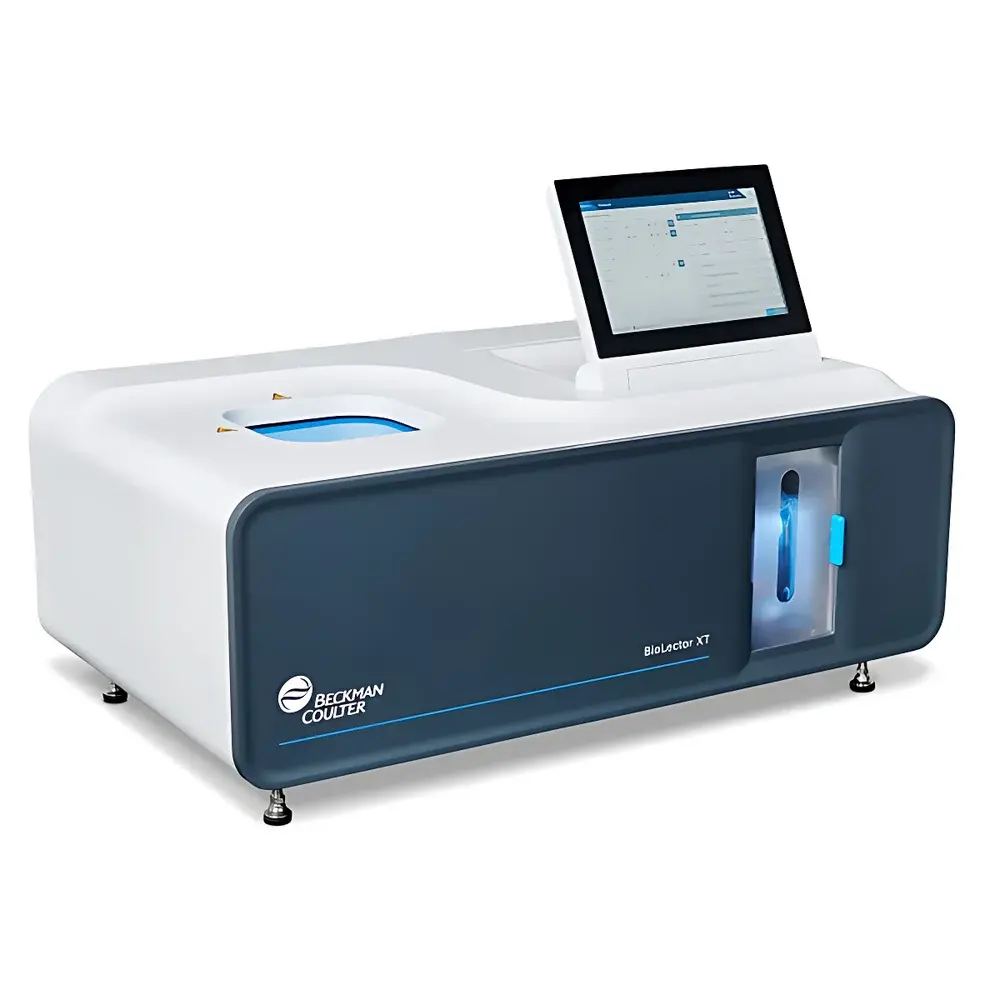
Beckman Coulter BioLector XT High-Throughput Microbioreactor System
| Brand | Beckman Coulter |
|---|---|
| Origin | USA |
| Manufacturer Type | Original Equipment Manufacturer (OEM) |
| Product Origin | Imported |
| Model | BioLector XT |
| Vessel Dimensions | 95 × 514 × 541 mm |
| Aeration System | Innovative Gassing Lid with Precise Gas Mixing |
| pH Control Range | ~4.0–6.0 or ~5.0–7.5 (calibration-dependent) |
| Dissolved Oxygen (DO) Control Range | 0–100% air saturation (via O₂/N₂/CO₂ blending) |
| Temperature Control Range | −8 °C to +50 °C |
| Working Volume per Well | 800–2400 µL |
| Plate Format | ANSI/SLAS-compliant 48-well microtiter plate (MTP) |
| Sensor Technology | Non-invasive optical measurement (scattered light, fluorescence, absorbance, pH & DO via immobilized optodes) |
| Optional Modules | Microfluidic Feeding Module, Humidification Unit, Multi-gas Blending Controller |
Overview
The Beckman Coulter BioLector XT is a high-throughput, parallel microbioreactor system engineered for precise, real-time monitoring and control of microbial and mammalian cell cultures under tightly regulated physiological conditions. Unlike conventional stirred-tank bioreactors, the BioLector XT operates on the principle of non-invasive optical sensing within standardized 48-well microtiter plates (MTPs), enabling simultaneous cultivation and kinetic profiling of up to 48 independent cultures in volumes ranging from 800 to 2400 µL. Its core measurement architecture integrates scattered light (for biomass estimation), multi-wavelength fluorescence (for reporter proteins, metabolites, or viability dyes), and immobilized optode-based sensors for continuous, calibration-stable tracking of pH and dissolved oxygen (DO). The system employs a patented gassing lid that delivers programmable gas mixtures—including O₂ (1–100%), CO₂ (1–12%), and N₂—directly to each well through microfluidic channels, ensuring minimal gas consumption (<5 mL/min total) and eliminating cross-contamination risks associated with shared sparging lines.
Key Features
- ANSI/SLAS-standard 48-well MTP platform compatible with automated liquid handlers and stackers
- Innovative gassing lid enabling anaerobic, microaerobic, and aerobic cultivation without external tubing or gas manifolds
- Integrated temperature control from −8 °C to +50 °C with ±0.1 °C stability and spatial uniformity across the plate
- Optical pH and DO sensors pre-calibrated and gamma-irradiated for single-use sterility (no in-situ calibration required)
- Optional microfluidic feeding module supporting per-well, nanoliter-precision acid/base addition and substrate feeding (e.g., glucose, methanol)
- Humidification unit minimizes evaporation-induced concentration drift during long-term cultivations (>72 h)
- Modular architecture: supports seamless integration of additional modules including multi-gas blending controllers and extended wavelength fluorescence detectors
- Real-time data acquisition at user-defined intervals (down to 15-second resolution) with timestamped metadata logging
Sample Compatibility & Compliance
The BioLector XT accommodates a broad spectrum of biological systems, including Gram-positive and Gram-negative bacteria (e.g., E. coli, Bacillus subtilis), yeasts (S. cerevisiae, P. pastoris), filamentous fungi, and suspension-adapted mammalian cells. Its design conforms to ISO 13485 quality management requirements for medical device manufacturing and supports GLP/GMP-aligned workflows through audit-trail-enabled software logging. All disposable components—including sealing foils (M2P-F-RSXT-10), gassing lids, and microfluidic cartridges—are gamma-sterilized and supplied with CoA documentation. The system meets electromagnetic compatibility (EMC) standards per IEC 61326-1 and electrical safety requirements per IEC 61010-1, making it suitable for installation in certified cleanrooms (ISO Class 5–8) and regulated QC laboratories.
Software & Data Management
Smart BioLection software provides a secure, multi-user environment compliant with FDA 21 CFR Part 11 requirements—including electronic signatures, role-based access control, and immutable audit trails for all parameter changes and data exports. Users define fully customizable feeding strategies (batch, fed-batch, bolus, or continuous), pH setpoints per well group, and gas composition profiles—all synchronized with optical measurements. Raw sensor data (scatter, fluorescence, pH, DO, temperature) are stored in HDF5 format with embedded metadata (time stamps, user ID, protocol version, hardware configuration). The software features an open API (RESTful interface) for integration into LIMS, MES, or digital twin platforms, and supports real-time streaming to third-party analytics tools such as MATLAB, Python (via PyBioLector), or cloud-based process modeling environments.
Applications
- High-throughput strain screening and bioprocess optimization for recombinant protein expression
- Dynamic characterization of probiotic growth kinetics under anaerobic or low-oxygen conditions
- Metabolic flux analysis using fluorescent biosensors (e.g., NADH/NAD⁺, ATP, cAMP)
- DoE-driven media development and feed strategy validation prior to scale-up
- Quality-by-Design (QbD) studies supporting regulatory submissions for biologics manufacturing
- Microbial community dynamics monitoring in synthetic consortia via multiplexed fluorescent reporters
- Accelerated stability testing of cell therapies under controlled hypothermic or hyperthermic stress
FAQ
Can the BioLector XT perform true anaerobic cultivation?
Yes—the gassing lid supports nitrogen-purged or hydrogen-containing atmospheres (with optional catalyst) to achieve O₂ levels below 10 ppm, validated using onboard DO optodes and external trace O₂ analyzers.
Is calibration required before each experiment?
No—optical pH and DO sensors are factory pre-calibrated and gamma-sterilized; only initial verification using reference buffers is recommended per ISO 17025 guidelines.
How is sterility maintained during microfluidic feeding?
All fluidic paths are contained within single-use, gamma-sterilized cartridges; no valves or tubing contact the culture medium outside the sealed MTP.
Does the system support integration with robotic liquid handlers?
Yes—it adheres to SLAS plate footprint standards and communicates via RS-232 and Ethernet protocols compatible with major automation platforms (e.g., Hamilton STAR, Tecan Freedom EVO).
What is the minimum working volume for reliable DO and pH measurement?
Reliable optode response is achieved at ≥800 µL/well; below this volume, signal-to-noise ratio degrades due to reduced optical path interaction and increased evaporation sensitivity.