
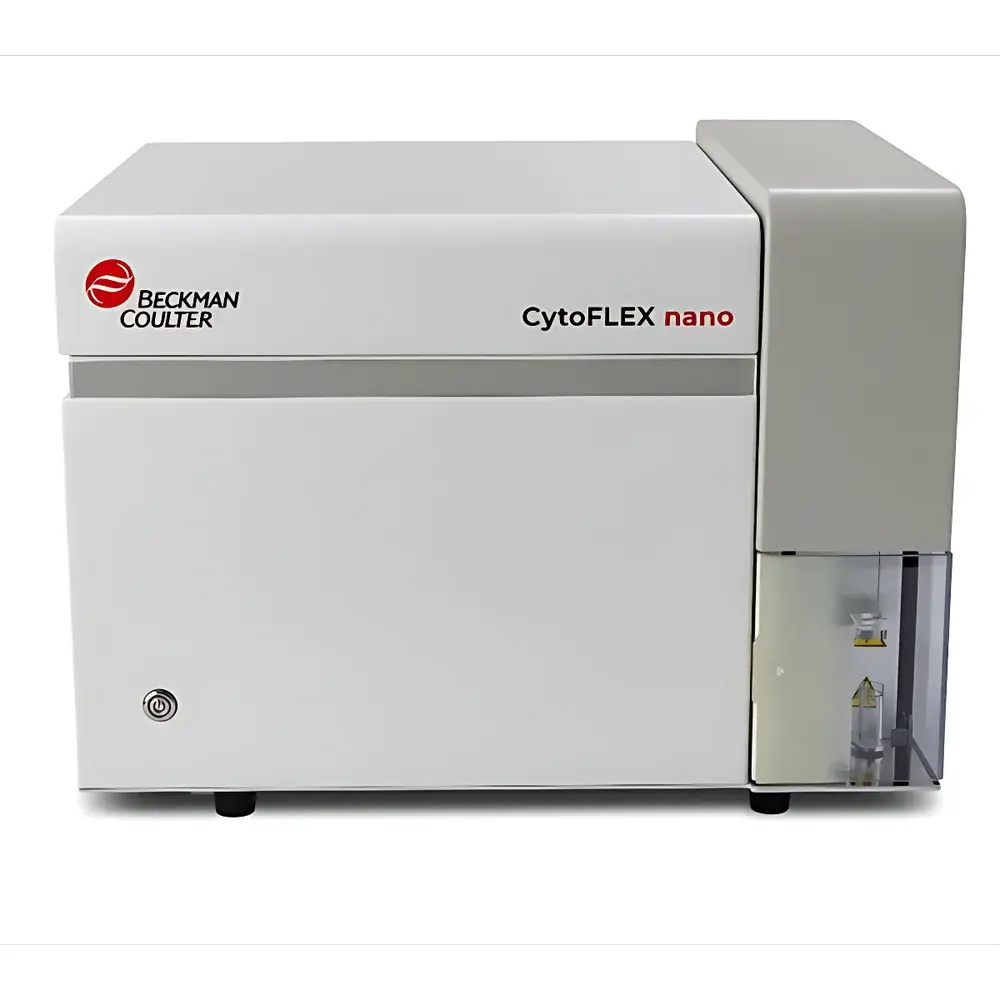
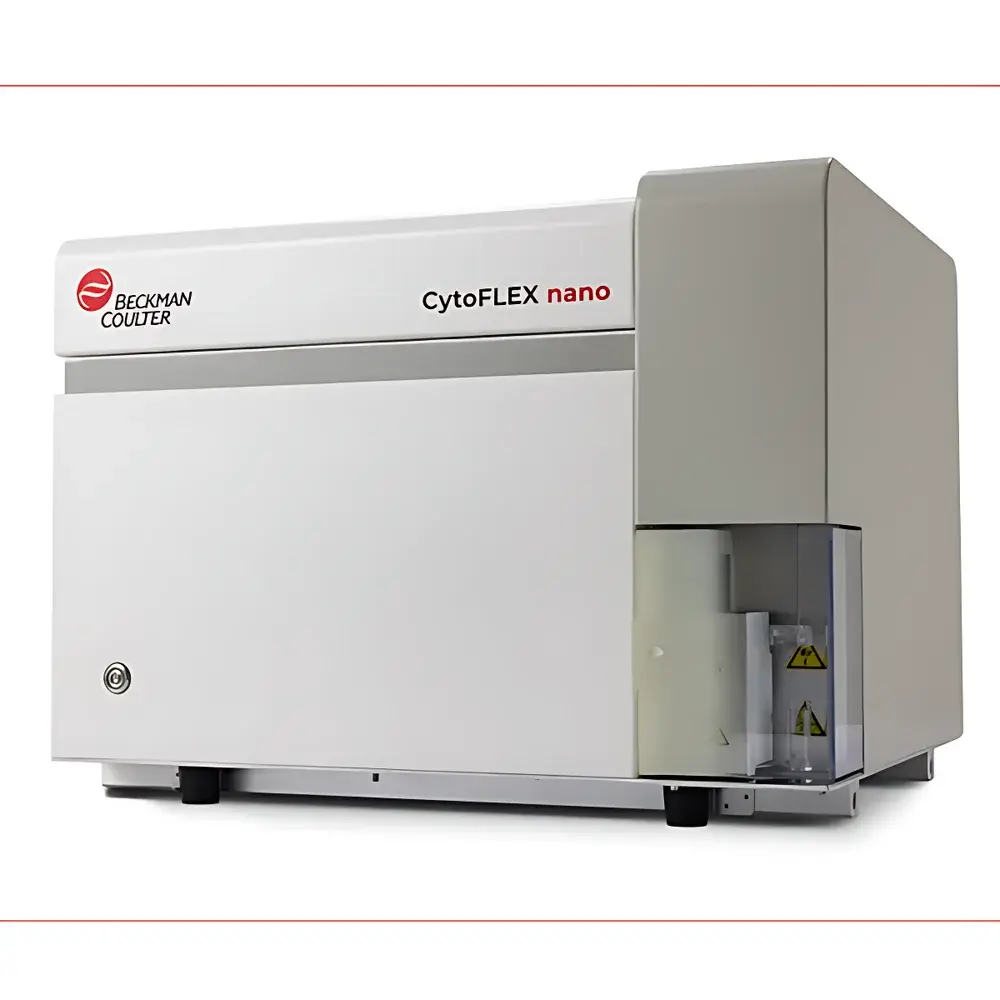
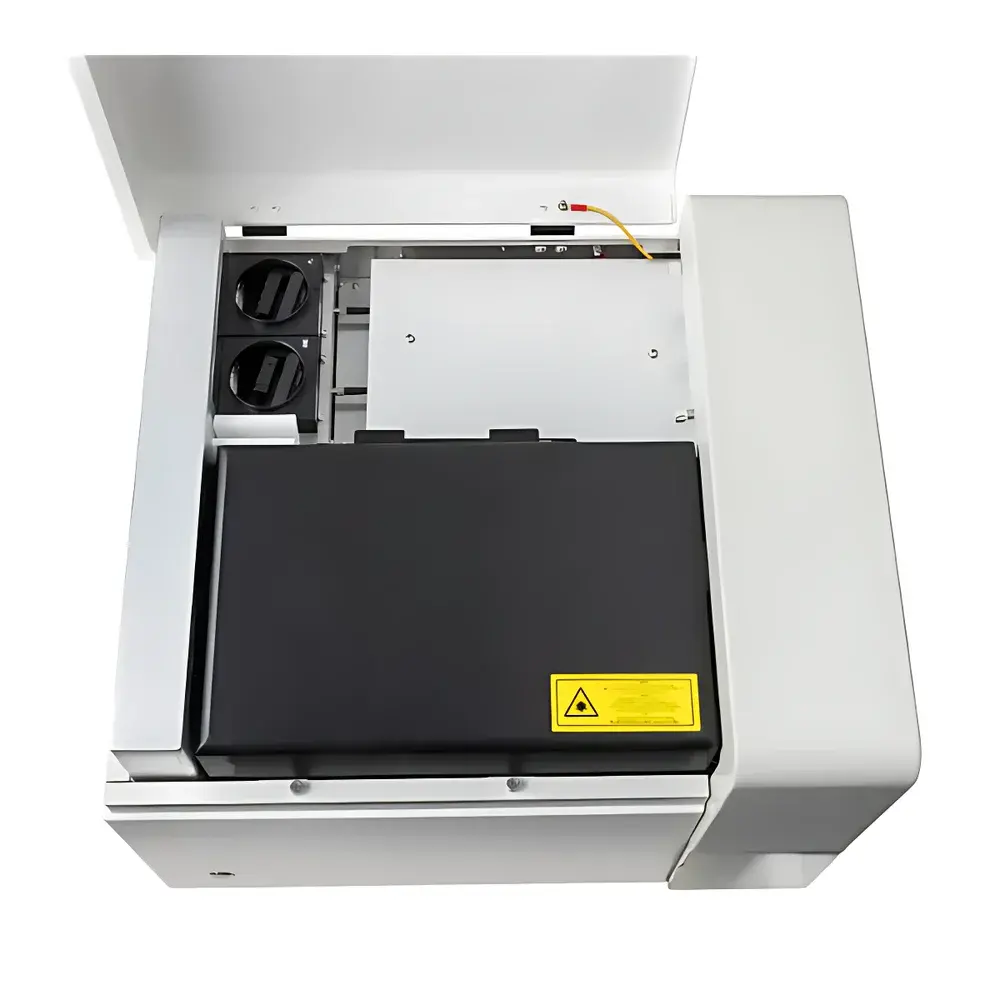
Beckman Coulter CytoFLEX nano Flow Cytometer
| Brand | Beckman Coulter |
|---|---|
| Origin | Jiangsu, China |
| Manufacturer Type | Original Equipment Manufacturer (OEM) |
| Regional Classification | Domestic (PRC-manufactured) |
| Model | CytoFLEX o |
| Technology Platform | Nanoscale Flow Cytometry |
| Product Category | Flow Cytometer |
| Primary Use Case | Research |
| Lasers | 405 nm, 488 nm, 561 nm, 638 nm |
| Fluorescence Detection Channels | 6 |
| Coefficient of Variation (rCV) | <10% |
| Fluorescence Sensitivity (8-peak calibration beads) | V447: 8 peaks |
| 8531 | 8 peaks |
| Y595 | 8 peaks |
| R670 | 6 peaks |
| R710 | 5 peaks |
| R792 | 4 peaks |
| Sample Acquisition Rate | 16,000 events/sec |
| Automated Sample Loading | Yes |
| Sample Flow Rate | 6 µL/min |
| Compensation Method | Automatic |
Overview
The Beckman Coulter CytoFLEX nano Flow Cytometer is an engineered solution for high-fidelity detection and phenotypic characterization of submicron biological particles—specifically designed to extend the analytical reach of conventional flow cytometry into the 40 nm–1 µm range. Unlike standard flow cytometers optimized for whole cells (typically >500 nm), the CytoFLEX nano employs a high-sensitivity optical architecture with low-noise photodetectors, optimized fluidics, and multi-angle side scatter (SSC) collection to resolve structural heterogeneity in nanoparticles without reliance on fluorescent labeling. Its measurement principle is based on hydrodynamic focusing combined with multi-wavelength laser excitation and parallel fluorescence/SSC signal acquisition—enabling quantitative, single-particle analysis of extracellular vesicles (EVs), viral particles, liposomes, migrasomes, and synthetic nanocarriers under physiological buffer conditions.
Key Features
- Multi-laser excitation platform with four discrete wavelengths: 405 nm (violet), 488 nm (blue), 561 nm (yellow-green), and 638 nm (red), enabling broad spectral coverage for contemporary nanoparticle dyes and fluorescent proteins (e.g., GFP-tagged EVs).
- Six independent fluorescence detection channels with optimized optical filters and high quantum-efficiency PMTs, supporting simultaneous multicolor surface marker profiling on low-abundance targets.
- Five side scatter (SSC) detection channels—each configured at distinct angular apertures—to generate SSC ratio metrics that differentiate particle populations by internal granularity, density, and morphology, eliminating the need for staining-based discrimination.
- Automated sample introduction system with precise 6 µL/min volumetric flow control, integrated syringe pump, and real-time pressure monitoring to minimize clogging, bubble formation, and carryover (<1% as verified by baseline monitoring).
- Onboard automatic compensation algorithm compliant with ISAC-standard spillover matrix calculation, reducing manual gating errors and ensuring inter-instrument reproducibility across multi-user labs.
- Instrument performance validation suite including daily sensitivity checks using 500 nm 8-peak calibration beads, baseline stability assessment, and rCV tracking—fully documented for GLP/GMP-aligned workflows.
Sample Compatibility & Compliance
The CytoFLEX nano accommodates native, unpurified, or size-exclusion chromatography (SEC)-fractionated samples in aqueous buffers (e.g., PBS, HEPES, Tris), with minimal requirement for pre-concentration or ultracentrifugation. It supports direct analysis of EV isolates from HEK293T cell supernatants (50–150 nm), influenza A virions (~100 nm), PEGylated liposomes (80–200 nm), and antibody-conjugated silica nanoparticles. The system complies with ISO 13319:2019 (particle size analysis by light scattering) and aligns with MIFlowCyt-EV reporting guidelines. All firmware and data handling modules support audit trails, electronic signatures, and user-access controls consistent with FDA 21 CFR Part 11 requirements for regulated research environments.
Software & Data Management
Acquisition and analysis are performed via Beckman Coulter’s CytExpert™ Nano Edition software—a dedicated interface built on a modular, scriptable framework. It provides real-time event visualization, batch processing of SEC fractions, automated bead-based normalization, and export of FCS 3.1-compliant files. Raw data are stored with embedded metadata (instrument settings, calibration logs, operator ID, timestamp), enabling traceability across longitudinal studies. The software integrates with third-party platforms including FlowJo v10+, Cytobank, and open-source tools (e.g., Python-based FlowKit) via standardized APIs. All instrument diagnostics—including laser power drift, PMT voltage stability, and fluidic pressure variance—are logged hourly and archived for retrospective QC review.
Applications
- Extracellular Vesicle Characterization: Quantification and immunophenotyping of CD63+/CD81+/GFP+ exosomes down to 50 nm; resolution of subpopulations differing by ≤10 nm in effective diameter.
- Viral Particle Analysis: Enumeration and envelope protein profiling (e.g., HA, gp120) of lentiviral vectors and enveloped RNA viruses without fixation or concentration artifacts.
- Liposome & Nanocarrier Development: Batch-to-batch consistency assessment, PEG density mapping via Alexa Fluor 488–anti-PEG staining, and payload encapsulation efficiency estimation.
- Migrasome Biology: Discrimination of migrasomes (300–1000 nm) from co-isolated microvesicles using SSC ratio gating and tetraspanin co-staining.
- Nanotoxicology Screening: Uptake kinetics and intracellular localization inference via time-resolved membrane dye labeling in primary macrophages and dendritic cells.
FAQ
What is the smallest detectable particle size under standard operating conditions?
The CytoFLEX nano achieves reliable detection of polystyrene calibration beads down to 40 nm in PBS buffer, with consistent signal-to-noise ratios ≥3:1 across all six fluorescence channels when using recommended dyes.
Can the instrument distinguish between aggregated and monodisperse nanoparticles?
Yes—through concurrent analysis of forward scatter pulse width, multi-angle SSC ratios, and fluorescence intensity distribution profiles, enabling identification of aggregation states without centrifugal separation.
Is the system compatible with sterile, closed-tube sampling for BSL-2 pathogens?
The autosampler supports sealed tube loading with optional biocontainment adapters; all fluidic pathways are autoclavable or chemically sterilizable per CDC/NIH biosafety protocols.
How frequently must the instrument be calibrated?
Daily sensitivity verification using 500 nm 8-peak beads is recommended; full optical alignment and PMT gain calibration are performed quarterly or after transport/maintenance.
Does the software support automated population gating for EV subtyping?
CytExpert Nano includes template-based gating workflows trained on reference EV datasets, with machine learning-assisted clustering (t-SNE, UMAP) available via optional add-on modules.





