
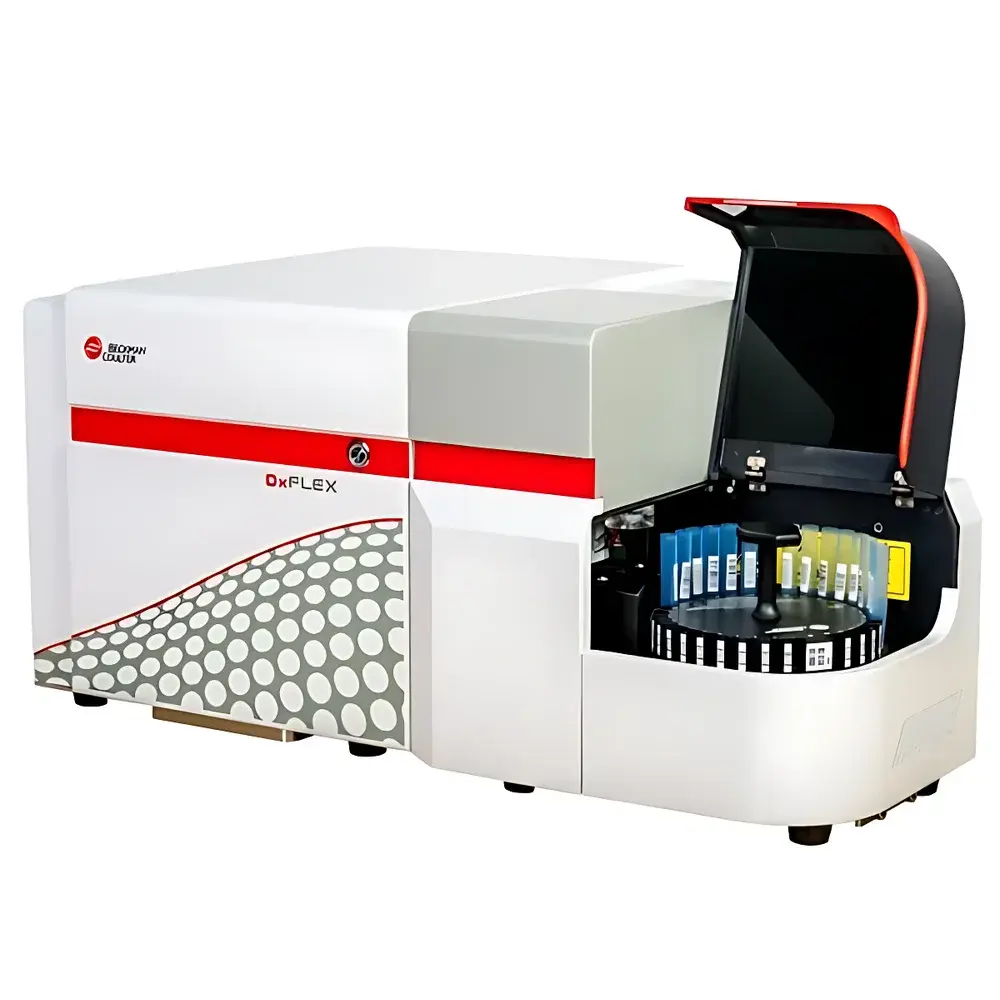
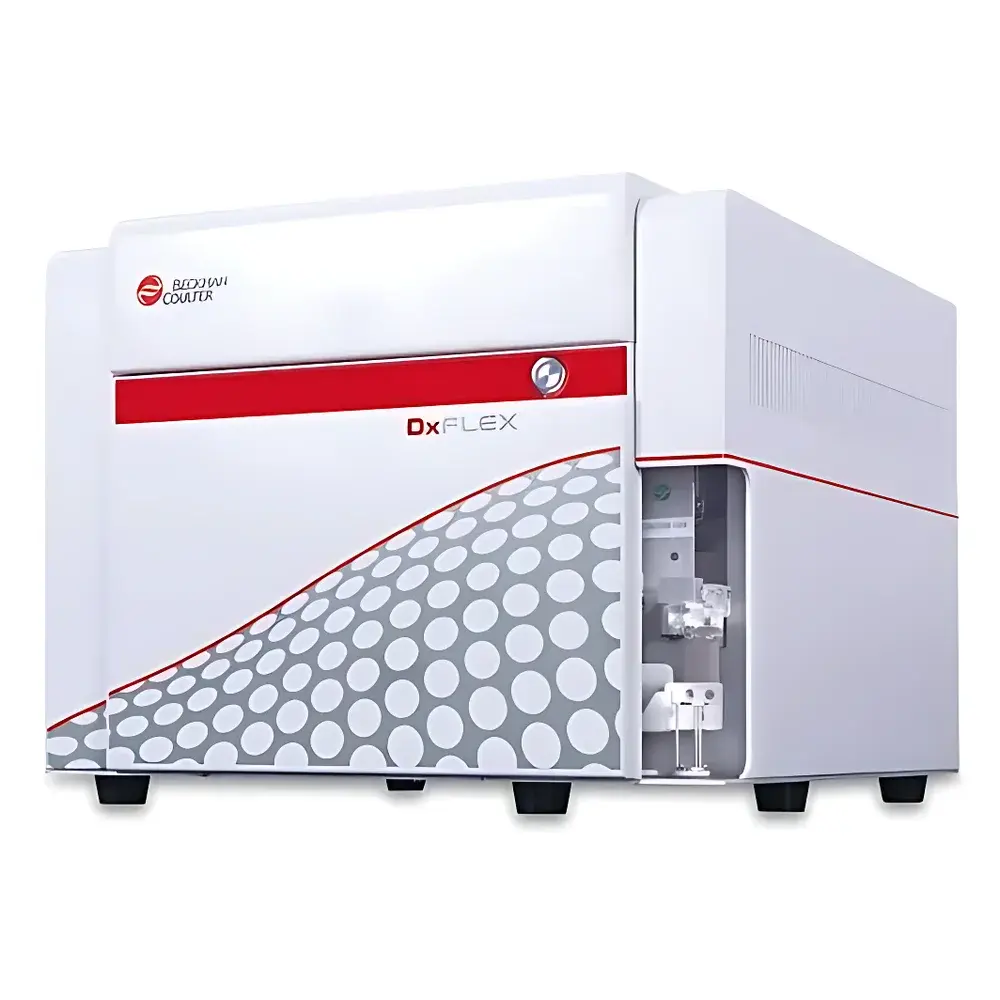
Beckman Coulter DxFLEX Flow Cytometer
| Brand | Beckman Coulter |
|---|---|
| Origin | Jiangsu, China |
| Manufacturer Type | Original Equipment Manufacturer (OEM) |
| Regional Classification | Domestic IVD Instrument |
| Model | DxFLEX |
| Product Category | Clinical Flow Cytometry System |
| Application Domain | In Vitro Diagnostic (IVD) Laboratories |
| Laser Configuration | 3 Lasers / 13 Fluorescence Parameters |
| Fluorescence Sensitivity | ≤30,000 Equivalent Stained Particles (ESPs) |
Overview
The Beckman Coulter DxFLEX Flow Cytometer is a CE-IVD and FDA-cleared (where approved) clinical-grade flow cytometry platform engineered for reproducible, standardized immunophenotyping in diagnostic laboratories. It employs hydrodynamic focusing and time-resolved fluorescence detection to resolve cellular heterogeneity at single-cell resolution. The system utilizes three solid-state lasers (405 nm, 488 nm, and 638 nm) with orthogonal excitation geometry and a wavelength-division multiplexing (WDM) optical architecture to minimize spectral overlap and maximize photon collection efficiency. Unlike traditional photomultiplier tube (PMT)-based systems, the DxFLEX integrates low-noise avalanche photodiode (APD) detectors across all fluorescence and scatter channels—enhancing signal-to-noise ratio and enabling robust detection of dim markers such as CD45RA or HLA-DR on rare lymphocyte subsets. Its compact footprint (52 × 62 × 45 cm) permits operation inside Class II biological safety cabinets, supporting biosafety-compliant workflows for primary blood, bone marrow aspirates, and cerebrospinal fluid samples.
Key Features
- Three-laser, thirteen-parameter detection configuration with configurable filter sets for optimal fluorochrome panel design (e.g., FITC, PE, APC, BV421, BV605, PerCP-Cy5.5, etc.)
- APD-based detection system delivering improved resolution and lower electronic noise compared to conventional PMT architectures
- Integrated WDM optical path with bandpass-only filtering—eliminating dichroic mirrors and reducing alignment drift
- Three user-selectable acquisition rates (High/Medium/Low), with maximum event rate up to 30,000 events/sec using standard 12×75 mm tubes
- Automated QC routines including laser delay calibration, gain stability monitoring, MFI tracking, and rCV (relative coefficient of variation) reporting per channel
- Predictive maintenance alerts and guided cleaning protocols compliant with ISO 13485–aligned service documentation
Sample Compatibility & Compliance
The DxFLEX accepts standard 12×75 mm polystyrene flow cytometry tubes and microtubes (e.g., 0.5 mL Eppendorf-style). Optional accessories include a 32-tube carousel autosampler and a 96-well plate adapter for high-throughput screening applications. All fluidics are designed for whole blood lysed-without-wash protocols and compatible with EDTA, citrate, or heparin anticoagulated specimens. As an IVD instrument, the DxFLEX conforms to IEC 61010-1 (safety), IEC 61326-1 (EMC), and ISO 15197:2013 (performance requirements for in vitro diagnostic devices). It supports audit trails, electronic signatures, and data integrity controls aligned with FDA 21 CFR Part 11 and EU Annex 11 for regulated environments.
Software & Data Management
Instrument control and analysis are performed via the DxONE software suite—a Windows-based application featuring dual-language (English/Chinese) UI, intuitive drag-and-drop gating, and real-time parameter optimization. Compensation matrices are stored in a centralized library with version-controlled naming conventions and automatic application during acquisition. Data export adheres to FCS 3.1 standard; raw .fcs files retain full metadata including instrument settings, QC logs, and timestamped maintenance records. Integrated reporting templates meet CAP-accredited lab requirements for CBC + differential + lymphocyte subset quantification (CD3/CD4/CD8/CD19/CD56), minimal residual disease (MRD) panels, and HIV monitoring assays.
Applications
- Routine immunophenotyping of peripheral blood, bone marrow, and CSF for hematologic malignancy diagnosis and monitoring (e.g., AML, ALL, CLL, lymphoma)
- CD4+ T-cell enumeration in HIV/AIDS management per WHO and CDC guidelines
- Immunosuppression monitoring post-transplant (e.g., Treg quantification, NK cell profiling)
- Minimal residual disease (MRD) detection at sensitivity levels ≤0.01% using 8–13-color leukemia-associated immunophenotype (LAIP) panels
- Functional assays including intracellular cytokine staining (ICS), phospho-flow, and apoptosis analysis (Annexin V/7-AAD)
FAQ
Is the DxFLEX compliant with regulatory standards for clinical diagnostics?
Yes—the DxFLEX is CE-marked as an IVD device under IVDR 2017/746 and has received FDA 510(k) clearance (K210022) for specific lymphocyte subset enumeration assays.
Can DxONE software generate CLIA-compliant reports?
Yes—preconfigured report templates include patient ID, sample ID, operator ID, QC pass/fail status, instrument calibration date, and traceable MFI values required for CLIA and CAP accreditation.
What maintenance intervals are recommended for the fluidics system?
Daily startup/shutdown procedures include automated sheath fluid priming and waste evacuation; monthly decontamination cycles are triggered automatically based on runtime hours and logged in the service history.
Does the DxFLEX support third-party reagents and antibody panels?
Yes—no proprietary reagent lock-in; validated compatibility with major vendors’ conjugated antibodies (BD Biosciences, BioLegend, Thermo Fisher) and compensation beads (UltraComp eBeads, ArC Amine Reactive Compensation Beads).
How is data security ensured during remote software updates?
All firmware and software updates are digitally signed, delivered over TLS 1.2–encrypted connections, and require administrator-level authentication prior to installation—fully auditable within the system log.
Related Products



