
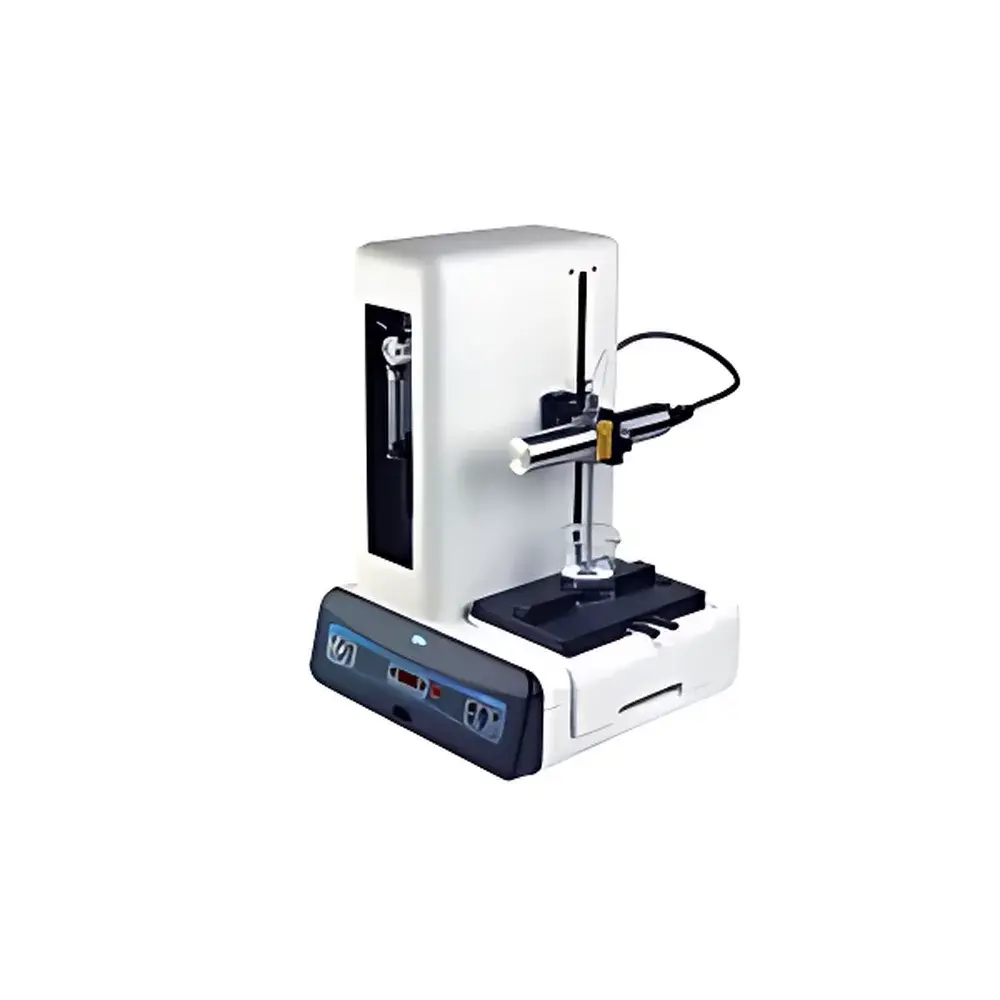
Beckman Coulter HIAC 9703+ Liquid Particle Counter
| Brand | Beckman Coulter |
|---|---|
| Origin | USA |
| Manufacturer Type | Original Equipment Manufacturer (OEM) |
| Product Category | Imported Instrument |
| Model | HIAC 9703+ |
| Instrument Type | Optical Liquid Particle Counter |
| Sample Volume Range | 1 mL to 1000 mL |
| Particle Size Detection Range | 0.5 µm to 600 µm |
| Regulatory Compliance | FDA 21 CFR Part 11, ISO 21501-4 |
| Preconfigured Pharmacopoeial Methods | USP <788>, USP <789>, EP 2.9.19, JP 6.07, KP 5.2.10 |
| Software | PharmSpec v5.x with Audit Trail, Electronic Signatures, and Automated Backup/Restore |
Overview
The Beckman Coulter HIAC 9703+ is a high-precision optical liquid particle counter engineered for quantitative analysis of suspended particulate matter in clear, low-viscosity liquids—primarily pharmaceutical parenterals, ophthalmic solutions, injectables, and purified water systems. It operates on the principle of light obscuration (also known as single-particle optical sizing, or SPOS), where particles passing through a focused laser beam cause transient reductions in detected light intensity proportional to their cross-sectional area. This enables direct, real-time enumeration and size classification of individual particles without reliance on statistical extrapolation or ensemble averaging. Designed for compliance-critical environments, the HIAC 9703+ integrates hardware-level traceability, sensor redundancy, and flow-path geometry optimized to minimize coincidence error and wall-induced artifacts—ensuring high reproducibility across batch-to-batch and lab-to-lab measurements.
Key Features
- Wide dynamic sample volume capability: programmable injection from 1 mL to 1000 mL per analysis, supporting both Small Volume Injection (SVI) and Large Volume Injection (LVI) protocols per USP and EP 2.9.19.
- Configurable flow rate control (0.5–100 mL/min) and interchangeable sensor modules enabling validated detection across 0.5 µm to 600 µm—covering submicron aggregates, process-related debris, and visible particulates.
- Automated rinse cycles and guided method setup wizard reduce operator dependency and support unattended operation for routine QC release testing.
- Dedicated small-sample vial holder minimizes residual volume loss and protects high-value formulations during analysis.
- Modular probe and syringe design allows rapid sensor exchange and cleaning between samples—critical for multi-product facilities handling potent or cytotoxic compounds.
- ISO 21501-4 compliant calibration using NIST-traceable latex sphere standards; full calibration verification report generation included.
Sample Compatibility & Compliance
The HIAC 9703+ is validated for use with aqueous and organic solvents exhibiting optical clarity at 650 nm (e.g., WFI, saline, ethanol/water mixtures, and certain API suspensions). It supports direct analysis of filtered and unfiltered samples, provided viscosity remains below 15 cP and particle concentration does not exceed 10,000 particles/mL at the smallest detectable size (to maintain counting accuracy within ±5% error margin). All system hardware and firmware comply with ISO 21501-4:2018 for light extinction particle counters. The instrument meets regulatory expectations for data integrity under FDA 21 CFR Part 11, EU Annex 11, and PIC/S guidelines—including role-based user access control, electronic signature enforcement, immutable audit trail logging (with timestamp, operator ID, parameter changes, and result modifications), and automatic encrypted database backup with versioned restore capability.
Software & Data Management
PharmSpec software v5.x serves as the integrated control, acquisition, and reporting platform. It ships with preloaded, editable test templates aligned to USP , USP , EP 2.9.19, JP 6.07, and KP 5.2.10—eliminating manual calculation of particle counts per volume unit and automatic pass/fail flagging against pharmacopoeial limits. All raw event data (pulse height, transit time, timestamp) is retained in a relational SQL Server database with daily automated backup to network storage. The software supports GLP/GMP-compliant report generation—including full metadata embedding (instrument ID, calibration status, environmental conditions, analyst ID)—and exports to PDF/A-1b, CSV, and XML formats for LIMS integration. IQ/OQ documentation packages and vendor-supported validation services are available upon request.
Applications
- Final container release testing of sterile injectables, vaccines, and biologics per USP .
- Stability-indicating monitoring of particulate formation during accelerated and real-time stability studies.
- Filter integrity verification and extractables/leachables assessment in single-use bioprocessing systems.
- Raw material qualification (e.g., excipients, buffers) and water-for-injection (WFI) system surveillance.
- Root-cause investigation of visible particulate incidents and manufacturing process deviations.
- Method development and transfer for novel dosage forms including liposomal and nanoparticulate therapeutics.
FAQ
Does the HIAC 9703+ require annual recalibration?
Yes—per ISO 21501-4 and internal quality system requirements, sensor calibration must be verified at least annually using certified reference materials; more frequent verification is recommended after sensor replacement or major maintenance.
Can PharmSpec software be deployed on a virtualized server environment?
Yes, when configured per Beckman Coulter’s validated virtualization specifications (VMware vSphere 7.0+ or Microsoft Hyper-V 2019+), including dedicated CPU allocation, persistent storage, and domain-joined authentication.
Is the HIAC 9703+ compatible with LIMS via ASTM E1384 or HL7?
It supports ASTM E1384-compliant data export via secure FTP or shared folder; HL7 messaging requires third-party middleware integration and is not natively supported.
What is the minimum required sample volume for USP compliance?
For SVI mode, the minimum is 5 mL per container; for LVI mode, ≥100 mL is required to achieve statistically robust counts at the 25- and 10-µm thresholds.
How does the system handle air bubbles or undissolved gas in the sample line?
Integrated bubble detection algorithms monitor baseline light transmission variance; sustained deviation triggers automatic pause, purge cycle initiation, and operator alert—preventing false-positive counts.



