
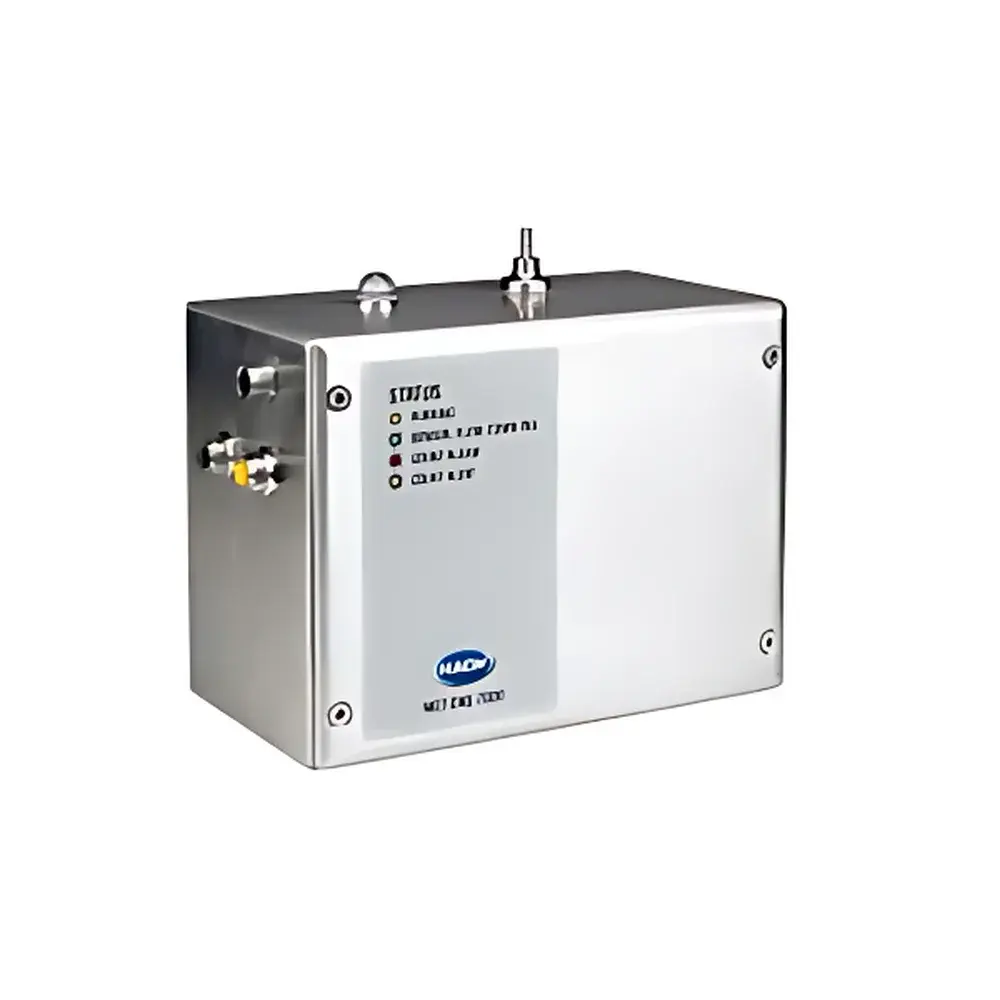
Beckman Coulter MET ONE 7000 Remote Airborne Particle Counter
| Brand | Beckman Coulter |
|---|---|
| Origin | USA |
| Manufacturer Type | Original Equipment Manufacturer (OEM) |
| Country of Origin | Imported |
| Model | MET ONE 7000 |
| Instrument Type | Optical Airborne Particle Counter |
| Flow Rate Options | 0.1 CFM or 1.0 CFM |
| Particle Size Sensitivity | 0.5 µm |
| Channel Configurations | 2-channel or 4-channel selectable |
| Light Source | Long-life laser diode |
| Housing Material | Electropolished stainless steel, VHP-resistant optics |
| Compliance | ISO 21501-4, ISO 14644-1/2, IEST-RP-CC021.1, FDA 21 CFR Part 11 (with optional audit trail software), GMP-environment validated design |
| Operating Temperature | 10–32 °C |
| Relative Humidity | 5–95% RH (non-condensing) |
| Power Supply | 24 VDC ±10% or 100–230 VAC, 50/60 Hz |
| Max Power Consumption | 6.9 W (Ethernet DC), 12.5 W (Wireless AC) |
| Vacuum Requirement | ≥40.6 cm Hg |
| Flow Control | Precision orifice-based |
| Counting Loss | ≤5% at 2×10⁶ particles/ft³ (7005 variant) or 4×10⁵ particles/ft³ (7015 variant) |
| False Count Rate | ≤1 particle per 5 minutes |
| Communication Interfaces | Ethernet TCP/IP, RS-485 Modbus RTU/FXB, 4–20 mA analog output, wireless (optional) |
| Enclosure Rating | NEMA 4X |
| Weight | 3.73 kg (AC), 3.67 kg (DC) |
| Dimensions | 22.9 W × 12.5 D × 16.0 H cm |
Overview
The Beckman Coulter MET ONE 7000 Remote Airborne Particle Counter is a precision-engineered optical particle counter designed for continuous, real-time monitoring of non-volatile particulate contamination in critical controlled environments—particularly sterile pharmaceutical manufacturing spaces governed by cGMP and FDA 21 CFR Part 11 requirements. Utilizing calibrated light-scattering photometry with a long-life laser diode source, the MET ONE 7000 detects and sizes airborne particles ≥0.5 µm in accordance with ISO 21501-4:2018 (“Determination of particle size distribution — Single particle light interaction methods — Part 4: Light scattering airborne particle counters for clean spaces”). Its measurement principle relies on Mie scattering theory, where incident laser light interacts with suspended particles, generating intensity signals proportional to particle cross-section and refractive index—enabling high-fidelity discrimination across user-selectable size channels (2- or 4-channel configurations). Unlike portable or intermittent sampling instruments, the MET ONE 7000 is engineered for permanent remote installation within HVAC ducts, ceiling-mounted manifolds, or point-of-use locations in ISO Class 5–8 cleanrooms, delivering traceable, auditable, and statistically robust data essential for ISO 14644-1 classification and routine operational qualification.
Key Features
- Electropolished 316L stainless steel housing with VHP (vaporized hydrogen peroxide)-resistant optical path—validated for repeated sterilization cycles without degradation in counting accuracy or signal stability.
- NEMA 4X-rated enclosure providing protection against dust ingress, water splashing, and corrosive chemical exposure—ensuring reliability in high-humidity or aggressive cleaning regimes.
- Integrated precision orifice flow control and solenoid isolation valve enabling stable volumetric sampling at either 0.1 CFM (2.83 L/min) or 1.0 CFM (28.3 L/min), configurable per application requirements.
- Compliance-grade flow sensor certified to ISO 21501-4, delivering real-time flow verification and automatic compensation for pressure/temperature drift—critical for regulatory data integrity.
- Multi-protocol communication architecture supporting native Ethernet TCP/IP, RS-485 Modbus RTU/FXB, 4–20 mA analog output, and optional Wi-Fi modules—facilitating seamless integration into Facility Monitoring Systems (FMS), SCADA, or MES platforms.
- Low false-count performance (<1 count/5 min) and ≤5% coincidence loss at high concentration thresholds—verified per IEST-RP-CC021.1 test protocols—ensuring fidelity in dynamic cleanroom environments.
Sample Compatibility & Compliance
The MET ONE 7000 is validated for use in ISO 14644-1 classified environments ranging from ISO Class 5 (Class 100) to ISO Class 8 (Class 100,000), with particular suitability for Grade A/B zones in aseptic processing suites. It meets the physical and metrological requirements of ISO 21501-4 for light-scattering airborne particle counters—including calibration traceability to NIST-traceable reference aerosols (e.g., PSL standards), resolution of particle size bins with ≤10% bin boundary uncertainty, and linearity verification over its full dynamic range. For regulated biopharmaceutical operations, the instrument supports 21 CFR Part 11 compliance when deployed with audit-trail-enabled FMS software (e.g., Beckman Coulter’s MET ONE Connect or third-party validated platforms), providing electronic signatures, role-based access control, and immutable data logging. It also aligns with EU GMP Annex 1 (2022) recommendations for continuous particle monitoring in critical zones and satisfies IEST-RP-CC021.1 environmental testing criteria for particle counter performance validation.
Software & Data Management
Data acquisition and system integration are supported through open-architecture communication protocols—eliminating vendor lock-in. The device natively transmits raw count data, flow status, alarm states, and diagnostic flags via Modbus registers or structured JSON over Ethernet. When integrated into a compliant FMS, it enables automated reporting of excursions per ISO 14644-2 surveillance schedules, trend analysis of particle load over time, and correlation with environmental parameters (e.g., differential pressure, humidity, room occupancy). Optional firmware upgrades support timestamped event logging with millisecond resolution, configurable alarm thresholds per channel, and configurable sample duration intervals (1–60 min). All data streams are compatible with CSV export, SQL database ingestion, and visualization dashboards compliant with GAMP 5 validation templates.
Applications
- Continuous monitoring of Grade A laminar airflow hoods and isolators during aseptic filling operations.
- Real-time verification of cleanroom classification during qualification (IQ/OQ/PQ) and periodic requalification per ISO 14644-2.
- Environmental monitoring in cell and gene therapy manufacturing suites where low-bioburden air quality is mandated.
- Monitoring of compressed gases (e.g., nitrogen, CO₂) used in process equipment via in-line sampling manifolds.
- Supporting root-cause analysis during contamination investigations by correlating particle spikes with HVAC events, personnel activity, or gowning breaches.
- Validation of VHP decontamination efficacy through pre- and post-cycle particle baseline comparisons.
FAQ
What ISO standards does the MET ONE 7000 comply with?
It is fully compliant with ISO 21501-4:2018 for optical particle counter performance and supports conformance with ISO 14644-1 (cleanroom classification) and ISO 14644-2 (monitoring requirements).
Can the MET ONE 7000 be installed in hazardous locations?
No—it is rated NEMA 4X for ingress protection but not intrinsically safe or explosion-proof; installation must follow NEC Class I, Division 2 guidelines if near flammable vapors.
Is calibration certification included with shipment?
Each unit ships with a factory calibration certificate traceable to NIST standards, including as-found/as-left data for flow rate, counting efficiency, and size calibration—valid for 12 months under normal operating conditions.
How is data integrity ensured for FDA-regulated applications?
When paired with audit-trail-capable FMS software, the system supports electronic records with time-stamped user actions, change history, and read-only archival—meeting 21 CFR Part 11 Subpart B requirements for closed systems.
What maintenance is required to sustain ISO 21501-4 compliance?
Annual recalibration is recommended; optical path cleaning using IPA-moistened lint-free swabs every 6 months; flow sensor verification quarterly using a primary flow standard.



