
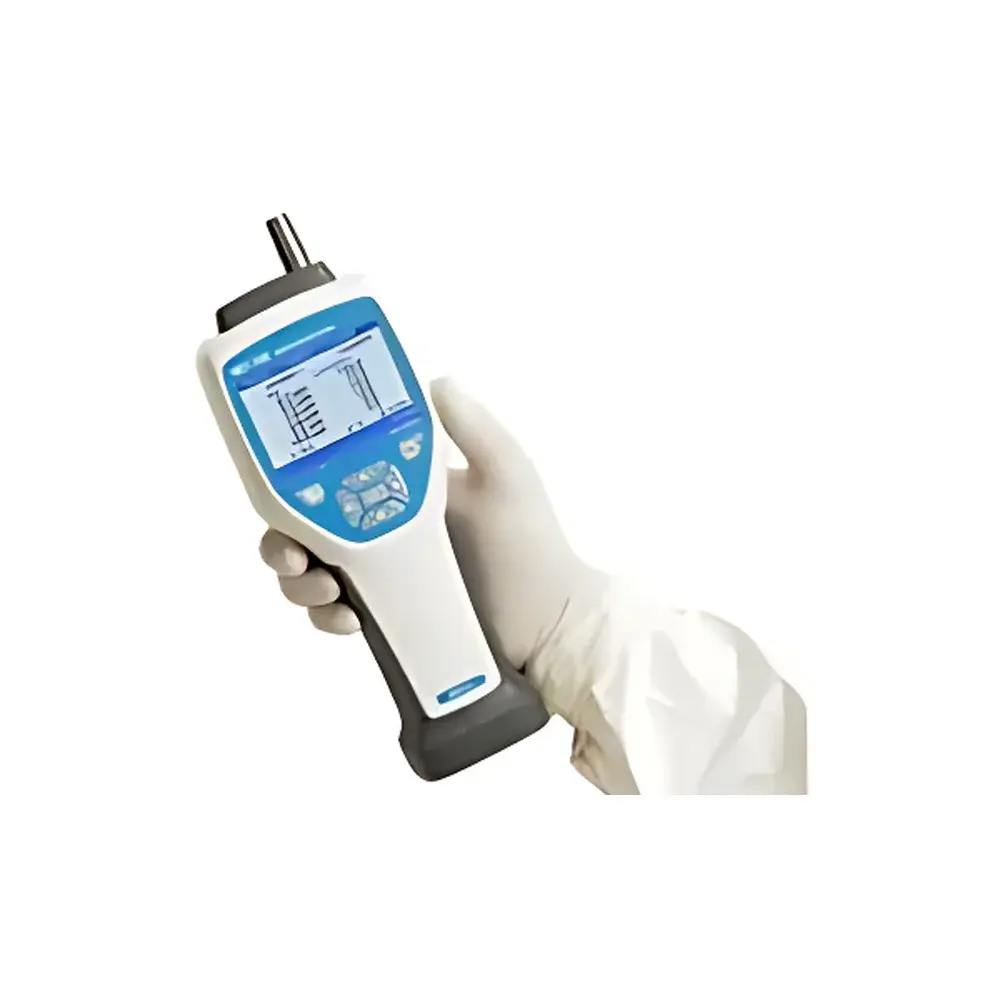
Beckman Coulter MET ONE HHPC 6+ Handheld Optical Particle Counter
| Brand | Beckman Coulter |
|---|---|
| Origin | USA |
| Manufacturer | Beckman Coulter, Inc. |
| Product Type | Imported |
| Model | MET ONE HHPC 6+ |
| Instrument Category | Optical Particle Counter |
| Particle Size Range | 0.3–10 µm (6 channels per ISO 14644-1 & ISO 21501) |
| Flow Rate | 2.83 L/min |
| Weight | 1.5 lbs (0.68 kg) |
| Display | 3.5" color LCD (320 × 240) |
| Data Storage | 10,000 records |
| Counting Efficiency | 50% at 0.3 µm |
| Zero Count Level | ≤1 count/5 min (JIS B9921) |
| Maximum Concentration Limit | 4,000,000 particles/ft³ with <10% coincidence loss (ISO 21501) |
| Operating Environment | 10–40 °C, ≤95% RH (non-condensing) |
| Battery Life | ≥10 h typical, ≥5.5 h minimum continuous |
| Charging Time | 3.5 h |
| Housing Material | Polycarbonate-ABS blend |
| Dimensions | 10.7" × 3.9" × 2.1" (272 × 99 × 53 mm) |
| Connectivity | USB 2.0, Ethernet (HTTP-based web interface), USB flash drive support |
| User Interface Languages | English, Japanese |
| Alarm Configuration | User-defined particle count thresholds |
| Security | Optional administrator password protection |
Overview
The Beckman Coulter MET ONE HHPC 6+ is a six-channel handheld optical particle counter engineered for precision airborne particulate monitoring in controlled environments governed by ISO 14644-1, ISO 21501-4, and US Federal Standard 209E. Utilizing calibrated light-scattering photometry, the instrument detects and sizes particles in real time across six user-selectable channels (0.3, 0.5, 0.7, 1.0, 3.0, and 10.0 µm), enabling compliance verification for ISO Class 5 (FED STD 100) through ISO Class 7 (FED STD 10,000) cleanrooms. Its compact, ergonomic design—measuring just 272 × 99 × 53 mm and weighing 0.68 kg—facilitates single-hand operation during HEPA filter leak testing, microenvironment qualification, and point-of-use contamination diagnostics in semiconductor fabrication, flat panel display manufacturing, MEMS/MOEMS production, and aseptic pharmaceutical processing.
Key Features
- Real-time six-channel optical detection with traceable calibration per ISO 21501-4, ensuring metrological integrity for GMP and FDA-regulated environments.
- Ergonomic polycarbonate-ABS housing with textured wave-pattern grip, optimized for prolonged handheld use in confined or elevated sampling locations.
- High-resolution 3.5-inch color LCD (320 × 240 pixels) supporting configurable ultra-large font display and dual visualization modes: tabular numeric output and time-series trend graphs.
- Integrated dual-mode data acquisition: direct USB 2.0 connection (plug-and-play, no driver required) and embedded HTTP server accessible via standard browsers (Chrome, Firefox, Safari, Edge) over Ethernet.
- On-device storage of up to 10,000 timestamped records—including raw counts, cumulative/differential concentrations (N/ft³, N/m³, N/L), and environmental metadata—retained during power cycling.
- Zero-count performance validated to JIS B9921 (≤1 count/5 min), critical for low-background validation in ISO 5 environments.
- Compliance-ready security architecture featuring optional administrator password lockout and user-defined alarm thresholds for rapid deviation detection.
Sample Compatibility & Compliance
The HHPC 6+ is validated for use with ambient air and compressed gases (oil-free, dry) within specified operating limits (10–40 °C, ≤95% RH non-condensing). It meets the sampling flow rate requirement of 2.83 L/min (0.1 ft³/min) mandated by ISO 14644-1 Annex B for Class 5 certification. Channel sizing accuracy adheres to ISO 21501-4:2018 for light-scattering particle counters, including stated counting efficiency (50% @ 0.3 µm, ≥100% @ ≥0.45 µm) and coincidence error control (<10% at 4×10⁶ particles/ft³). The device supports audit-ready documentation workflows aligned with FDA 21 CFR Part 11 (when paired with validated data export protocols), EU GMP Annex 1, and ISO/IEC 17025-accredited laboratory practices.
Software & Data Management
Data retrieval requires no proprietary software: users export CSV-formatted datasets directly to Excel via three interoperable methods—(1) USB cable tethering (appears as removable storage), (2) insertion of standard USB flash drives (FAT32 formatted), or (3) browser-based HTTP download from the device’s embedded web server. All exported files include UTC timestamps, instrument ID, channel configuration, and sampling duration metadata. Trend visualization tools enable immediate on-device assessment of particle excursions, reducing root-cause analysis time during contamination investigations. Exported logs are compatible with LIMS integration and statistical process control (SPC) platforms compliant with ISO 13485 and ICH Q9 frameworks.
Applications
The HHPC 6+ serves as a primary verification tool in high-integrity manufacturing and regulated life science operations. Key use cases include: routine ISO classification audits of cleanrooms and isolators; HEPA/ULPA filter integrity testing at terminal outlets and laminar flow hoods; source identification during yield loss events in wafer fab or LED epitaxy lines; environmental monitoring in aseptic filling suites (e.g., blow-fill-seal, vial capping); particulate challenge testing of packaging systems (Tetra Pak®, sterile barrier trays); and qualification of micro-environments in optical lens assembly, medical device machining, and aerospace component coating facilities. Its portability and battery endurance make it especially suited for mobile QA/QC teams performing unannounced surveillance across multi-site GMP facilities.
FAQ
Does the HHPC 6+ require annual recalibration to maintain ISO 14644-1 compliance?
Yes—Beckman Coulter recommends traceable recalibration every 12 months using NIST-traceable PSL standards, documented per ISO/IEC 17025 requirements.
Can the device measure particles below 0.3 µm?
No—the optical detection limit is defined at 0.3 µm per ISO 21501-4; sub-0.3 µm aerosols require condensation particle counters (CPCs) or scanning mobility particle sizers (SMPS).
Is the Ethernet interface compatible with enterprise IT security policies?
Yes—the HTTP server supports static IP assignment and operates without inbound remote access; all data transfer is initiated client-side, minimizing network exposure.
What is the maximum allowable particle concentration before coincidence error invalidates readings?
Per ISO 21501-4, the upper limit is 4,000,000 particles/ft³ (141 million/m³) with ≤10% coincidence loss; exceeding this requires dilution or alternative sampling strategies.
Does the unit comply with FDA 21 CFR Part 11 for electronic records?
The hardware supports Part 11 principles (audit trail-capable exports, user authentication via password), but full compliance depends on site-specific procedural controls and validated export workflows.



