
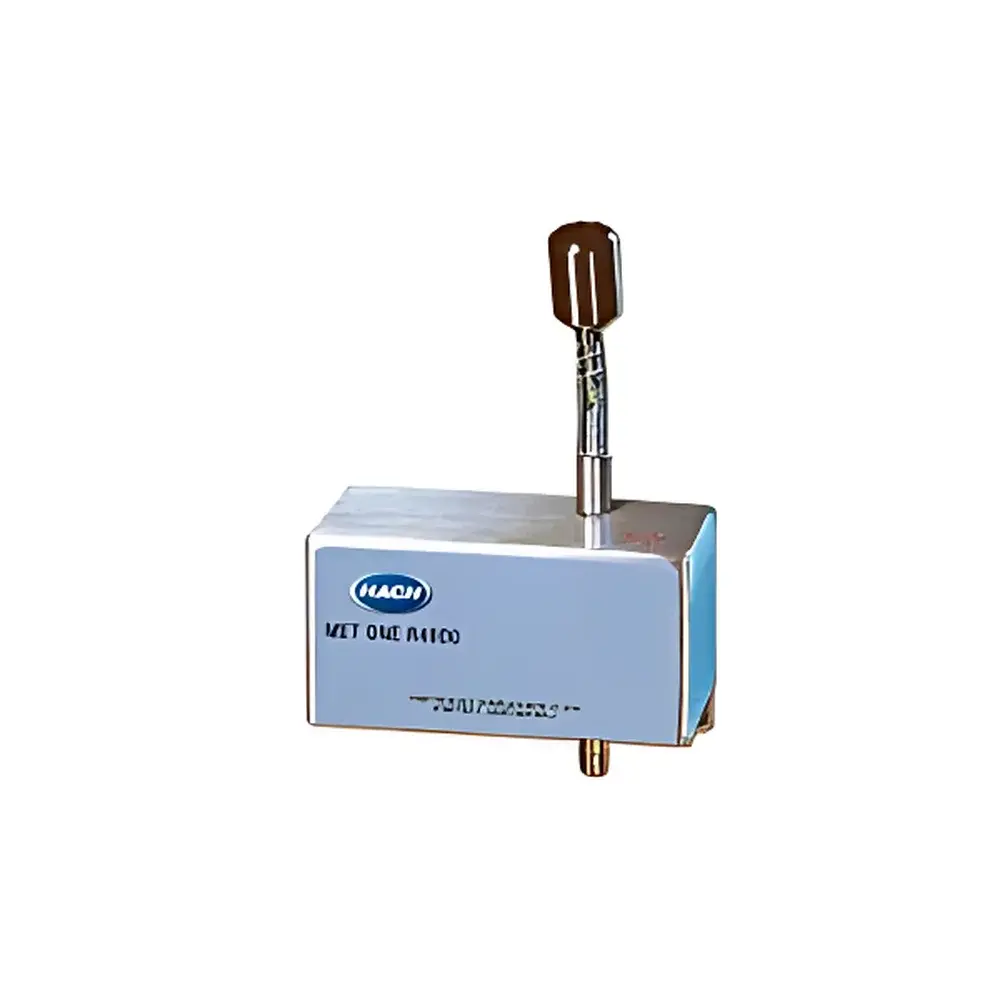
Beckman Coulter MET ONE R4800/R4900 Remote Airborne Particle Counter
| Brand | Beckman Coulter |
|---|---|
| Origin | USA |
| Manufacturer Type | Original Equipment Manufacturer (OEM) |
| Product Category | Imported Instrument |
| Model | MET ONE R4800/R4900 |
| Instrument Type | Optical Particle Counter |
| Minimum Detectable Size | 0.3 µm (R4803/R4903) or 0.5 µm (R4805/R4815/R4905/R4915) |
| Flow Rate | 0.1 CFM (2.83 L/min) or 1.0 CFM (28.3 L/min) |
| Detection Principle | Laser Diode-Based Light Scattering |
| Channel Configuration | Dual-channel (e.g., 0.3/0.5 µm or 0.5/5.0 µm) |
| Counting Efficiency Loss | <5% at 2×10⁶ particles/ft³ |
| Operating Temperature | 12–41°C |
| Relative Humidity | 20–95% RH (non-condensing) |
| Power Interface | Open-collector FET output (max. 150 mA sink, 30 VDC off-state) |
| Communication | RS-485 (R4800 series) or 4–20 mA analog (R4900 series) |
| Housing Material | Stainless steel |
| Weight | 0.3 kg |
Overview
The Beckman Coulter MET ONE R4800 and R4900 Series Remote Airborne Particle Counters are precision-engineered optical instruments designed for continuous, real-time monitoring of airborne particulate contamination in controlled environments. Utilizing laser diode-based light scattering detection, these counters provide high-fidelity particle concentration data across two user-selectable size channels—enabling compliance with ISO 14644-1, EU GMP Annex 1, and USP environmental monitoring requirements. Unlike benchtop or portable units, the R4800/R4900 series is purpose-built for permanent installation in cleanroom ceilings, ductwork, or process-critical zones where minimal intrusion into laminar airflow is essential. Their fanless design eliminates localized turbulence and pressure drop, allowing placement within 30 cm of sensitive semiconductor wafer handling stations or aseptic filling lines without compromising unidirectional flow integrity. With a mean time to failure (MTTF) of ≥10 years for the laser source and calibrated performance traceable to NIST-traceable reference aerosols, these instruments serve as foundational nodes in Facility Monitoring Systems (FMS) for regulated manufacturing.
Key Features
- Fanless, compact stainless-steel enclosure (0.3 kg) rated for operation in ISO Class 3–8 cleanrooms and industrial process environments.
- Dual-channel optical detection with configurable size thresholds: 0.3/0.5 µm (R4803/R4903) or 0.5/5.0 µm (R4805/R4815/R4905/R4915), supporting multi-tiered alerting per ISO 14644-2 surveillance protocols.
- Two standardized flow options: 0.1 CFM (2.83 L/min) for low-flow duct sampling or remote manifold integration; 1.0 CFM (28.3 L/min) for high-sensitivity point-of-use monitoring in critical zones.
- Robust analog and digital interface architecture: R4800 models support RS-485 Modbus RTU for direct FMS integration; R4900 models deliver industry-standard 4–20 mA current loop outputs compatible with PLCs, DCS, and legacy BMS platforms.
- On-device configuration via RS-485—including counting interval, hold time, alarm thresholds, alarm delay, and channel scaling—retained across power cycles without external memory dependency.
- Integrated status LED indicators: power-on confirmation, calibration due warning, and flashing alarm signal synchronized to user-defined concentration limits.
Sample Compatibility & Compliance
The MET ONE R4800/R4900 series is validated for use with ambient air, compressed gases (N₂, dry air, CO₂), and HEPA-filtered process air streams. Its inlet vacuum requirement (−0.1″ Hg / −450 mbar minimum) ensures compatibility with centralized vacuum manifolds common in pharmaceutical and microelectronics facilities. Particle loss is rigorously characterized: <5% coincidence loss at concentrations up to 2×10⁶ particles/ft³ (7.1×10⁷ particles/m³), meeting ISO 21501-4 and JIS B 9921 accuracy criteria for optical particle counters. The instrument’s mechanical and electrical design conforms to IEC 61000-6-2 (immunity) and IEC 61000-6-4 (emissions), while its firmware architecture supports audit-ready event logging required under FDA 21 CFR Part 11 when integrated with compliant FMS software.
Software & Data Management
While the R4800/R4900 operate autonomously as sensor nodes, they are fully interoperable with Beckman Coulter’s MET ONE Fusion™ FMS platform and third-party systems including Siemens Desigo, Honeywell Experion, and Rockwell FactoryTalk. All configuration parameters, real-time counts, and alarm events are accessible via Modbus register mapping or 4–20 mA proportional scaling. For GLP/GMP environments, timestamped raw count data—including channel-specific cumulative and differential histograms—is transmitted without on-board storage, ensuring data integrity and simplifying 21 CFR Part 11 validation. Optional firmware updates maintain alignment with evolving ISO 14644-2:2015 surveillance interval recommendations and EU GMP Annex 1 (2022) risk-based monitoring expectations.
Applications
- Pharmaceutical aseptic processing: continuous monitoring of Grade A/B background areas adjacent to isolators and RABS.
- Semiconductor front-end fabrication: real-time detection of sub-0.5 µm defects in photolithography tool environments and FOUP load ports.
- HDD and flat-panel display manufacturing: quantification of airborne molecular contamination (AMC)-associated particulates in coating and etching chambers.
- Medical device clean assembly: verification of ISO 13485-compliant environmental controls during Class 7/8 packaging operations.
- Research cleanrooms: long-term stability studies requiring drift-free baseline characterization over 12+ month deployments.
FAQ
What is the difference between the R4800 and R4900 series?
The R4800 series uses RS-485 serial communication (Modbus RTU) for digital integration, while the R4900 series provides 4–20 mA analog output for compatibility with analog-input PLCs and legacy building management systems.
Can the instrument be installed inside a laminar flow hood?
Yes—its fanless design and low-profile stainless-steel housing allow flush-mounting directly into laminar airflow paths without disrupting velocity uniformity or introducing recirculation zones.
Is NIST traceability provided with each unit?
Each instrument ships with a Certificate of Calibration referencing NIST-traceable PSL (polystyrene latex) standards at 0.3 µm and 0.5 µm, with full uncertainty budgets per ISO/IEC 17025.
How is alarm signaling implemented?
A dedicated open-collector FET output delivers a hardware-level alarm pulse synchronized to user-configured concentration thresholds; no software polling is required for fail-safe response.
What vacuum source specifications are required?
A minimum sustained vacuum of −450 mbar (−0.1″ Hg) is required at the inlet; typical centralized cleanroom vacuum manifolds operating at −500 to −700 mbar meet this specification reliably.



