
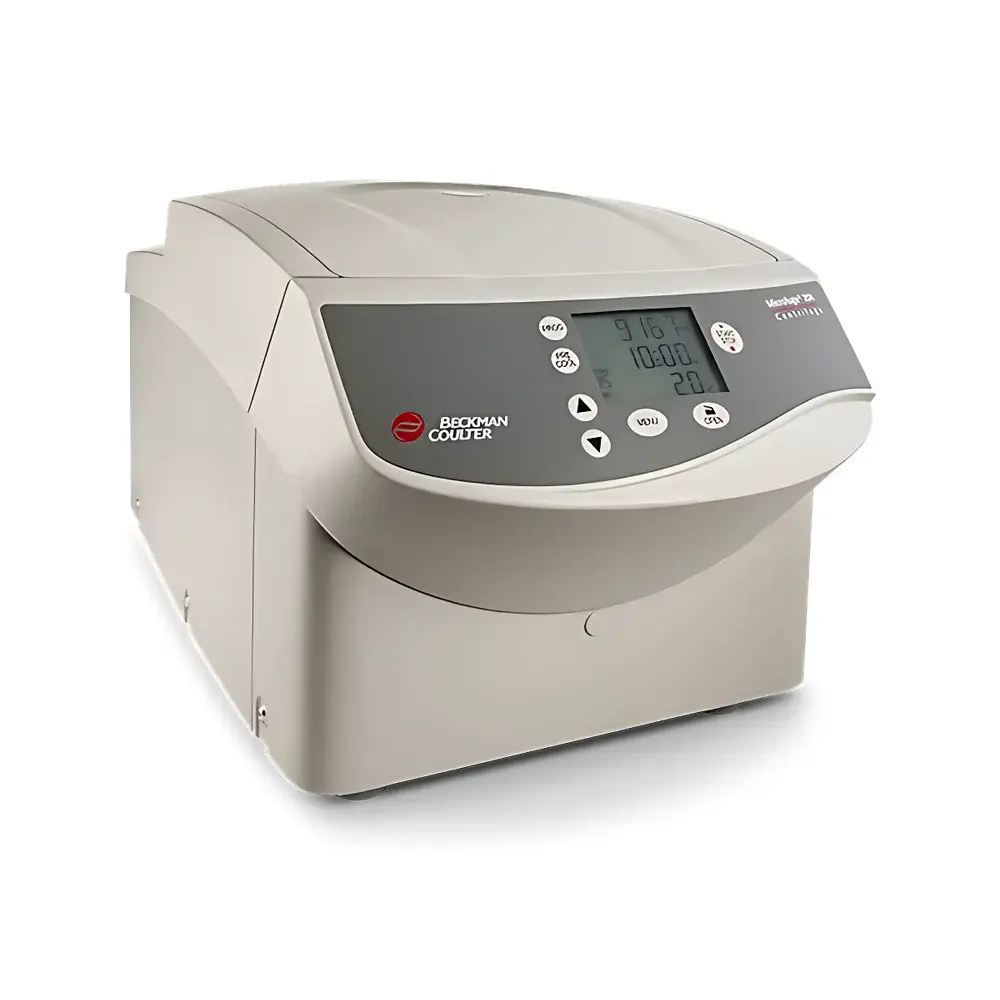
Beckman Coulter Microfuge 20R Benchtop Refrigerated Centrifuge
| Brand | Beckman Coulter |
|---|---|
| Origin | USA |
| Manufacturer | Beckman Coulter, Inc. |
| Product Type | Benchtop Refrigerated Centrifuge |
| Model | Microfuge 20R |
| Centrifuge Category | High-Speed Refrigerated Centrifuge |
| Speed Range | Up to 15,000 rpm |
| Max RCF | 20,627 × g |
| Max Capacity | 36 × 2.0 mL |
| Dimensions (W × D × H) | 31 × 66 × 29.1 cm |
| Rotor Type | Fixed-Angle (e.g., FA361.5) |
| Application Scope | Cellular & bacterial pelleting, nucleic acid/protein isolation, subcellular fractionation, phase separation, receptor binding assays, and particulate sedimentation |
Overview
The Beckman Coulter Microfuge 20R is a compact, high-performance benchtop refrigerated centrifuge engineered for precision, reproducibility, and operational safety in demanding life science laboratories. Utilizing fixed-angle rotor architecture and active thermoelectric cooling, it delivers consistent temperature control (typically –9 °C to 40 °C) during high-speed operation—critical for preserving labile biomolecules such as RNA, membrane proteins, and enzyme complexes. Its core design adheres to fundamental principles of centrifugal force generation (RCF = 1.118 × r × N²/10⁶, where r = rotor radius in mm and N = rotational speed in rpm), enabling reliable pelleting of cells, bacteria, organelles, and macromolecular complexes at up to 15,000 rpm (20,627 × g). The unit’s small footprint (31 × 66 × 29.1 cm) integrates seamlessly into biosafety cabinets, cold rooms, or shared core facility workspaces without compromising performance integrity.
Key Features
- Refrigerated operation with precise temperature setpoint control (–9 °C to 40 °C) and real-time monitoring, ensuring thermal stability throughout runs—even during rapid acceleration or extended hold times.
- High-speed capability: 15,000 rpm maximum speed with 20,627 × g relative centrifugal force, validated for efficient pelleting of mammalian cells (e.g., HEK293, CHO), bacterial cultures (E. coli, Bacillus spp.), and subcellular fractions (mitochondria, nuclei).
- FA361.5 fixed-angle rotor standard configuration: accommodates 36 × 2.0 mL tubes; aluminum construction ensures mechanical robustness, corrosion resistance, and compatibility with common sterilization protocols (e.g., 70% ethanol wipe-down, autoclaving per manufacturer guidelines).
- Intuitive dual-display interface showing simultaneous rpm and × g values—enabling direct verification of force equivalence across rotor types and eliminating manual conversion errors.
- User-programmable protocols (up to 99 stored methods) support GLP-compliant workflows, including pre-cool activation, acceleration/deceleration ramp control, and automatic brake inhibition for sensitive samples.
- Energy-efficient thermoelectric cooling system reduces power consumption versus compressor-based alternatives while maintaining stable thermal profiles under variable ambient conditions (15–32 °C).
Sample Compatibility & Compliance
The Microfuge 20R supports routine use with standard polypropylene and polycarbonate microcentrifuge tubes (0.2–2.0 mL), including certified low-binding and RNase/DNase-free variants. It complies with IEC 61010-1:2010 for laboratory electrical equipment safety and meets electromagnetic compatibility (EMC) requirements per EN 61326-1. When operated with validated rotors and protocols, the system supports data integrity frameworks aligned with FDA 21 CFR Part 11 (when integrated with compliant LIMS or ELN systems), ISO/IEC 17025 method validation, and USP Analytical Instrument Qualification. Routine maintenance—including rotor lifetime tracking, vibration diagnostics, and door interlock verification—is documented per Beckman Coulter’s IQ/OQ/PQ guidance.
Software & Data Management
While the Microfuge 20R operates via standalone front-panel controls, its programmable memory enables audit-ready protocol execution. Each run logs timestamp, set parameters (speed, time, temperature, acceleration profile), and final status (e.g., “Completed”, “Stopped”, “Error Code E07”). These records are exportable via USB port for integration into electronic lab notebooks (ELNs) or quality management systems (QMS). Optional connectivity modules (e.g., Beckman Coulter CentriLink™) allow remote monitoring, fleet-wide usage analytics, and automated firmware updates—supporting centralized instrument management in multi-user environments subject to GMP/GLP oversight.
Applications
- Nucleic acid purification: rapid pelleting of silica-membrane spin columns post-binding/wash steps; recovery of plasmid DNA, genomic DNA, and total RNA from lysates.
- Protein biochemistry: clarification of cell lysates prior to affinity chromatography; precipitation of inclusion bodies; concentration of dilute protein solutions using centrifugal filter devices.
- Cell biology: harvesting adherent and suspension cells; isolating cytosolic vs. membrane fractions; preparing exosome-enriched supernatants after sequential centrifugation.
- Clinical & diagnostic workflows: processing serum/plasma for biomarker analysis; separating PBMCs from whole blood; concentrating viral particles for titer determination.
- Pharmaceutical QC: residual host-cell protein (HCP) removal verification; particle contamination screening in final drug substance batches.
FAQ
What is the minimum sample volume compatible with the FA361.5 rotor?
The FA361.5 rotor is optimized for 2.0 mL tubes but accepts volumes as low as 0.2 mL with minimal risk of tube deformation or imbalance—provided tubes are matched by mass within ±0.1 g.
Can the Microfuge 20R be used for continuous operation over multiple shifts?
Yes—its thermally managed motor and sealed bearing design support uninterrupted daily use up to 16 hours, contingent on adherence to recommended duty cycles and ambient temperature limits.
Is rotor lifetime tracked automatically?
Rotor usage (total run time and cumulative stress cycles) must be manually logged per Beckman Coulter’s Rotor Life Management Guide; no embedded RFID or auto-counting sensor is present in the base Microfuge 20R configuration.
Does the unit meet ISO 13485 requirements for medical device manufacturing environments?
The hardware platform satisfies essential design and safety clauses of ISO 13485:2016; however, full compliance requires site-specific risk assessment, documented calibration procedures, and integration into a qualified quality management system.
Are third-party rotors supported?
Only Beckman Coulter–certified rotors (e.g., FA361.5, FA45-6-30, FA35-12-18) are validated for use; installation of non-OEM rotors voids warranty and compromises safety certification.



