
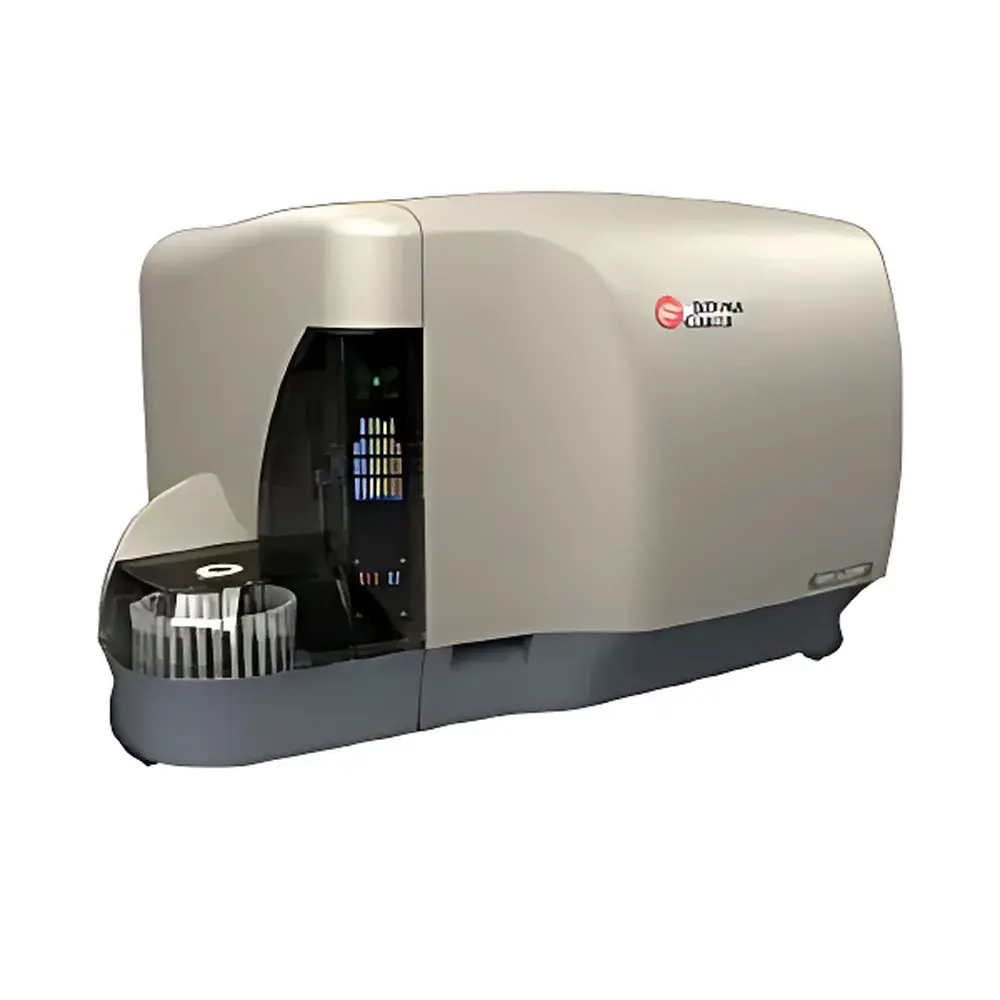
Beckman Coulter Navios Series Flow Cytometer
| Brand | Beckman Coulter |
|---|---|
| Origin | USA |
| Manufacturer Type | Original Equipment Manufacturer (OEM) |
| Import Status | Imported |
| Model | Navios |
| Product Category | Flow Cytometry Analyzer |
| Intended Use | Clinical Diagnostics |
| Lasers | 405 nm (violet), 488 nm (blue), 638 nm (red) |
| Detection Channels | Up to 10-color capability |
| Fluorescence Sensitivity | <112 MESF (FITC), <78 MESF (PE), <15 MESF (PC5) |
| Forward & Side Scatter Detection | Photodiode-based FSC/SSC |
| Fluorescence Detection | Photomultiplier Tube (PMT)-based |
| Optical System | Solid-state diode lasers with integrated flow cell |
| Flow Cell Dimensions | 150 µm × 460 µm rectangular quartz cuvette |
| Temperature Control | Integrated thermal regulation for optical path stability |
| Data Processing | Real-time digital signal processing |
| Power Supply | 100–240 VAC, 50/60 Hz |
| Regulatory Certification | China NMPA Import Registration No. 20172401770 |
| Compliance | Designed for CLIA- and CAP-aligned clinical laboratories |
Overview
The Beckman Coulter Navios Series Flow Cytometer is a clinical-grade, high-parameter benchtop flow cytometer engineered for reproducible, multi-color immunophenotyping in diagnostic and translational research environments. Utilizing orthogonal laser excitation (405 nm violet, 488 nm blue, and 638 nm red solid-state diode lasers) and precision-engineered optical detection paths, the system enables simultaneous acquisition of up to ten fluorescent parameters plus forward scatter (FSC) and side scatter (SSC). Its core measurement principle relies on hydrodynamic focusing of single-cell suspensions through a precisely dimensioned quartz flow cell (150 µm × 460 µm), where cells intersect laser beams one-by-one. Scattered light and emitted fluorescence are collected via high-quantum-efficiency photodiodes (FSC/SSC) and low-noise photomultiplier tubes (PMTs), digitized in real time using embedded high-speed analog-to-digital converters. The instrument’s architecture prioritizes analytical robustness—thermal stabilization of the optical train minimizes drift, while digital compensation algorithms maintain matrix integrity across extended acquisition sessions.
Key Features
- Triple-laser configuration enabling full-spectrum excitation compatibility with common fluorochromes including FITC, PE, PC5, APC, and BV421
- Digital signal processing engine delivering stable fluorescence sensitivity thresholds: <112 MESF (FITC), <78 MESF (PE), and <15 MESF (PC5)
- Integrated quartz flow cell with minimized internal reflection losses and optimized light collection geometry
- Automated daily startup/shutdown sequences with onboard QC bead calibration tracking
- Bi-directional LIS interface supporting HL7 v2.x messaging for automated sample routing, worklist ingestion, and result export
- On-instrument sample probe wash cycle using dedicated cleaning fluid to prevent carryover and reduce proteinaceous residue accumulation in fluidics lines
- Real-time compensation matrix application with user-editable and protocol-locked settings for GLP/GCP-aligned workflows
Sample Compatibility & Compliance
The Navios platform accommodates standard anticoagulated whole blood, bone marrow aspirates, cerebrospinal fluid (CSF), and peripheral blood mononuclear cell (PBMC) preparations. Sample introduction is compatible with 12×75 mm round-bottom polystyrene tubes and optional 96-well plate autoloaders (with separate accessory module). All fluidic pathways comply with ISO 8573-1 Class 3 compressed air purity standards where applicable. The system meets IEC 61010-1 safety requirements and is certified under China NMPA Import Registration No. 20172401770. When operated with Kaluza Clinical Software v2.5 or later and configured with audit trail, electronic signature, and data encryption modules, it supports compliance with FDA 21 CFR Part 11, EU Annex 11, and CAP-accredited laboratory quality systems.
Software & Data Management
Data acquisition and analysis are performed using Beckman Coulter’s Kaluza Software suite—available in Research Use Only (RUO) and FDA-cleared Clinical versions. The clinical version includes pre-validated gating templates for lymphocyte subset enumeration (CD3/CD4/CD8, CD19, CD56/CD16), leukemia/lymphoma panels, and minimal residual disease (MRD) assays per EuroFlow guidelines. All raw FCS 3.0/3.1 files are stored with embedded instrument metadata, compensation matrices, and acquisition timestamps. Audit trails log user actions—including gate edits, compensation adjustments, and report generation—with immutable timestamps and operator IDs. Data export supports CSV, PDF, and XML formats compliant with local EHR integration specifications.
Applications
The Navios system serves as a primary analytical tool in clinical hematology laboratories for immunophenotypic characterization of hematologic malignancies, including acute myeloid leukemia (AML), chronic lymphocytic leukemia (CLL), and non-Hodgkin lymphomas. It supports routine CD4+ T-lymphocyte quantification in HIV monitoring, HLA-B27 testing, and neutrophil function assays. In translational settings, it facilitates longitudinal immune monitoring in vaccine trials, CAR-T cell persistence studies, and cytokine secretion profiling following intracellular staining protocols. Its high-resolution SSC/FSC discrimination enables reliable identification of blast populations, microparticles, and apoptotic bodies within heterogeneous samples.
FAQ
What regulatory clearances does the Navios system hold for clinical use in the United States?
The Navios platform itself is not FDA 510(k)-cleared as a standalone device; however, when used with Kaluza Clinical Software and validated reagent kits (e.g., IOTest® Beta Mark, IMAGN™ panels), it operates within FDA-cleared test systems for specific clinical indications.
Can the Navios be integrated into a hospital-wide LIS without custom middleware?
Yes—the instrument natively supports HL7 ADT and ORU messages over TCP/IP. Standard configuration includes bidirectional communication for worklist download, patient ID verification, and structured result transmission.
Is temperature control active during idle periods?
Yes. The optical compartment maintains a stabilized ambient temperature (±0.5°C) continuously, whether acquiring data or in standby mode, ensuring minimal photodetector dark current drift.
How is carryover managed between high-concentration samples?
The system executes an automated post-run probe flush using proprietary cleaning solution, followed by air purge and sheath fluid rinse—reducing carryover to <0.1% as verified per ISO 15189 Annex B protocols.
Does the Navios support spectral unmixing or only traditional compensation?
The base configuration uses classical compensation matrices. Spectral unmixing requires upgrade to Kaluza Spectral Analysis Module (SAM), which is available as an optional licensed feature for advanced panel design and autofluorescence subtraction.




