
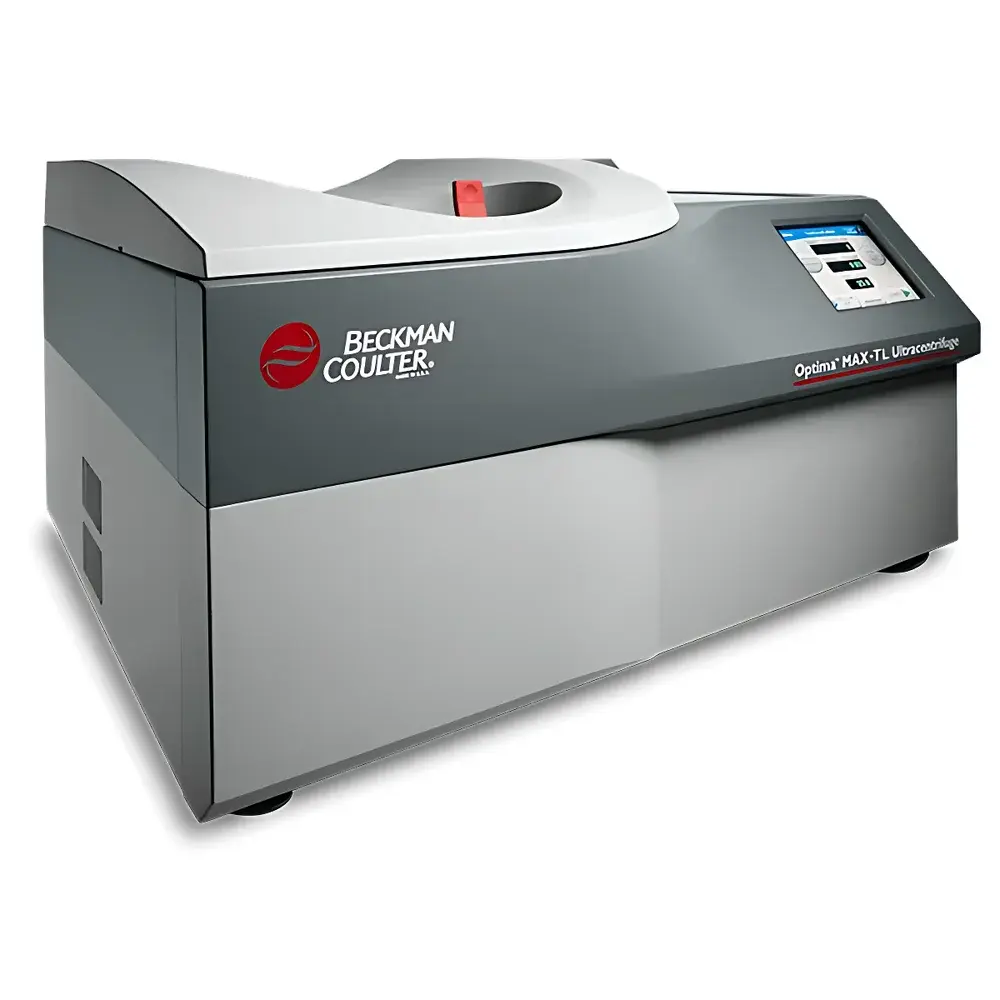
Beckman Coulter Optima MAX-TL Desktop Ultracentrifuge
| Brand | Beckman Coulter |
|---|---|
| Origin | USA |
| Manufacturer Type | Original Equipment Manufacturer (OEM) |
| Product Origin | Imported |
| Model | Optima MAX-TL |
| Instrument Type | Benchtop Centrifuge |
| Speed Class | Ultracentrifuge (>30,000 rpm) |
| Function | General-purpose ultracentrifugation |
| Configuration | Horizontal rotor compatible |
| Separation Level | Cellular and bacterial subfractionation |
| Maximum Capacity | 40.8 mL |
| Maximum Speed | 120,000 rpm |
| Maximum RCF | 657,000 × g |
| Dimensions (W × D × H) | 73.9 × 61.7 × 39.4 cm |
Overview
The Beckman Coulter Optima MAX-TL is a high-performance benchtop ultracentrifuge engineered for precision separation of macromolecules, subcellular organelles, viruses, and nanoparticles. Utilizing advanced vacuum-sealed rotor chamber technology and active magnetic bearing drive systems, the instrument achieves exceptional rotational stability at speeds up to 120,000 rpm—enabling sedimentation-based separations under precisely controlled temperature (typically 0–40 °C) and vacuum conditions. Its compact footprint (73.9 × 61.7 × 39.4 cm) and low acoustic emission (<55 dBA at maximum speed) make it suitable for placement within standard laboratory workspaces, including biosafety cabinets (Class II A2/B2 compatible). Designed for research-grade reproducibility—not clinical diagnostics—the Optima MAX-TL complies with IEC 61010-1 (Safety Requirements for Electrical Equipment for Measurement, Control, and Laboratory Use) and meets essential requirements for GLP-compliant environments through traceable calibration protocols and audit-ready operational logs.
Key Features
- Ultra-high-speed capability: 120,000 rpm maximum speed with real-time RCF calculation and automatic rotor recognition
- Integrated vacuum system with dual-stage oil-free pump for rapid chamber evacuation and thermal stability during prolonged runs
- Intelligent temperature control: Peltier-cooled rotor chamber with ±0.5 °C accuracy across 0–40 °C range
- BioSafe-certified design: Compatible with standard biosafety cabinets; optional dual PALL pharmaceutical-grade sterilizing-grade filters (0.2 µm) for exhaust air path
- Robust mechanical architecture: Titanium-alloy rotor body construction tested to ISO 15841 standards for fatigue resistance and burst safety
- User-centric interface: Full-color 7-inch LCD touchscreen with intuitive icon-driven navigation and glove-compatible touch sensitivity
- Multi-language support: Interface available in English, German, French, Spanish, Italian, Japanese, Chinese (Simplified), Korean, and Portuguese—configured via firmware without external software dependency
Sample Compatibility & Compliance
The Optima MAX-TL supports all legacy and current Beckman Coulter TL-series rotors—including Type 70 Ti, Type 50.2 Ti, and TLS-55—ensuring seamless integration into established workflows. Its horizontal rotor configuration accommodates standard ultracentrifuge tubes (e.g., 13 × 51 mm, 25 × 89 mm, and 38 × 99 mm formats), with maximum sample volume per run reaching 40.8 mL (using six 6.8 mL tubes). All rotors undergo individual dynamic balancing and certified burst testing per ISO 21501-4. The system is validated for use with non-clinical research applications only and is not intended for diagnostic or therapeutic use. It conforms to FDA 21 CFR Part 11 requirements when paired with Beckman Coulter’s optional Data Management Software (DMS), supporting electronic signatures, user access controls, and immutable audit trails.
Software & Data Management
Control and monitoring are managed via embedded firmware with no external PC dependency. The onboard operating system stores up to 1,000 method protocols with timestamped execution history. Optional Beckman Coulter DMS enables export of raw run data (speed, time, temperature, vacuum pressure, RCF) in CSV and XML formats compliant with LIMS integration standards. All data fields are digitally signed and version-controlled; changes to critical parameters (e.g., max speed, temperature setpoint) require administrator-level authentication. Firmware updates follow ISO/IEC 17025-aligned validation procedures and include rollback capability.
Applications
- Isolation of exosomes and extracellular vesicles from cell culture supernatants and biofluids
- Subcellular fractionation: purification of mitochondria, lysosomes, and microsomes
- Macromolecular characterization: sedimentation velocity and equilibrium analysis of proteins, nucleic acids, and synthetic polymers
- Virus purification and concentration for structural biology and vaccine development
- Nanoparticle size distribution profiling via sucrose or iodixanol density gradient centrifugation
- Preparative-scale isolation of ribosomal subunits and protein complexes
FAQ
Is the Optima MAX-TL certified for use in biosafety cabinets?
Yes—it is mechanically and acoustically engineered for safe operation inside Class II A2 and B2 biosafety cabinets, with optional exhaust filtration meeting ISO 14644-1 Class 5 cleanroom particulate requirements.
Does it support regulatory compliance for GMP/GLP environments?
When configured with DMS and appropriate access controls, the system satisfies core elements of FDA 21 CFR Part 11, EU Annex 11, and ISO/IEC 17025 for data integrity and traceability.
Can existing TL-series rotors be used without recalibration?
Yes—all TL-series rotors are auto-recognized and require no manual input; rotor-specific parameters (k-factor, Rmax, Rmin) are loaded from embedded EEPROM chips.
What maintenance intervals are recommended?
Vacuum pump oil replacement every 12 months (if equipped with oil-lubricated option), annual verification of temperature sensor accuracy, and biannual inspection of rotor seating surfaces per Beckman Coulter Service Bulletin SB-ULTRA-2023-01.
Is remote monitoring supported?
No native Ethernet/Wi-Fi connectivity is provided; however, USB export of run logs enables offline review and integration with third-party lab automation platforms via standardized file ingestion protocols.



