
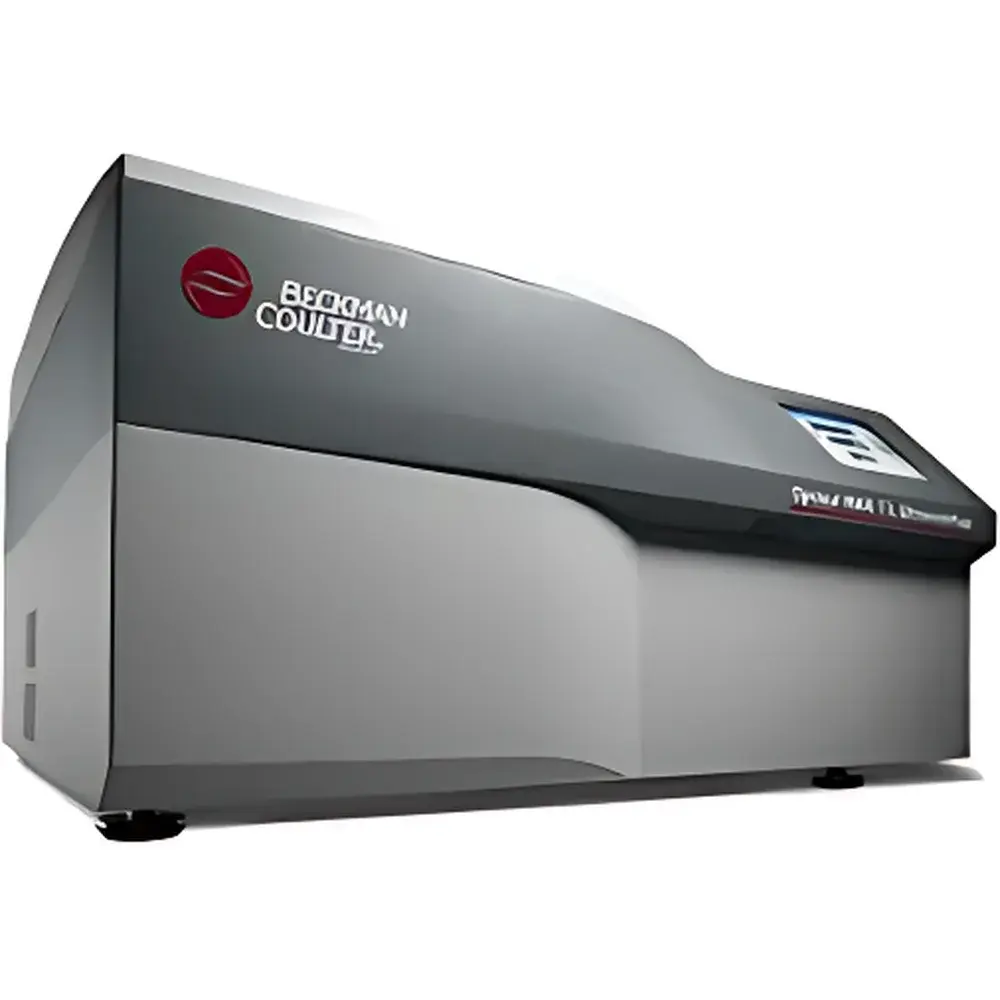
Beckman Coulter Optima MAX-TL Desktop Ultracentrifuge
| Brand | Beckman Coulter |
|---|---|
| Origin | USA |
| Manufacturer | Beckman Coulter, Inc. |
| Product Type | Desktop Ultracentrifuge |
| Speed Range | Up to 120,000 rpm |
| Maximum RCF | 657,400 × g |
| Maximum Capacity | 8 × 5.1 mL |
| Refrigeration | Yes (Cryogenic Cooling) |
| Rotor Compatibility | Full backward compatibility with Optima TL-series rotors (fixed-angle, swinging-bucket, vertical, near-vertical) |
| Dimensions (W × H × D) | 58.4 × 73.7 × 40.9 cm |
| Safety Certification | BioSafe-compliant design |
| Display | Full-color LCD touchscreen with multilingual UI (including Chinese and English) |
| Regulatory Compliance | Designed for GLP/GMP environments |
Overview
The Beckman Coulter Optima MAX-TL is a high-performance desktop ultracentrifuge engineered for precision separation of macromolecular complexes, subcellular organelles, viruses, and nanoscale particles. Operating on the principle of sedimentation equilibrium and rate-zonal centrifugation under vacuum, the Optima MAX-TL delivers exceptional rotational stability at speeds up to 120,000 rpm and generates a maximum relative centrifugal force (RCF) of 657,400 × g. Its compact footprint—measuring only 58.4 cm wide, 73.7 cm tall, and 40.9 cm deep—enables installation in space-constrained laboratories without compromising ultracentrifuge-grade performance. The system features an integrated refrigeration unit capable of maintaining sample temperatures between 0 °C and 40 °C, ensuring thermal integrity during prolonged high-speed runs. Vacuum-sealed rotor chamber technology minimizes windage heating and enhances rotor longevity while enabling rapid acceleration and deceleration profiles.
Key Features
- Desktop form factor with full ultracentrifuge capability: 120,000 rpm maximum speed and 657,400 × g RCF
- Cryogenic temperature control (0–40 °C) with real-time monitoring and programmable ramping
- Full-color capacitive touchscreen interface supporting nine languages—including English and Simplified Chinese—for intuitive parameter entry and protocol navigation
- BioSafe-certified mechanical architecture: includes reinforced rotor containment, automatic lid interlock, and dynamic imbalance detection
- Optional dual-stage PALL pharmaceutical-grade sterilizing filters for exhaust air handling in BSL-2/BSL-3 environments
- Integrated HEPA filtration module (optional) for particulate removal from internal airflow paths
- Backward compatibility with all Optima TL-series rotors—fixed-angle, swinging-bucket, vertical, and near-vertical—reducing operational overhead and consumable costs
Sample Compatibility & Compliance
The Optima MAX-TL accommodates standard ultracentrifuge tubes up to 5.1 mL per position (8-place configuration), including Beckman Coulter polyallomer and thick-wall polycarbonate tubes rated for >100,000 rpm operation. It supports density gradient media such as sucrose, glycerol, iodixanol, and cesium chloride for nucleic acid, lipoprotein, and exosome isolation workflows. The instrument is designed and validated in accordance with ISO 13485 quality management standards for medical device manufacturing support, and its safety architecture aligns with IEC 61010-1 for laboratory equipment. When operated with validated rotors and tubes under documented SOPs, it meets requirements for GLP-compliant studies and supports 21 CFR Part 11–compliant data integrity when interfaced with compliant LIMS or acquisition software.
Software & Data Management
Control and monitoring are executed via the onboard touchscreen interface, which logs run parameters—including speed, time, temperature, RCF, and vacuum status—with timestamped records stored internally. Export functionality supports USB transfer of CSV-formatted run logs for traceability. Optional integration with Beckman Coulter’s CentriLog™ software enables remote monitoring, method sharing across instruments, electronic signature capture, and audit trail generation compliant with FDA 21 CFR Part 11 Annex 11 expectations. All rotor-specific calibration data—including k-factor, rmax, and ravg values—are embedded and auto-applied upon rotor recognition, eliminating manual input errors.
Applications
The Optima MAX-TL serves critical roles in structural biology, virology, extracellular vesicle research, and biopharmaceutical development. Typical applications include: isolation of ribosomal subunits and protein complexes via sucrose gradient centrifugation; purification of AAV vectors and lentiviral particles; separation of HDL/LDL fractions in clinical lipidomics; preparation of membrane-bound nanodiscs; and preparative isolation of synthetic nanoparticles for characterization. Its consistent performance under extended runtime conditions makes it suitable for multi-hour equilibrium centrifugation protocols required in equilibrium density gradient analysis.
FAQ
What rotor types are compatible with the Optima MAX-TL?
All original Optima TL-series rotors—including Type 70 Ti, Type 80 Ti, TLS-55, and TLS-30—are fully supported.
Does the system meet biosafety requirements for BSL-2 work?
Yes—when equipped with optional PALL sterilizing filters and HEPA exhaust, it satisfies CDC/NIH BSL-2 containment recommendations for aerosol-generating procedures.
Can run data be exported for regulatory submission?
Yes—CSV export is standard; full 21 CFR Part 11 compliance requires CentriLog™ software and configured user authentication protocols.
Is refrigeration active during rotor acceleration and deceleration?
Yes—the compressor operates continuously throughout the entire run cycle, including spin-up and coast-down phases.
What is the minimum sample volume supported per tube?
The system supports volumes as low as 100 µL in compatible ultracentrifuge tubes, though optimal recovery and resolution depend on rotor geometry and gradient design.
Related Products



