
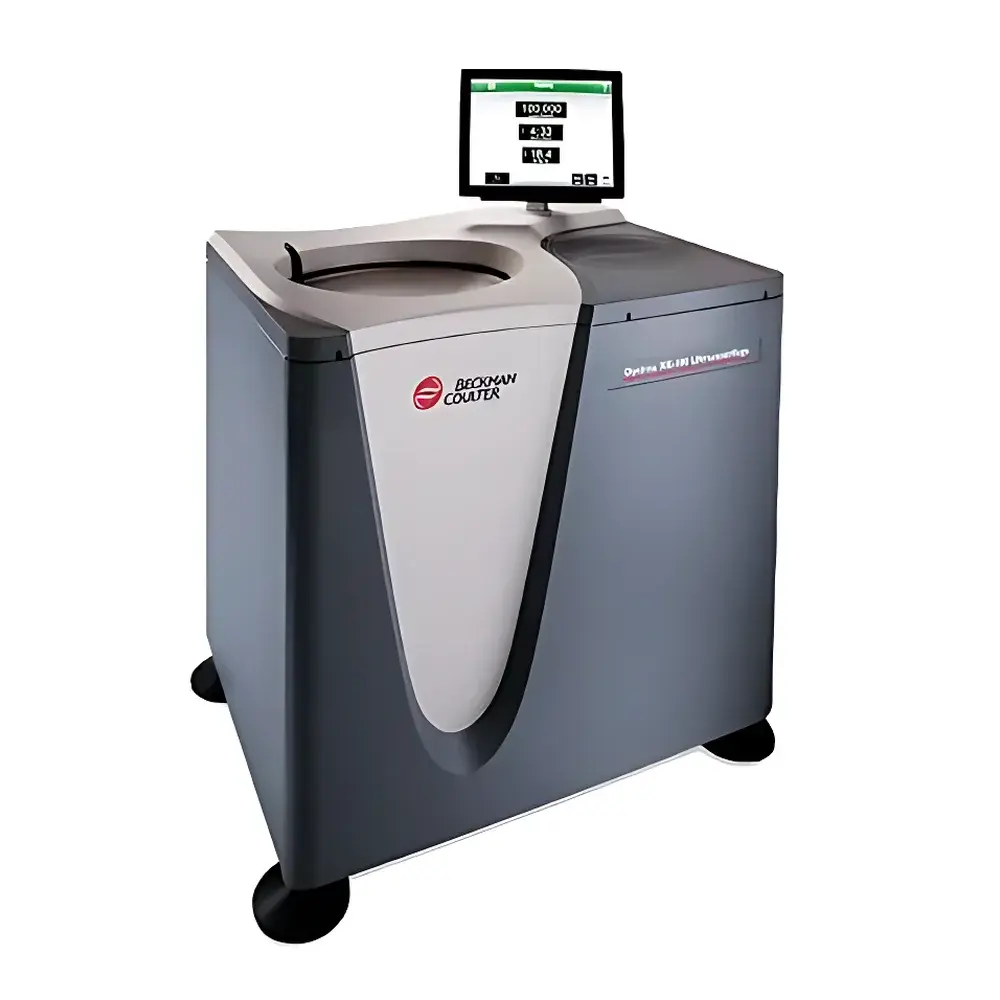
Beckman Coulter Optima XE Series Ultracentrifuge
| Brand | Beckman Coulter |
|---|---|
| Origin | USA |
| Manufacturer | Beckman Coulter, Inc. |
| Type | Floor-standing ultracentrifuge |
| Speed Range | 100,000 / 90,000 rpm |
| Max RCF | 802,400 / 694,000 × g |
| Max Capacity | 1.5 L |
| Temperature Range | 0–40 °C (1 °C increment) |
| Temp Accuracy | ±0.5 °C |
| Acceleration Profiles | 10 selectable |
| Deceleration Profiles | 11 selectable (including coast-down) |
| Speed Control Resolution | ±2.00 rpm (≥1,000 rpm) |
| Runtime | up to 999 h 59 min |
| Noise Level | <51 dBA |
| Dimensions | 94 × 68.1 × 125.7 cm |
| Compliance | FDA 21 CFR Part 11 ready, ISO 13485 certified, GLP/GMP-compatible design |
Overview
The Beckman Coulter Optima XE Series Ultracentrifuge is an engineered platform for high-precision separation of biomolecular species—including proteins, nucleic acids, viruses, subcellular organelles, and synthetic nanoparticles—under controlled thermal and mechanical conditions. Operating on the principle of sedimentation velocity and equilibrium centrifugation, the Optima XE leverages ultra-high rotational speeds (up to 100,000 rpm) and exceptional RCF generation (up to 802,400 × g) to resolve macromolecular complexes with nanometer-scale size differentials. Its vacuum-sealed rotor chamber minimizes air resistance and heat generation, enabling stable operation at cryogenic temperatures while maintaining rotor integrity and sample stability over extended runs. Designed for integration into regulated laboratory environments, the system meets foundational requirements for analytical reproducibility, audit readiness, and operational traceability.
Key Features
- Vacuum-enclosed drive system with low-friction magnetic bearing technology ensures minimal vibration, thermal drift, and acoustic emission (<51 dBA), supporting long-duration runs without compromising resolution.
- Dynamic Rotor Inertia Check (DRIC) performs real-time validation of rotor mass distribution and balance prior to acceleration—preventing catastrophic failure and eliminating manual pre-spin verification steps.
- Intelligent touchscreen interface featuring a full-color LCD with glove-compatible touch response, icon-driven workflow navigation, and multi-language support (English, Spanish, French, German, Japanese, Chinese).
- Regulatory-compliant control architecture includes timestamped audit trails, user-level access permissions, electronic signature capability, and optional 21 CFR Part 11 compliance modules for GxP environments.
- Energy-optimized operation via regenerative braking, low-idle power draw, and adaptive voltage stabilization—maintaining consistent performance across ±10% line voltage fluctuations.
- Robust safety interlocks, including solenoid-actuated steel chamber door with dual redundant position sensors, overspeed cutoff, and automatic rotor recognition via embedded RFID tags.
Sample Compatibility & Compliance
The Optima XE supports a broad range of Beckman Coulter-certified rotors—including Type 70 Ti, Type 90 Ti, and NVT 100—for both fixed-angle and vertical configurations. Compatible with standard ultracentrifuge tubes (e.g., polyallomer, thick-wall polycarbonate, and quartz) ranging from 1.5 mL to 250 mL capacity, the system accommodates total sample volumes up to 1.5 L per run. All rotors undergo individual dynamic balancing and fatigue testing per ISO 21501-4 and ASTM F2119 standards. The instrument’s temperature control system (0–40 °C, ±0.5 °C accuracy) is validated per ICH Q5C and USP guidelines for analytical instrument qualification. CE marking, FDA 510(k) clearance (K172629), and ISO 13485:2016 certification confirm its suitability for clinical research and biopharmaceutical process development.
Software & Data Management
Operated via Beckman Coulter’s Centriware™ software (v5.0+), the Optima XE enables method creation, parameter locking, batch scheduling, and remote monitoring via Ethernet or USB. Data export supports CSV, XML, and PDF formats with embedded metadata (user ID, timestamp, rotor serial number, calibration status). Audit trail logs record all critical events—including speed changes, temperature deviations, door openings, and error codes—with immutable timestamps. For laboratories implementing LIMS or ELN systems, Centriware provides OPC UA-compliant APIs and HL7-compatible data packets. Optional Centriware Secure module adds role-based authentication, encrypted local storage, and automated backup to network drives compliant with HIPAA and GDPR requirements.
Applications
- Isolation and purification of extracellular vesicles (exosomes, microvesicles) for biomarker discovery and therapeutic delivery studies.
- Sedimentation velocity analysis of protein oligomerization states and conformational dynamics under native buffer conditions.
- Preparative isolation of ribosomal subunits, chromatin fragments, and viral capsids for structural biology workflows (cryo-EM, X-ray crystallography).
- Characterization of liposome and polymer nanoparticle formulations using sucrose or iodixanol density gradients.
- Quality control of monoclonal antibody aggregates and fragments in upstream and downstream bioprocessing stages.
- Separation of organelles (mitochondria, lysosomes, peroxisomes) for functional proteomics and metabolomics profiling.
FAQ
What regulatory standards does the Optima XE meet for use in GMP environments?
The system complies with ISO 13485:2016 and is designed to support 21 CFR Part 11 compliance when configured with Centriware Secure and validated user access controls.
Can the Optima XE perform continuous operation for >24 hours?
Yes—runtime is programmable up to 999 hours and 59 minutes, with automatic power-resume functionality following grid interruptions.
Is rotor compatibility limited to Beckman Coulter-branded rotors?
Only Beckman Coulter-certified rotors with integrated RFID tags are recognized and enabled; third-party rotors are not supported for safety and performance assurance.
How is temperature uniformity verified across the rotor chamber?
Each unit undergoes chamber mapping per ASTM E2251-17 using calibrated thermocouples at ≥9 spatial points, with results documented in the Factory Acceptance Test (FAT) report.
Does the system support gradient fraction collection during runs?
No—fraction collection requires post-run manual harvesting or integration with external peristaltic pumps and fraction collectors via analog/digital I/O ports.



