
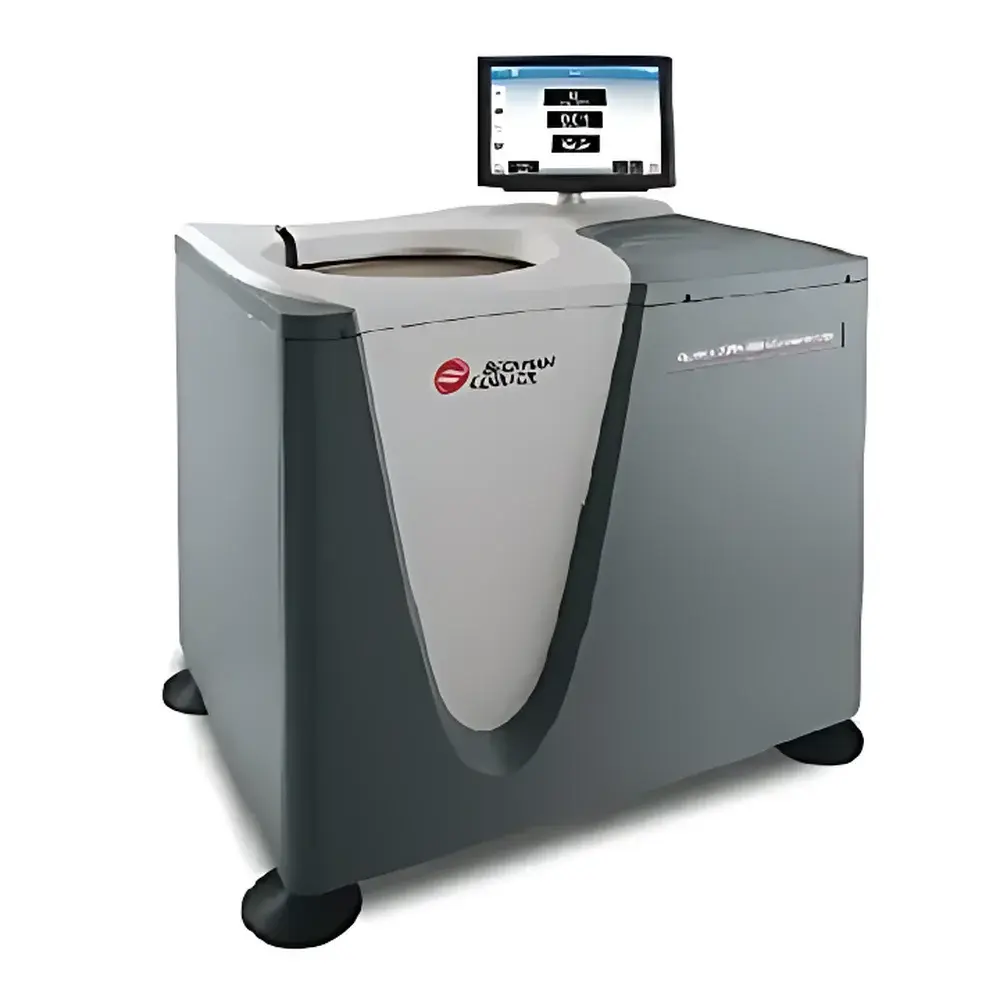
Beckman Coulter Optima XPN Series Benchtop Ultracentrifuge
| Brand | Beckman Coulter |
|---|---|
| Origin | Jiangsu, China |
| Manufacturer Type | Original Equipment Manufacturer (OEM) |
| Regional Classification | Domestic |
| Model | Optima XPN |
| Instrument Type | Floor-standing Ultracentrifuge |
| Speed Class | Ultrahigh-speed Centrifuge (>30,000 rpm) |
| Primary Function | Analytical & Preparative Ultracentrifugation |
| Typical Configuration | Fixed-angle Rotor System |
| Separation Target | Subcellular Organelles, Viruses, Macromolecular Complexes |
| Maximum Capacity | 1.5 L |
| Max Speed Options | 100,000 / 90,000 / 80,000 rpm |
| Max RCF | 802,000 × g / 694,000 × g / 548,300 × g |
| Dimensions (W × D × H) | 94 × 68.1 × 125.7 cm |
Overview
The Beckman Coulter Optima XPN Series is a high-performance floor-standing ultracentrifuge engineered for analytical and preparative applications requiring extreme rotational forces and precise control over sedimentation kinetics. Operating on the fundamental principle of differential centrifugal force—where particles separate based on mass, density, shape, and solute viscosity—the Optima XPN delivers reproducible, high-resolution separations across biological and nanomaterial systems. Designed to meet the rigorous demands of core facilities, biopharmaceutical QC labs, and structural biology research groups, this instrument supports both routine high-yield pelleting and delicate equilibrium sedimentation experiments. Its robust vacuum chamber, active magnetic bearing drive system, and real-time rotor monitoring architecture ensure stable operation at sustained speeds up to 100,000 rpm—enabling isolation of ribosomal subunits, enveloped viruses, exosomes, and synthetic nanoparticles with minimal thermal perturbation or shear-induced aggregation.
Key Features
- Triple-tier speed configuration: Selectable maximum speeds of 100,000 rpm (802,000 × g), 90,000 rpm (694,000 × g), or 80,000 rpm (548,300 × g) to match application-specific resolution and throughput requirements.
- Advanced eXpert Centrifuge Software Suite: Enables protocol-driven operation, automated rotor calibration, real-time torque and temperature profiling, and built-in calculation tools for sedimentation coefficient (S-value), buoyant density, and k-factor derivation.
- Comprehensive safety architecture: Includes Dynamic Rotor Inertia Check (DRIC), rotor overspeed protection, simulated and live diagnostic testing, and electromagnetic interlock on the reinforced steel chamber door—certified to IEC 61010-2-020 and EN 61326-1 standards.
- Regulatory-ready compliance framework: Supports electronic signatures (21 CFR Part 11 compliant when deployed with validated software configurations), password-protected user roles, full audit trail logging, and rotor lifecycle tracking via unique serial number registration.
- Remote diagnostics & connectivity: Integrated VNC server allows secure remote access from laptops or tablets; email-based alerting notifies designated users of system anomalies, maintenance windows, or rotor expiration events.
Sample Compatibility & Compliance
The Optima XPN accommodates a broad spectrum of rotor types—including fixed-angle, vertical, and near-vertical rotors—compatible with standard Beckman Coulter ultracentrifuge tubes (e.g., polyallomer, titanium, and thick-wall polycarbonate). It supports common biological sample formats: cell lysates, clarified supernatants, gradient fractions (sucrose, glycerol, iodixanol), and purified nucleic acid or protein complexes. All rotor-tube combinations are validated per ISO 15195:2018 for metrological traceability in clinical laboratory settings. The system’s mechanical design complies with GLP/GMP environmental monitoring guidelines and is routinely deployed in FDA-inspected biologics manufacturing environments where documentation integrity and process consistency are critical.
Software & Data Management
eXpert software provides a unified interface for method development, execution, and post-run analysis. Each run generates a timestamped, digitally signed data package containing raw sensor logs (temperature, vacuum pressure, RPM, acceleration), calculated parameters (RCF, k-factor, S20,w), and user-defined annotations. Data export conforms to ASTM E2500-21 (Standard Guide for Specification, Design, and Verification of Pharmaceutical and Biopharmaceutical Manufacturing Systems) and supports CSV, XML, and PDF archival. Optional integration with LIMS platforms via OPC UA or RESTful API enables seamless workflow synchronization across enterprise laboratory infrastructures.
Applications
- Isolation and purification of extracellular vesicles (exosomes, microvesicles) from plasma, serum, and conditioned media.
- Sedimentation velocity and equilibrium analysis of protein-protein interactions, oligomeric states, and conformational stability under varying buffer conditions.
- Preparative separation of viral vectors (AAV, lentivirus) for gene therapy process development and QC release testing.
- Density gradient fractionation of lipoprotein subclasses (HDL, LDL, VLDL) in cardiovascular biomarker research.
- Nanoparticle characterization—including size distribution assessment via sucrose gradient sedimentation—supporting formulation development in nanomedicine.
FAQ
What regulatory standards does the Optima XPN comply with?
It meets IEC 61010-2-020 for safety, ISO 15195:2018 for metrological traceability, and supports 21 CFR Part 11 compliance when configured with validated eXpert software and controlled access protocols.
Can the Optima XPN be integrated into an existing LIMS environment?
Yes—via optional OPC UA or RESTful API modules, enabling bidirectional data exchange for sample tracking, instrument scheduling, and electronic batch record generation.
Is rotor lifetime monitoring automated?
Yes—each rotor is registered with a unique serial number; cumulative run time, maximum speed history, and thermal cycles are logged automatically and trigger alerts upon approaching manufacturer-specified service limits.
Does the system support gradient centrifugation protocols?
Yes—pre-programmed gradient methods are available in eXpert software, including step-gradient formation, slow-acceleration ramping, and hold-at-speed stabilization to preserve gradient integrity during ultracentrifugation.
What maintenance intervals are recommended for routine operation?
Vacuum pump oil replacement every 6 months, refrigeration system validation annually, and full rotor certification every 2 years—or after any incident involving imbalance, overheating, or unexpected shutdown—as mandated by Beckman Coulter’s Service Bulletin SB-XPN-2023-01.



