
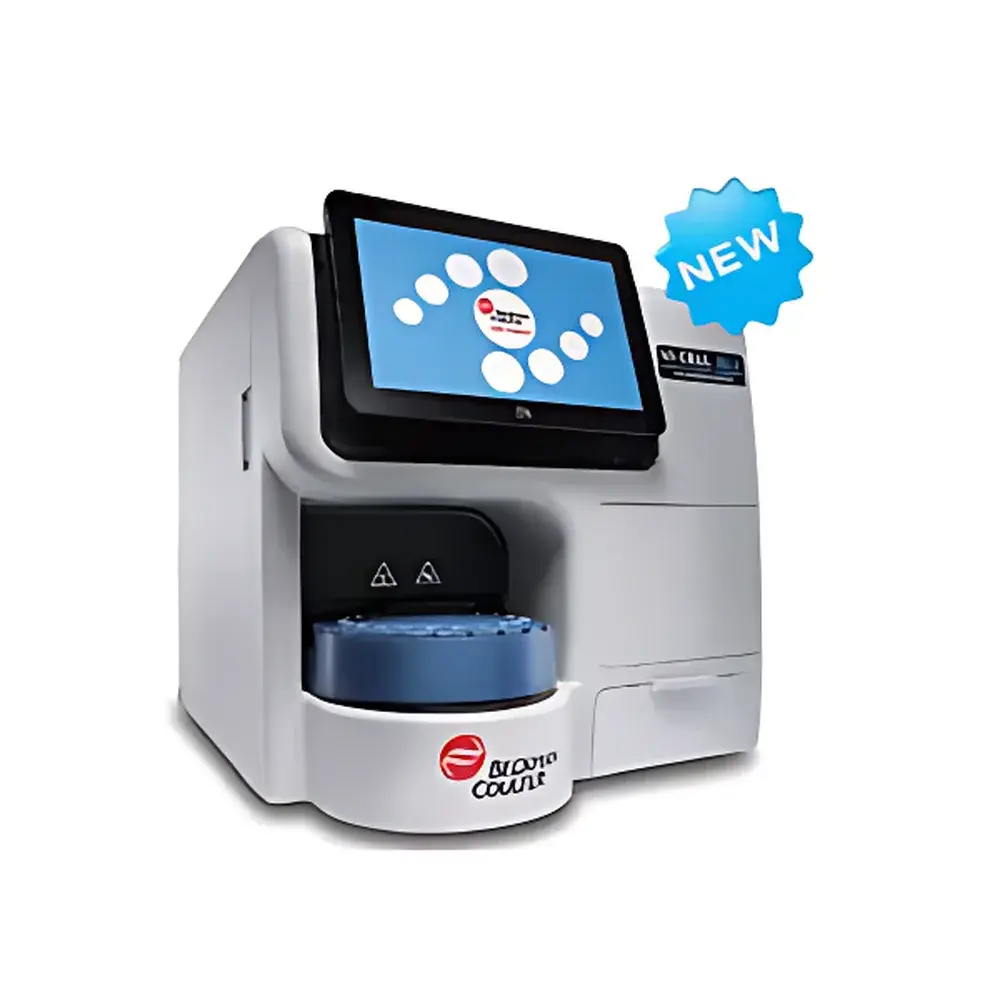
Beckman Coulter Vi-CELL BLU Automated Cell Counter and Viability Analyzer
| Brand | Beckman Coulter |
|---|---|
| Origin | USA |
| Manufacturer Type | Original Equipment Manufacturer (OEM) |
| Import Status | Imported |
| Model | Vi-CELL BLU |
| Assay Time | Fast Mode 80 s/sample, Standard Mode 110 s/sample |
| Cell Concentration Range | 2 × 10⁴ to 1.5 × 10⁷ cells/mL |
| Sample Volume | Fast Mode 170 µL, Standard Mode 200 µL |
| Throughput | 96 samples per run |
| Detectable Cell Size | 2–60 µm |
Overview
The Beckman Coulter Vi-CELL BLU is an automated, image-based cell counter and viability analyzer engineered for precision, reproducibility, and regulatory compliance in bioprocessing, cell therapy, and upstream/downstream development laboratories. It employs trypan blue dye exclusion coupled with high-resolution digital microscopy and proprietary image analysis algorithms to quantify total cell concentration, viable cell concentration, viability percentage, and average cell diameter—all in a single, unattended assay. Unlike flow cytometry or impedance-based counters, the Vi-CELL BLU captures full-field brightfield images of stained cells within a fixed-volume flow chamber, enabling morphological assessment, debris discrimination, and consistent gating based on pixel intensity and size thresholds. Its design adheres to core principles of Good Manufacturing Practice (GMP) and Good Laboratory Practice (GLP), supporting critical applications where data integrity, instrument-to-instrument comparability, and audit readiness are non-negotiable.
Key Features
- Two-Mode Assay Flexibility: Select between Fast Mode (80 s/sample, 170 µL volume, no post-run wash) for rapid screening or Standard Mode (110 s/sample, 200 µL volume, integrated cleaning cycle) for maximum inter-assay consistency and carryover prevention.
- Dual-Sample Introduction Options: Supports both 24-position sample racks and ANSI/SLAS-compliant 96-well deep-well plates—switching requires only mechanical reconfiguration of the stage adapter, no software revalidation.
- Integrated Reagent Cartridge System: Pre-packaged, RFID-tagged consumable kits contain trypan blue dye, diluent, and cleaning solution. Each cartridge supports up to 310 assays and auto-tracks lot number, expiration date, and remaining test count via embedded memory.
- Single-Use Calibration Standards: Includes NIST-traceable, lyophilized QC beads (10 µm diameter) and three certified cell concentration standards (2 × 10⁶, 4 × 10⁶, and 1 × 10⁷ cells/mL) with 50% viability control—requiring no manual pipetting, mixing, or user intervention during calibration.
- Compact Footprint & Benchtop Integration: Occupies < 0.15 m² of lab space; features an integrated 10.1-inch capacitive touchscreen interface eliminating external PC dependency and optimizing workflow ergonomics.
- Cross-Instrument Reproducibility: Factory-calibrated against a global reference standard; inter-instrument variability remains ≤ ±10% across concentration and viability measurements, ensuring data portability across multi-site facilities.
Sample Compatibility & Compliance
The Vi-CELL BLU accommodates mammalian suspension cultures (e.g., CHO, HEK293, hybridomas), primary human cells (PBMCs, T-cells), and stem cell lines within the 2–60 µm size range. It excludes aggregated cells and submicron debris using adaptive thresholding and shape-based segmentation. All assays comply with ISO 21501-4 (particle sizing by optical microscopy) and support alignment with USP , ASTM E2877-13, and ICH Q5D guidelines for cell counting methodology validation. The system meets FDA 21 CFR Part 11 requirements out-of-the-box, including role-based access control, electronic signatures, immutable audit trails, and encrypted .smp result file storage with SHA-256 checksum verification.
Software & Data Management
Vi-CELL BLU runs on Beckman Coulter’s embedded BLU OS v3.x—designed specifically for regulated environments. The touchscreen interface enables full system configuration, method creation, user management, and report generation without external computing hardware. Audit trails record all user actions—including login/logout, parameter changes, calibration events, and result exports—with timestamped, tamper-evident logs stored locally and mirrored to network drives. Data export options include CSV, PDF, and XML formats compatible with LIMS and ELN systems. Automatic backup mirroring, scheduled archival, and on-screen retrieval from historical datasets ensure continuous data availability while maintaining ALCOA+ (Attributable, Legible, Contemporaneous, Original, Accurate, Complete, Consistent, Enduring, Available) principles.
Applications
- Bioreactor inoculation and harvest timing decisions based on real-time viability trends
- Process characterization studies requiring high-throughput, low-variance cell enumeration
- Cell banking and release testing under GMP conditions
- ATMP (Advanced Therapy Medicinal Product) manufacturing workflows compliant with EMA CHMP and FDA CBER guidance
- QC/QA of cryopreserved cell products pre- and post-thaw
- Supporting DOE (Design of Experiments) in media optimization and feeding strategy development
FAQ
What regulatory standards does the Vi-CELL BLU support?
The system is validated for 21 CFR Part 11 compliance and supports alignment with ISO 21501-4, USP , ASTM E2877-13, and ICH Q5D.
Can the Vi-CELL BLU be integrated into a laboratory information management system (LIMS)?
Yes—via configurable CSV, PDF, and XML export protocols; direct API integration is available through Beckman Coulter’s Enterprise Connect platform.
Is method transfer between Vi-CELL BLU instruments straightforward?
Yes—inter-instrument reproducibility ≤ ±10% eliminates the need for site-specific revalidation when deploying identical configurations.
How is data integrity maintained during power loss or unexpected shutdown?
All active assays write to non-volatile memory; interrupted runs resume from last valid frame capture upon restart, and audit logs retain full context of the event.
Does the system require annual recalibration by service engineers?
No—routine user-performed calibration using included QC standards satisfies ongoing performance verification; factory recalibration is recommended every 24 months or per internal SOP.
Related Products



