
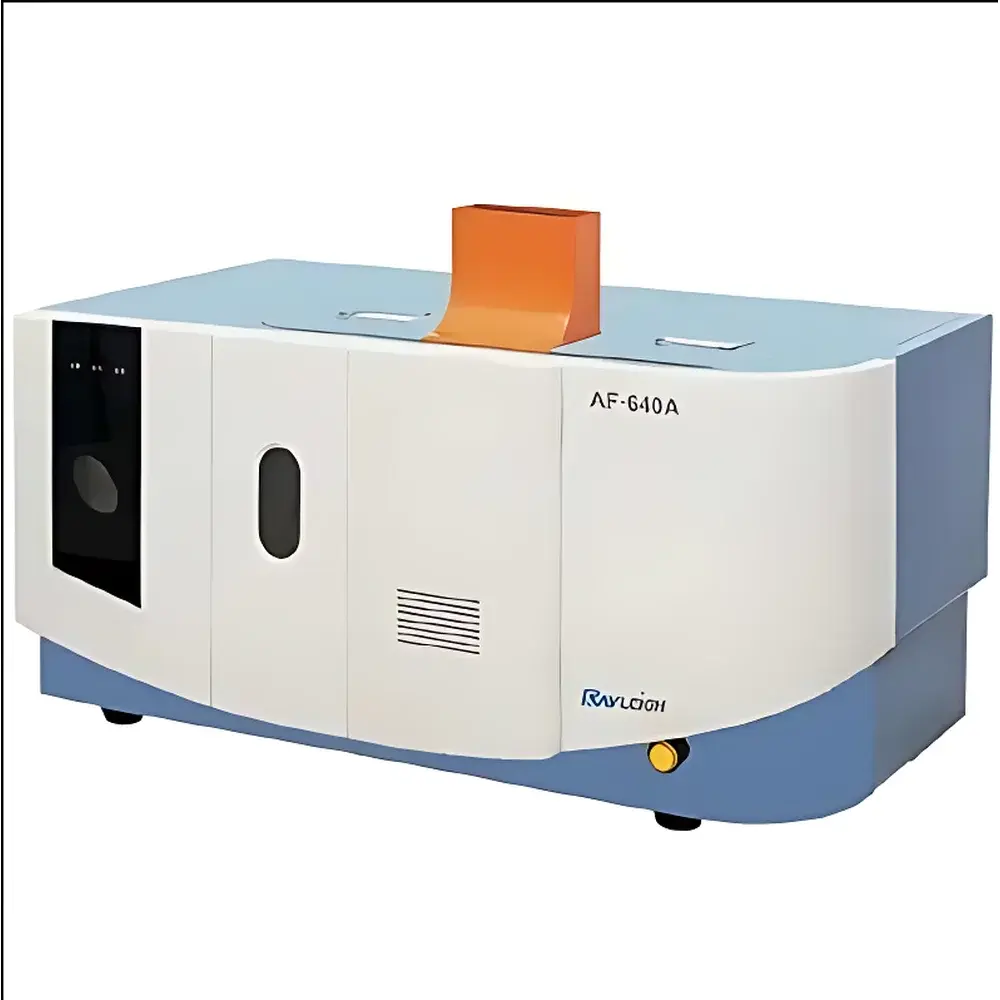
Beifen Ruili AF-640A Dual-Channel Atomic Fluorescence Spectrometer
| Brand | Beifen Ruili |
|---|---|
| Origin | Beijing, China |
| Model | AF-640A |
| Instrument Type | Multi-channel Atomic Fluorescence Spectrometer |
| Sample Introduction | Peristaltic Pump |
| Detectable Elements | As, Sb, Bi, Se, Te, Pb, Sn, Hg, Cd, Ge, Zn, Au (12 elements) |
| Relative Standard Deviation (RSD) | <1% |
| Linear Dynamic Range | >3 orders of magnitude |
| Detection Limits | As, Sb, Bi, Se, Te, Pb, Sn: <0.01 µg/L |
| Hg, Cd | <0.001 µg/L |
| Ge | <0.05 µg/L |
| Zn | <1.0 µg/L |
| Au | <3.0 µg/L |
Overview
The Beifen Ruili AF-640A Dual-Channel Atomic Fluorescence Spectrometer is a hydride generation–atomic fluorescence (HG-AFS) instrument engineered for trace and ultra-trace elemental analysis in environmental, food safety, geological, and pharmaceutical laboratories. It operates on the principle of atomic fluorescence spectroscopy: analyte elements are chemically reduced to volatile hydride species (e.g., AsH₃, SbH₃, H₂Se) or cold vapor (e.g., Hg⁰) in acidic medium, swept into a quartz atomizer by argon carrier gas, and atomized in an Ar–H₂ flame. Excitation is achieved via high-intensity, element-specific hollow cathode lamps (HCLs), and fluorescence emission at characteristic wavelengths is detected by a low-noise photomultiplier tube (PMT). The dual-channel architecture enables simultaneous, independent quantification of two elements—significantly improving throughput while maintaining full compliance with ISO/IEC 17025 method validation requirements.
Key Features
- Dual-channel parallel detection with fully independent optical paths and signal processing channels—enabling true simultaneous analysis of paired elements such as As/Hg or Sb/Bi without cross-talk or time-lag.
- Patented “High-Efficiency Mercury Trapping” system: active large-flow mercury capture module integrated into exhaust ducting, reducing ambient Hg vapor concentration to below occupational exposure limits (OELs) per OSHA and EU Directive 2017/67/EU.
- Optimized optical design: short-focal-length lens-based non-dispersive closed-beam optics, minimizing stray light and maximizing photon collection efficiency.
- Intelligent dual-cathode HCL power management: microprocessor-controlled primary/auxiliary current matching ensures lamp stability, extends service life (>5,000 h), and reduces baseline drift to <0.5% over 4-hour operation.
- Enhanced hydride generation: pressure-balanced continuous-flow/injection hybrid sample introduction eliminates bubble-induced signal noise; integrated gas–liquid separator achieves >99.8% phase separation efficiency with auto-drain waste handling.
- Low-temperature quartz cell atomization: precise temperature regulation (±0.3 °C) and auto-ignition Ar–H₂ flame ensure optimal atomization efficiency and minimal spectral interferences from matrix-derived molecular species.
- Modular valve-island gas control: dual-path argon flow routing with real-time pressure monitoring, automatic shutoff upon leak detection, and audible/visual alarm per IEC 61508 SIL-2 functional safety guidelines.
Sample Compatibility & Compliance
The AF-640A supports aqueous matrices including drinking water, wastewater, soil extracts (EPA Method 6010D), biological digests (USP /), and food leachates (ISO 11885). Its validated detection limits meet or exceed regulatory thresholds defined in EPA Method 1631E (Hg), ISO 17892-10 (As), and GB/T 5750.6–2023 (Chinese standard for drinking water). Instrument design conforms to electromagnetic compatibility (EMC) standards IEC 61326-1 and electrical safety IEC 61010-1. Data integrity features—including electronic audit trail, user access levels, and immutable raw data storage—support compliance with FDA 21 CFR Part 11 and GLP/GMP documentation requirements when used with optional PDI-10 software upgrade.
Software & Data Management
The Windows-based workstation software provides real-time fluorescence intensity plotting, automated peak identification, and dynamic scaling of y-axis ranges. Calibration curves support linear, quadratic, and cubic regression with residual error reporting. Multi-sample overlay functionality enables direct visual comparison of replicate injections or inter-sample kinetics. All analytical parameters—including lamp current, PMT voltage, delay time, and integration period—are programmable per element. Raw signal files (.raw) and processed reports (.pdf/.xls) are timestamped, digitally signed, and archived with full metadata (operator ID, method version, instrument serial number). Optional PDI-10 add-on enables speciation analysis workflows compliant with ASTM D6724–22 (Hg species) and ISO/IEC 17025 clause 7.7.2.
Applications
- Environmental monitoring: quantification of As, Sb, and Hg in surface water, groundwater, and sediment pore water per EU Water Framework Directive Annex IX.
- Food safety testing: screening of Cd and Pb in rice, infant formula, and seafood per Codex Alimentarius STAN 193–1995.
- Clinical toxicology: measurement of urinary Hg and blood Se in occupational exposure assessment (NIOSH Method 6009).
- Geochemical exploration: rapid field-deployable analysis of Au and Te in acid-digested rock samples.
- Pharmaceutical QC: verification of catalyst residues (Pd, Pt) and elemental impurities (Cd, Pb, As) in APIs per ICH Q3D.
FAQ
What regulatory standards does the AF-640A support for routine compliance testing?
It meets performance criteria specified in EPA Methods 1631E, 200.9, and 6020B; ISO 11885 and ISO 17892-10; and Chinese national standards GB/T 5750.6–2023 and HJ 694–2014.
Can the instrument be upgraded for elemental speciation analysis?
Yes—via optional PDI-10 hardware/software module, enabling HPLC–AFS coupling for As(III)/As(V), methylmercury/ethylmercury, and Se(IV)/Se(VI) separation and detection.
Is the AF-640A compatible with autosamplers from third-party vendors?
It interfaces exclusively with Beifen Ruili’s circular multi-ring autosampler (model AS-640), which supports up to 144 positions and features barcode recognition, tray auto-detection, and seamless RS232/USB protocol handshaking.
How is mercury contamination mitigated during long-term operation?
The integrated active mercury trap uses iodine-impregnated activated carbon with >99.95% capture efficiency at 1 L/min flow; trap saturation status is monitored via real-time pressure differential sensors and logged automatically.
What validation documentation is provided with the system?
Factory-installed IQ/OQ protocols, certified reference material (CRM) test reports (NIST SRM 1640a, 1643e), and a full traceable calibration certificate covering wavelength accuracy, sensitivity, and RSD performance are included.
Related Products





