
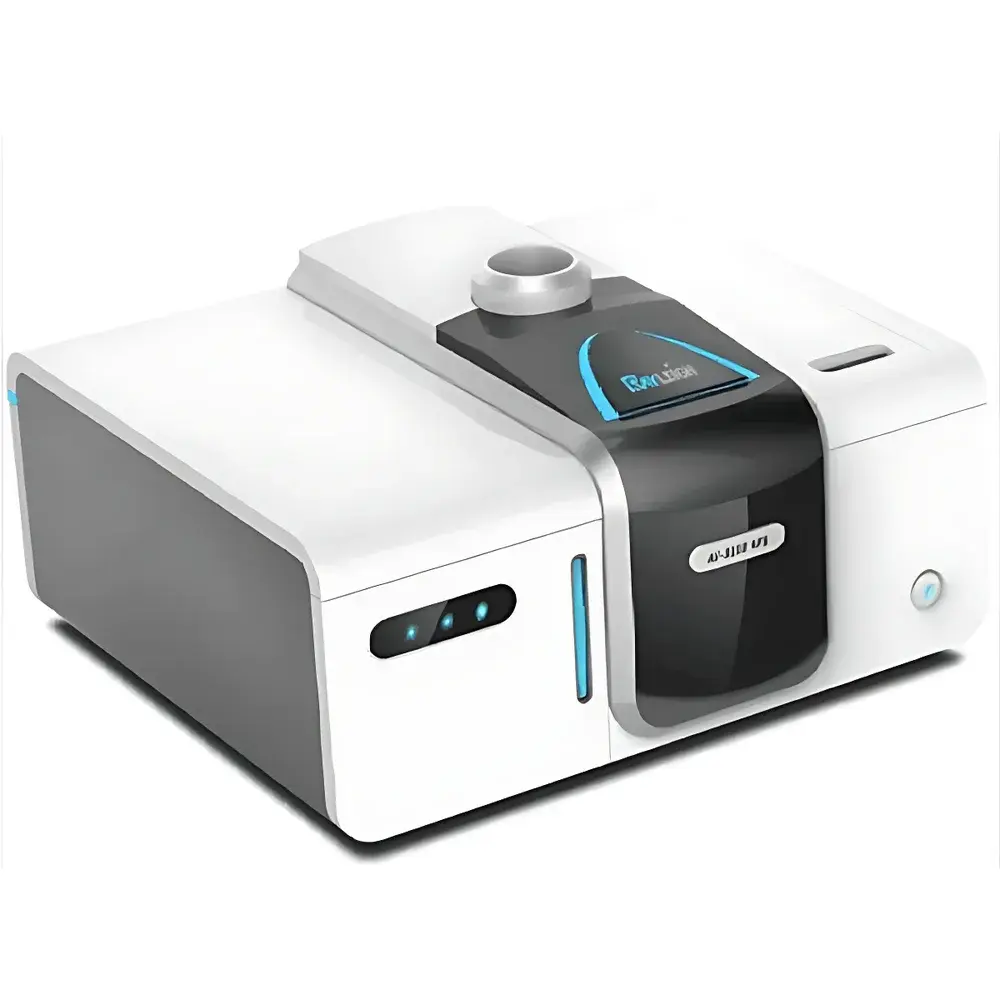
Beifen Ruili AF3000 Series Multi-Channel Atomic Fluorescence Spectrometer
| Brand | Beifen Ruili |
|---|---|
| Origin | Beijing, China |
| Model | AF3000 |
| Instrument Type | Multi-channel Atomic Fluorescence Spectrometer |
| Sample Introduction | Peristaltic Pump |
| Detectable Elements | As, Sb, Bi, Se, Te, Pb, Sn, Hg, Cd, Ge, Zn, Au, Ag, Co, Cu, Ni (16 elements) |
| Relative Standard Deviation (RSD) | < 0.7% |
| Linear Dynamic Range | > 3 orders of magnitude |
| Detection Limits | As, Sb, Bi, Se, Te, Pb, Sn < 0.01 µg/L |
Overview
The Beifen Ruili AF3000 Series Multi-Channel Atomic Fluorescence Spectrometer is a high-performance analytical instrument engineered for trace-level quantification of hydride-forming and cold-vapor elements in liquid matrices. It operates on the principle of atomic fluorescence spectroscopy (AFS), where analyte atoms—generated in situ via hydride generation (HG) or cold vapor (CV) techniques—are atomized in a quartz cell and excited by a high-intensity, element-specific hollow cathode lamp (HCL). The resulting atomic fluorescence emission is collected at right angles to the excitation beam, minimizing background scatter and enabling exceptional signal-to-noise ratios. Designed for routine compliance-driven laboratories, the AF3000 delivers sub-part-per-trillion detection sensitivity, robust inter-day reproducibility, and long-term operational stability—making it suitable for regulatory testing under ISO/IEC 17025-accredited environments and aligned with method requirements in USP <233>, EPA Method 1631E, and GB 5009.11–2014.
Key Features
- Multi-channel optical architecture supporting simultaneous measurement of up to three elements (triple-channel mode), with configurable single-, dual-, or triple-channel acquisition and enhanced-sensitivity modes (up to 3× signal amplification)
- Low-temperature quartz furnace atomization coupled with pulsed thermal surface ignition using Si3N4 ceramic igniters—ensuring lifetime maintenance-free operation and stable atom cloud formation
- Jet-type three-stage gas–liquid separator with self-forming water seal, automatic waste discharge, and bubble suppression—eliminating carryover and improving reaction homogeneity
- Adaptive exhaust filtration system integrating gold-coated wire mercury traps (“High-Efficiency Mercury Trapping Technology”) for >99.9% Hg adsorption, meeting OSHA PEL and laboratory indoor air quality guidelines
- RFID-enabled hollow cathode lamp management: automatic lamp identification, usage logging, lifetime tracking, and replacement alerts; fully compatible with non-encoded lamps
- Modular gas control architecture featuring imported solenoid valve islands, dual mass flow controllers (MFCs), and electronic pressure regulators for precise carrier gas (Ar) and shielding gas delivery
- PEEK-based sequential injection system (AF-3320 variant) with 12,000-step micro-positioning accuracy, >1000× on-line dilution capability, and sub-microliter dead volume mixing manifolds
- Gradient-heated reaction manifold: programmable temperature zoning along the vapor generation path to suppress water vapor interference, enhance hydride yield consistency, and improve RSD across matrix-rich samples
Sample Compatibility & Compliance
The AF3000 accommodates aqueous digests and extracts from diverse sample types—including foodstuffs (e.g., rice, seafood), pharmaceutical excipients, soil leachates, wastewater, geological digests (HF/HNO3), and metallurgical process streams. Its hydride generation module supports both continuous-flow and batch-mode reactions for As, Sb, Bi, Se, Te, Pb, Sn, and Cd; cold-vapor atomic fluorescence (CV-AFS) mode enables ultra-trace Hg and Au analysis. All hardware and software components comply with GLP documentation standards. Audit trail functionality meets FDA 21 CFR Part 11 requirements for electronic records and signatures. Data integrity safeguards include user role-based access control, immutable method versioning, and timestamped calibration logs.
Software & Data Management
The integrated AFS Control Suite provides real-time four-quadrant beam alignment diagnostics, automated lamp intensity drift compensation, and dynamic baseline correction. It supports single-standard curve generation with auto-dilution series, customizable calculation formulas (e.g., spike recovery, concentration normalization), and optional energy-saving “gas-saver” mode that reduces argon consumption by up to 40% during idle periods. Communication interfaces include RS-232, USB 2.0, Wi-Fi LAN (IEEE 802.11n), and direct Wi-Fi pairing for remote monitoring. Raw spectral data, chromatogram-like peak tables, and QC reports are exportable in CSV, PDF, and XML formats compatible with LIMS integration.
Applications
The AF3000 serves as a primary tool in environmental monitoring labs for arsenic speciation screening in groundwater; in food safety programs for cadmium and lead verification per EU Commission Regulation (EC) No 1881/2006; in pharmacopeial QA/QC for elemental impurities testing (ICH Q3D); and in mining geochemistry for rapid multi-element survey analysis of exploration core digests. Its low detection limits and high RSD performance make it especially valuable for certified reference material (CRM) validation and inter-laboratory proficiency testing.
FAQ
What elements can the AF3000 quantify with validated methodology?
As, Sb, Bi, Se, Te, Pb, Sn, Hg, Cd, Ge, Zn, Au, Ag, Co, Cu, and Ni—16 elements total—with documented detection limits and linear ranges compliant with national standard methods.
Is the system compatible with existing laboratory informatics infrastructure?
Yes. The AF3000 supports ASTM E1384-compliant data exchange protocols and offers configurable API endpoints for seamless LIMS or ELN integration.
How does the gradient heating system improve analytical precision?
By maintaining precise, zone-specific temperatures along the reaction coil, it minimizes condensation-induced signal fluctuation and ensures consistent hydride transport efficiency—directly contributing to RSD < 0.7% across replicate analyses.
Does the instrument support method validation per ISO 17025 requirements?
Yes. Full traceability of calibration history, reagent lot tracking, environmental condition logging (temperature/humidity), and electronic signature workflows satisfy Clause 7.7 (Uncertainty of Measurement) and Clause 7.8 (Reporting Results) of ISO/IEC 17025:2017.





