
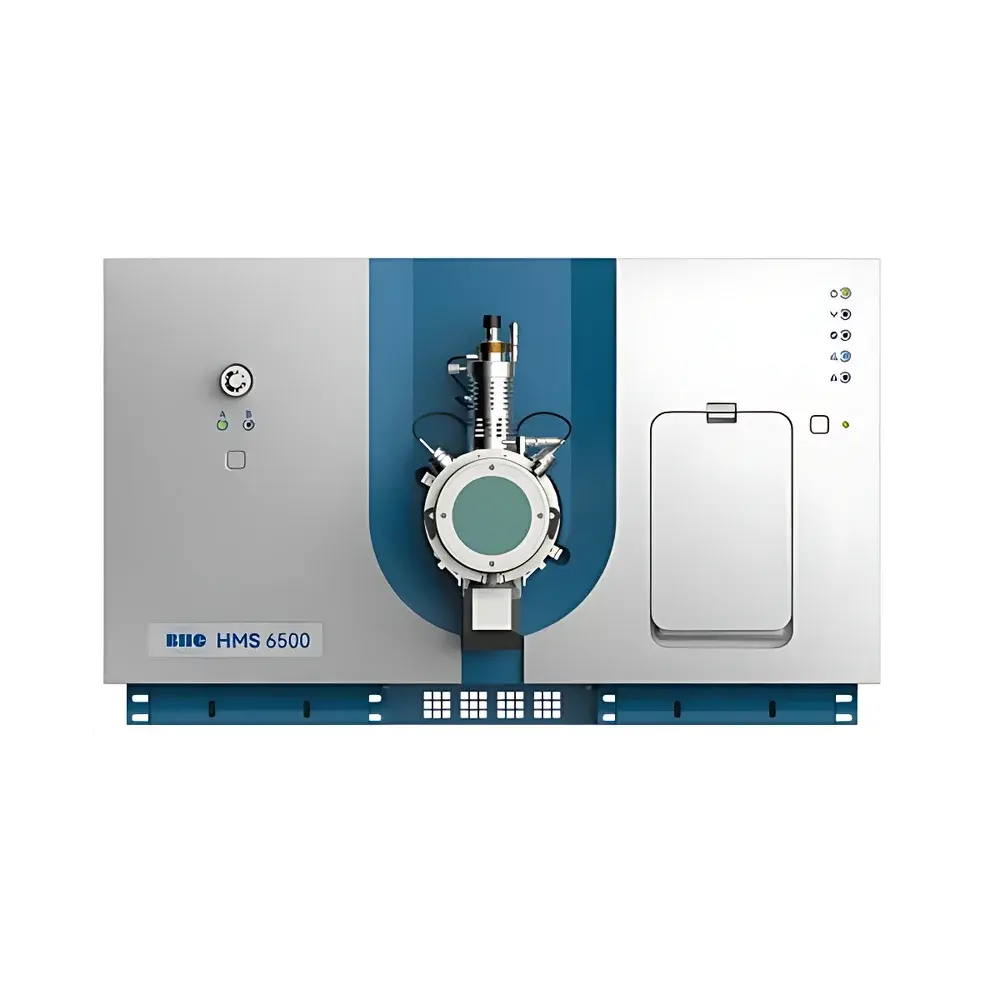
Beifen Ruili HMS6500 Liquid Chromatography-Triple Quadrupole Tandem Mass Spectrometer
| Brand | Beifen Ruili |
|---|---|
| Origin | Beijing, China |
| Manufacturer Type | Authorized Distributor |
| Instrument Type | Triple Quadrupole (QqQ) |
| Application Field | General-Purpose |
| Mass Range | 10–2250 Da |
| Ionization Sources | Dual ESI/APCI |
| Collision Cell | Curved RF-only Quadrupole Design |
| Gas System | Counter-Flow Curtain Gas Configuration |
| Software | Integrated Intelligent Tuning, Calibration, Method Optimization & Reporting Engine |
Overview
The Beifen Ruili HMS6500 is a high-performance liquid chromatography–triple quadrupole tandem mass spectrometer (LC-MS/MS) engineered for robust, quantitative analysis of trace-level analytes in complex matrices. Operating on the principle of electrospray ionization (ESI) and atmospheric pressure chemical ionization (APCI), followed by mass-selective filtering in Q1, collision-induced dissociation (CID) in a curved RF-only quadrupole collision cell (Q2), and product-ion detection in Q3, the HMS6500 delivers exceptional specificity and sensitivity across a broad mass range of 10–2250 Da. Its architecture adheres to fundamental requirements of regulated quantitative bioanalysis—namely, high duty cycle, low chemical noise, reproducible ion transmission, and stable signal response over extended acquisition periods. Designed for laboratories engaged in environmental monitoring, food safety testing, clinical toxicology, and pharmaceutical metabolism studies, the system supports both targeted quantitation (e.g., MRM, SRM) and qualitative screening workflows without hardware reconfiguration.
Key Features
- Dual ionization capability: Integrated electrospray ionization (ESI) and atmospheric pressure chemical ionization (APCI) sources enable optimal ionization efficiency across polar, thermally labile, and semi-volatile compounds—eliminating the need for source swapping during method development.
- Extended mass range (10–2250 Da): Facilitates confident detection and quantification of high-molecular-weight pharmaceuticals including cyclosporin A (m/z 1202.8), everolimus (m/z 975.6), sirolimus (m/z 931.7), and tacrolimus (m/z 821.5), supporting immunosuppressant therapeutic drug monitoring (TDM) and biotransformation studies.
- Curved collision cell geometry: Reduces neutral species and non-charged matrix components from entering Q3, significantly lowering background noise and improving signal-to-noise (S/N) ratios—critical for low-abundance analyte detection in biological fluids or environmental extracts.
- Counter-flow curtain gas design: Enhances desolvation efficiency while minimizing source contamination, contributing to improved long-term stability (>48 h continuous operation) and extended maintenance intervals between cleaning cycles.
- Intelligent tuning and calibration suite: Automates mass axis calibration, resolution optimization, and detector gain adjustment using internal reference compounds; supports user-defined tuning protocols aligned with ISO/IEC 17025 method validation requirements.
- Integrated data processing engine: Provides automated peak integration, matrix-matched calibration curve fitting (linear/log-linear), IS-normalized quantitation, and audit-trail-enabled reporting compliant with GLP and FDA 21 CFR Part 11 principles.
Sample Compatibility & Compliance
The HMS6500 accommodates a wide range of sample types—including plasma, urine, tissue homogenates, soil extracts, food homogenates, and water concentrates—when coupled with standard reversed-phase, HILIC, or mixed-mode LC columns. It meets essential performance criteria outlined in ASTM D7622 (for pesticide residue analysis), ISO 17025:2017 (for accredited testing laboratories), and USP (validation of analytical procedures). The system’s software architecture supports full electronic signature functionality, secure user role management, and immutable audit trails—enabling compliance with GxP environments where regulatory submissions (e.g., FDA IND/NDA, EFSA dossiers) require documented data integrity.
Software & Data Management
The HMS6500 operates under a Windows-based acquisition and analysis platform featuring modular workflow templates for method setup, sequence definition, real-time monitoring, and post-run review. All raw data files are stored in vendor-neutral .d format compatible with third-party spectral libraries (NIST, MassBank) and open-source tools (e.g., Skyline, OpenMS). Data security features include AES-256 encryption at rest, automatic backup scheduling, and configurable retention policies. The software includes built-in tools for system suitability assessment (SSA), carryover evaluation, and linearity/range verification—streamlining routine QC documentation per ISO/IEC 17025 Clause 7.7.
Applications
- Environmental analysis: Quantification of emerging contaminants (e.g., PFAS, microplastic additives, pharmaceutical residues) in wastewater, surface water, and sediment at sub-ppt levels.
- Food safety: Multi-residue screening and confirmation of veterinary drugs, mycotoxins, and unauthorized food colorants in meat, dairy, and produce matrices.
- Life sciences: Pharmacokinetic profiling, metabolite identification (via precursor ion scanning), and endogenous biomarker quantification (e.g., steroids, bile acids, acylcarnitines) in clinical and preclinical studies.
- Forensic toxicology: High-confidence identification and quantification of opioids, stimulants, and novel psychoactive substances (NPS) in blood and hair samples.
FAQ
Is the HMS6500 compliant with FDA 21 CFR Part 11 requirements?
Yes—the software implements electronic signatures, audit trail logging, and role-based access control as defined in 21 CFR Part 11 Subpart B.
Can the system perform both quantitative and qualitative analyses without hardware modification?
Yes—MRM, SIM, product ion scan, and precursor ion scan modes are all accessible via software configuration without physical component changes.
What level of service and technical support is provided internationally?
Beifen Ruili partners with certified regional service providers offering on-site installation, preventive maintenance contracts, and remote diagnostics support in North America, Europe, and APAC regions.
Does the instrument support isotopically labeled internal standards?
Yes—the data processing module automatically aligns and integrates co-eluting native and labeled analyte peaks, applying user-specified correction factors for accurate ratio-based quantitation.
How is mass accuracy maintained over time?
The system performs daily automated mass calibration using a dual-point calibrant solution; optional lock-mass correction is available for ultra-high-stability applications requiring sub-10 ppm deviation over 24-hour runs.




