
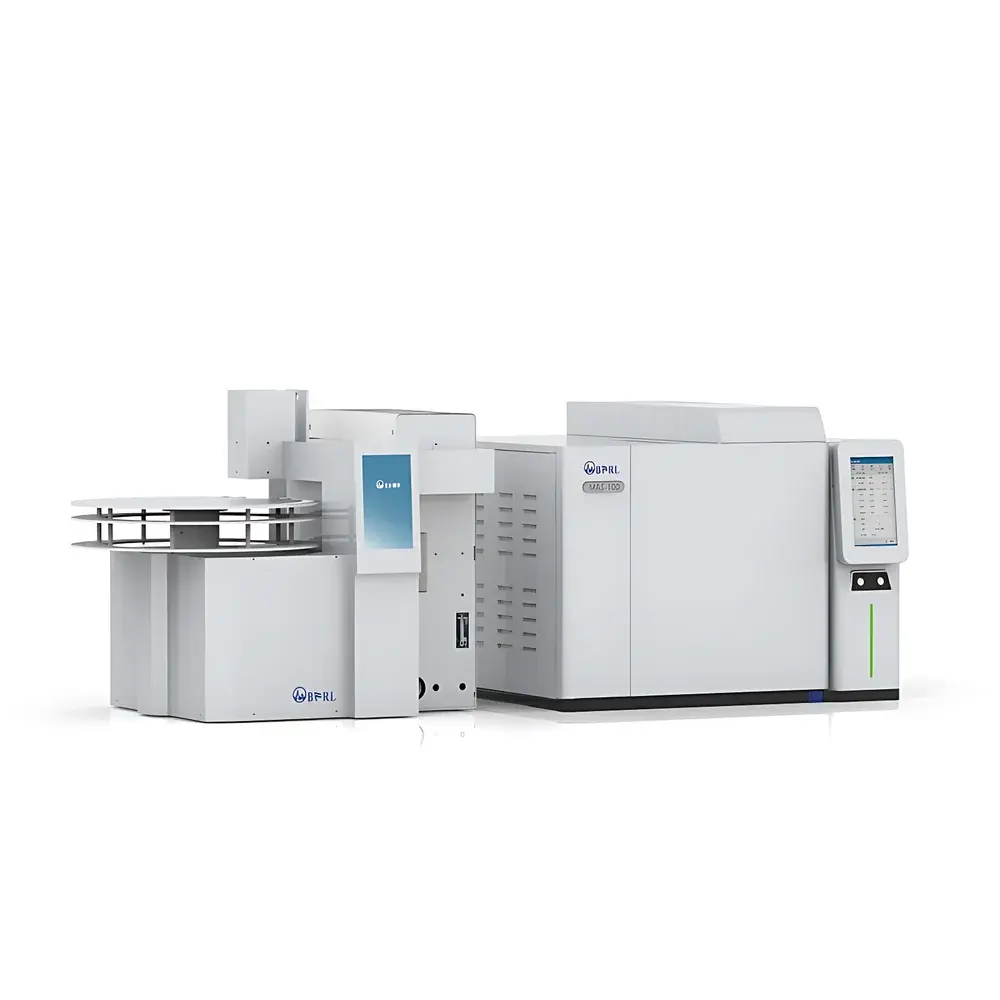
Beifen Ruili MAS-100 Alkylmercury Analyzer
| Brand | Beifen Ruili |
|---|---|
| Origin | Beijing, China |
| Manufacturer Type | Authorized Distributor |
| Regional Category | Domestic (PRC) |
| Model | MAS-100 |
| Pricing | Upon Request |
Overview
The Beifen Ruili MAS-100 Alkylmercury Analyzer is a purpose-built gas chromatography–cold vapor atomic fluorescence detection (GC-AFD) system engineered for the selective, sensitive, and compliant quantification of alkylmercury species—primarily methylmercury (MeHg) and ethylmercury (EtHg)—in aqueous environmental matrices. It implements the analytical principle defined in China’s national standard HJ 977–2018, “Determination of Alkylmercury in Water—Purge-and-Trap Gas Chromatography Coupled with Cold Vapor Atomic Fluorescence Spectrometry.” The method relies on quantitative derivatization of ionic alkylmercury species using sodium tetrapropylborate (NaBPr₄), generating volatile propylated analogs (e.g., methylpropylmercury, ethylpropylmercury). These derivatives are purged from solution under argon flow, preconcentrated on a Tenax® sorbent trap, thermally desorbed, separated on a fused-silica capillary column, and detected via cold vapor atomic fluorescence following high-temperature pyrolysis (950 °C) in an integrated quartz cell. This hyphenated approach delivers trace-level sensitivity (sub-pg/L detection capability), high specificity for organomercury compounds, and robustness across routine batch analysis workflows in environmental monitoring laboratories.
Key Features
- Patented miniaturized Atomic Fluorescence Detector (AFD): Integrated directly onto standard laboratory GC platforms; occupies <3.3% of the footprint of conventional benchtop atomic fluorescence spectrometers.
- High-efficiency pyrolysis module: Features nanoscale thermal insulation layers to maintain stable 950 °C internal temperature while limiting external heat transfer—preserving capillary column integrity and baseline stability.
- Optimized optical detection cell: Incorporates multi-stage stray-light trapping geometry to suppress background fluorescence, enhancing signal-to-noise ratio and enabling low-concentration alkylmercury quantification.
- Active mercury vapor capture system: Post-detection effluent is continuously drawn through a gold-coated wire trap (Au filament adsorption tube), ensuring >99.9% retention of elemental mercury vapor—meeting occupational health and environmental safety requirements.
- Modular detector compatibility: Designed for co-installation with conventional GC detectors (FID, ECD, TCD, FPD) on the same instrument platform, supporting method flexibility without hardware replacement.
- Capillary column–optimized separation: Achieves baseline resolution of MeHg and EtHg in ≤4 minutes using high-resolution fused-silica columns, improving throughput and reducing carrier gas consumption.
Sample Compatibility & Compliance
The MAS-100 is validated for use with surface water, groundwater, wastewater, and porewater samples per HJ 977–2018. Sample introduction employs automated purge-and-trap (P&T) configuration with Tenax®-based trapping, ensuring quantitative recovery across variable matrix compositions. System performance meets or exceeds EPA Method 1630 (for methylmercury) in terms of method detection limit (MDL), precision (RSD <8% at 5× MDL), and spike recovery (85–115%). While not certified to ISO/IEC 17025 by default, the platform supports full GLP-compliant operation when paired with audit-trail-enabled chromatography data systems (CDS) and adheres to key elements of FDA 21 CFR Part 11 for electronic records and signatures when configured accordingly.
Software & Data Management
Control and data acquisition are performed via vendor-supplied GC-AFD acquisition software compatible with Windows-based workstations. The software provides real-time fluorescence intensity monitoring, peak integration with customizable baseline algorithms, calibration curve generation (linear or quadratic), and report templates aligned with HJ 977–2018 reporting requirements. Raw data files are stored in proprietary but exportable formats (CSV, TXT), supporting third-party statistical analysis tools. Audit trail functionality—including user login history, parameter change logs, and reprocessing annotations—is configurable to meet internal QA/QC protocols and regulatory readiness standards.
Applications
- Regulatory monitoring of alkylmercury in drinking water sources and effluents under national environmental quality standards.
- Research-scale speciation analysis in biogeochemical studies of mercury methylation/demethylation pathways in sediments and wetlands.
- Multi-analyte screening: With interchangeable detectors, the underlying GC platform supports concurrent analysis of VOCs (via FID), halogenated hydrocarbons (ECD), organophosphorus pesticides (FPD), and permanent gases (TCD).
- Method development labs requiring flexible, cost-efficient expansion of existing GC infrastructure into trace metal speciation without dedicated AFS instrumentation.
- Academic and government laboratories seeking ISO/IEC 17025-aligned validation packages for alkylmercury testing accreditation.
FAQ
Does the MAS-100 require dedicated laboratory space for mercury containment?
No. Its integrated active gold-trap system eliminates the need for secondary fume hoods or external mercury scrubbers during normal operation, provided ambient ventilation meets general lab safety guidelines.
Can the AFD be retrofitted onto existing GC instruments?
Yes—provided the host GC features a standard detector port, compatible power supply (24 V DC), and mechanical interface dimensions matching the MAS-100 AFD mounting bracket. Installation requires calibration verification per HJ 977–2018 Annex B.
Is method validation support available for regulatory submission?
Beifen Ruili provides application notes, system suitability test protocols, and blank/spike recovery data sets aligned with HJ 977–2018. Full validation documentation (e.g., precision, accuracy, linearity, ruggedness) must be generated by the end user per ISO/IEC 17025 Clause 7.2.
What maintenance intervals are recommended for the gold trap and pyrolysis quartz tube?
Gold traps should be replaced after ~200 injections of 10 ng/mL MeHg standard or upon observed signal decay >15%. Pyrolysis tubes are rated for ≥1,000 injections under routine use; visual inspection for carbon deposition or cracking is advised every 500 runs.
Does the system support unattended overnight analysis?
Yes—when coupled with an autosampler and P&T concentrator, the MAS-100 supports fully automated sequences of up to 48 samples with programmable standby and regeneration cycles.
Related Products






