
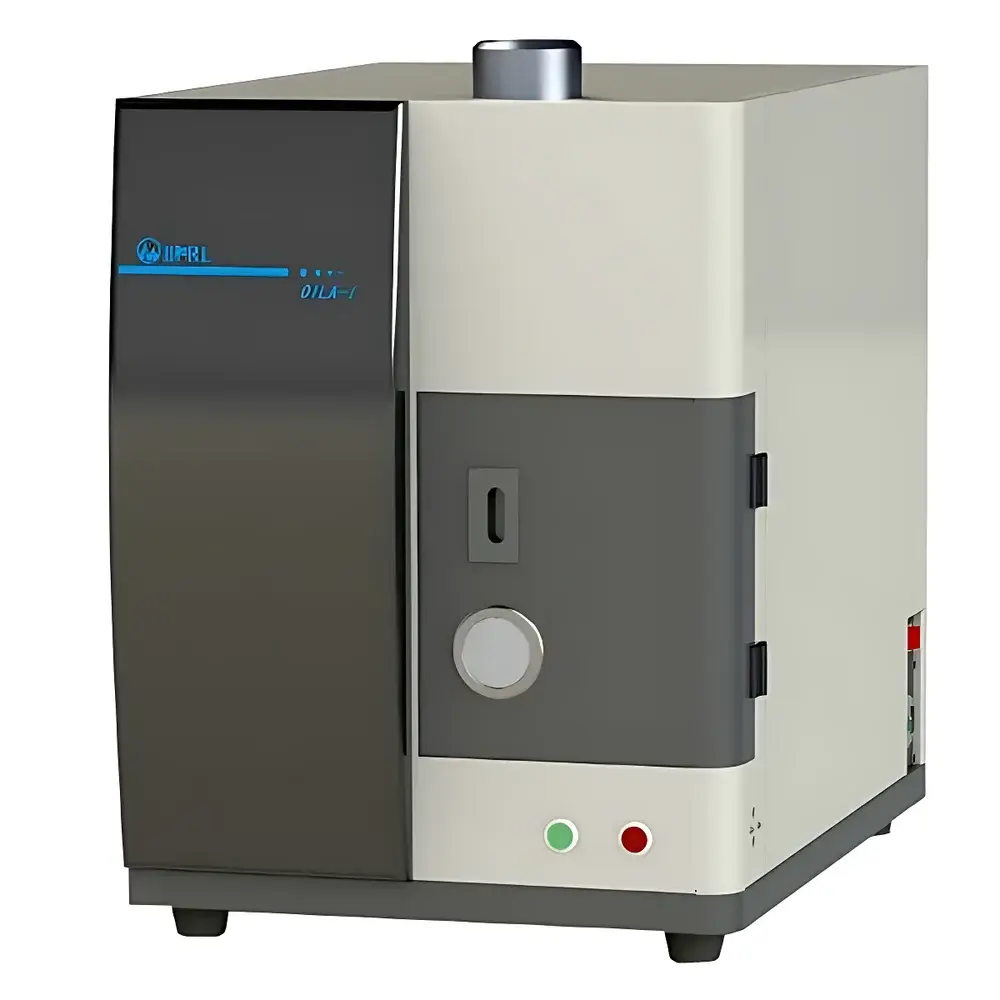
Beifen Ruili OILA-I Rotating Disk Electrode Atomic Emission Spectrometer (RDE-AES)
| Brand | Beifen Ruili |
|---|---|
| Origin | Beijing, China |
| Model | OILA-I |
| Instrument Type | Benchtop |
| Excitation Method | Arc |
| Detector Type | CMOS |
| Focal Length | 400 mm |
| Grating Grooves | 2400 lines/mm |
| Wavelength Range | 201–810 nm |
| Detection Mode | Full-Spectrum Simultaneous Acquisition |
| Argon Consumption | None |
| Detector Resolution | High-Density CMOS Array with Pixel-Level Spectral Sampling |
Overview
The Beifen Ruili OILA-I Rotating Disk Electrode Atomic Emission Spectrometer (RDE-AES) is a benchtop analytical instrument engineered for rapid, direct elemental analysis of liquid lubricants and industrial fluids. It operates on the fundamental principle of arc-excited atomic emission spectroscopy: a rotating graphite disk electrode immersed in the sample serves as both sampling interface and excitation source. Under controlled DC arc discharge, analyte atoms in the oil matrix are atomized, excited, and emit characteristic photons across the UV-Vis spectrum (201–810 nm). These emissions are dispersed via a high-resolution Czerny-Turner optical system featuring a 400 mm focal length and 2400 lines/mm grating, then captured simultaneously by a multi-CMOS detector array. This full-spectrum acquisition architecture eliminates sequential scanning delays and enables quantitative multi-element measurement—typically completed within 30 seconds per sample—without acid digestion, dilution, or solvent extraction.
Key Features
- Direct liquid sampling: No sample preparation required—introduce undiluted oil, hydraulic fluid, coolant, or electrolyte directly into the RDE cell.
- Zero consumable gas dependency: Operates without argon purge or auxiliary cooling water, reducing infrastructure requirements and operational overhead.
- Robust optical design: Incorporates a thermally stabilized Paschen-Runge spectrometer layout with integrated vibration-damping mechanics and precision-controlled spectrograph chamber temperature (±0.1 °C), ensuring long-term spectral stability and wavelength reproducibility.
- High-fidelity detection: Multi-CMOS sensor array provides pixel-level spectral resolution across the entire 201–810 nm range, supporting accurate peak deconvolution and interference correction.
- Enhanced operator safety: Interlocked excitation chamber door, electromagnetic shielding enclosure, and ergonomic access geometry comply with IEC 61010-1 electrical safety standards for laboratory instrumentation.
- Low total cost of ownership: Eliminates pre-analytical labor, gas supply contracts, and chiller maintenance; startup time is instantaneous; training curve is minimal for QC technicians.
Sample Compatibility & Compliance
The OILA-I is validated for analysis of mineral- and synthetic-based lubricants, turbine oils, diesel and jet fuels, hydraulic fluids, gear oils, coolants, and battery electrolytes. Its methodology aligns with multiple internationally recognized standard test methods, including ASTM D6595 (wear metals and contaminants in used lubricants), ASTM D6728 (contaminants in turbine and diesel fuels), NB/SH/T 0865–2013 (Chinese petroleum industry standard for RDE-AES), SN/T 1652–2005 (inspection and quarantine protocol), HB 2009.4.1–2012 (aviation working fluids), DL/T 1550–2016 (mineral insulating oils), and JJF(Defense) 175–2018 (calibration specification for oil spectrometers). Data integrity meets GLP/GMP-aligned audit trail requirements through timestamped calibration logs, user-access controls, and electronic signature support in the OESCS software platform.
Software & Data Management
OESCS Oil Emission Spectroscopy Control & Diagnostics Software is a purpose-built analytical suite compliant with FDA 21 CFR Part 11 principles. It performs real-time spectral acquisition, automatic peak identification, multivariate interference correction (including background subtraction via adaptive polynomial fitting and iterative digital filtering), and quantification using internal standard normalization and matrix-matched calibration curves. The platform integrates trend analysis engines that track elemental concentration drift over time, compares results against OEM wear limits and industry thresholds (e.g., ASTM D7622, ISO 4406), and delivers condition-based diagnostic reports—including probable wear mechanisms (e.g., fatigue vs. abrasive wear), component localization hypotheses (e.g., bearing vs. gear mesh), and evidence-based oil change recommendations. All raw spectra, processed data, calibration records, and diagnostic outputs are stored in a relational database with version-controlled backups and role-based access permissions.
Applications
The OILA-I supports predictive maintenance programs across critical rotating equipment domains: power generation (steam/gas turbines, transformers, generators), rail transport (locomotive engines, traction gearboxes), civil and military aviation (APU oils, hydraulic reservoirs), marine propulsion (main engines, reduction gears), petrochemical processing (compressors, pumps, catalyst circulation systems), and mining equipment (hydraulic excavators, conveyor drives). By quantifying trace concentrations of Fe, Cu, Al, Cr, Pb, Si, Na, Ca, Mg, and additive elements (e.g., Zn, P, Ba), it enables early detection of abnormal wear modes, contamination ingress (e.g., coolant leakage, dust ingestion), and additive depletion—providing actionable intelligence to extend component life, optimize oil drain intervals, and reduce unplanned downtime.
FAQ
Does the OILA-I require external argon supply or cooling water?
No. The instrument operates without argon purge or recirculating chillers, making it suitable for mobile labs, field workshops, and facilities with limited utility infrastructure.
What sample volume is needed per analysis?
Approximately 1.5 mL of undiluted liquid sample is required for each RDE measurement.
Can the system detect non-metallic elements such as boron or phosphorus?
Yes—the 201–810 nm spectral coverage includes emission lines for B I (249.68 nm), P I (253.56 nm), S I (256.96 nm), and other non-metals relevant to additive chemistry and contamination profiling.
How is calibration maintained over extended operation?
The OESCS software supports daily intensity-based recalibration using certified reference oils; long-term stability is verified via drift monitoring of internal standard lines (e.g., C I at 247.86 nm) and automated spectral registration against master reference libraries.
Is method validation documentation available for regulatory submissions?
Yes—full IQ/OQ/PQ protocols, uncertainty budgets per element, and linearity/range verification reports are provided upon request to support ISO/IEC 17025 accreditation and internal quality audits.






