
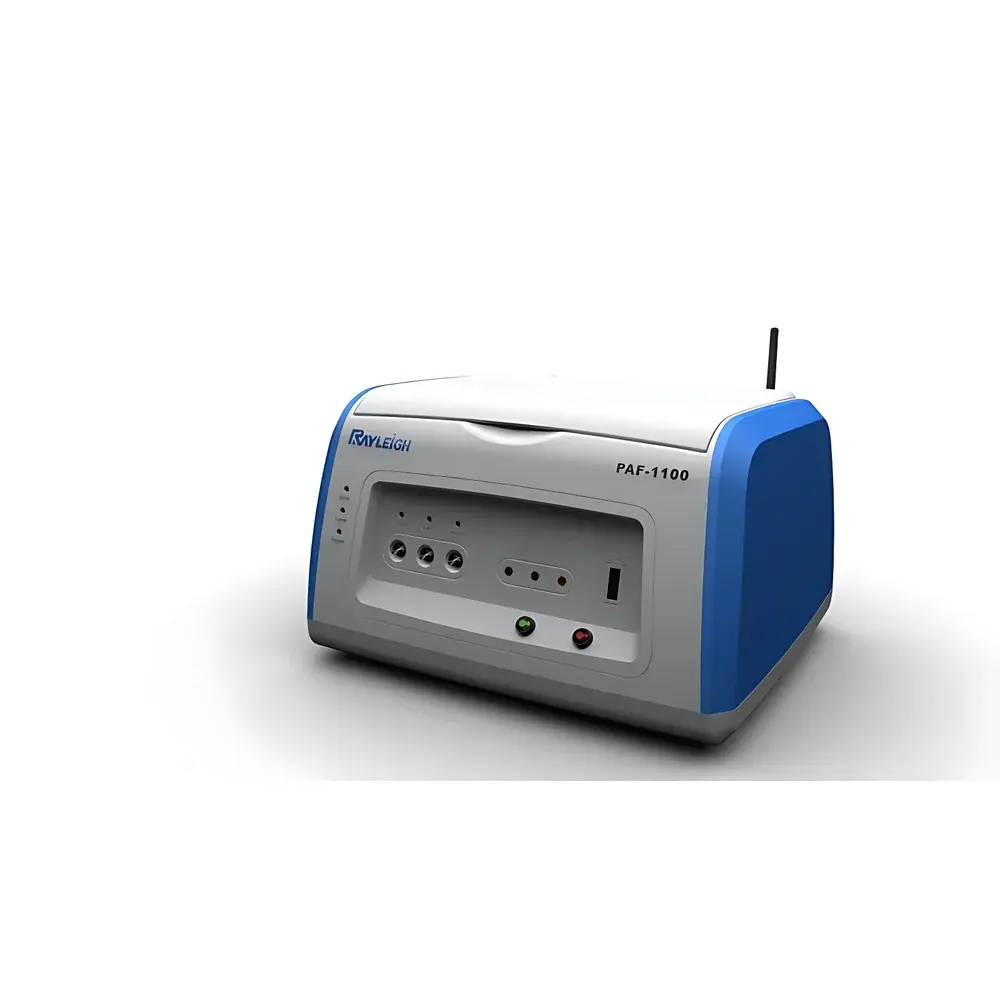
Beifen Ruili PAF-1100 Portable Atomic Fluorescence Spectrometer
| Brand | Beifen Ruili |
|---|---|
| Origin | Beijing, China |
| Model | PAF-1100 |
| Instrument Type | Single-channel Atomic Fluorescence Spectrometer |
| Sample Introduction | Peristaltic Pump |
| Detectable Elements | As, Sb, Bi, Se, Te, Pb, Sn, Hg, Cd, Ge, Zn, Au, Cu, Ag, Co, Ni |
| Detection Limits | As ≤ 0.06 µg/L, Hg (Cold Vapor Method) ≤ 0.006 µg/L |
| Relative Standard Deviation (RSD) | As ≤ 1.5%, Hg (Cold Vapor Method) ≤ 1.5% |
| Linear Dynamic Range | > 3 orders of magnitude |
| Linearity (r) | ≥ 0.999 for As (0.5–50 µg/L) and Hg (0.05–5 µg/L) |
| Drift | ≤ 2% over 30 min |
| Noise | ≤ 2% over 30 min |
Overview
The Beifen Ruili PAF-1100 Portable Atomic Fluorescence Spectrometer is a field-deployable analytical instrument engineered for trace-level quantification of hydride-forming and cold-vapor-forming elements in environmental, food, clinical, and industrial matrices. It operates on the principle of atomic fluorescence spectroscopy (AFS), where analyte atoms—generated in a quartz cell via hydride generation (for As, Sb, Bi, Se, etc.) or cold vapor atomic absorption/fluorescence (for Hg)—are excited by a high-intensity hollow cathode lamp (HCL) or electrodeless discharge lamp (EDL). The resulting element-specific fluorescence emission is collected at 90° to the excitation beam using a short-focal-length non-dispersive optical system, enabling high signal-to-noise ratio with minimal spectral interference. Designed explicitly for on-site analysis, the PAF-1100 integrates core AFS functionality into a 10 kg, 12 W platform—reducing mass, volume, and power consumption to 1/5, 1/6, and 1/20 of conventional benchtop AFS systems—without compromising analytical performance.
Key Features
- Ultra-portable architecture: 10 kg total mass, 12 W nominal power draw, integrated rechargeable Li-ion battery support for >4 hours continuous operation.
- Environmentally optimized reagent delivery: Solid-phase acidic reagents (tablet-form solid acids) replace hazardous liquid mineral acids (HCl, HNO₃, H₃PO₄, H₂SO₄), eliminating acid handling risks and simplifying field logistics.
- Low-power atomization: Fully enclosed, low-energy quartz tube atomizer with thermal stabilization and adaptive exhaust management minimizes energy demand while maintaining stable atom cloud geometry.
- Digital beam alignment: Motorized, feedback-controlled optical alignment system ensures reproducible lamp–atomizer–detector geometry without manual recalibration.
- Advanced signal processing: Embedded S-G smoothing and wavelet transform filtering algorithms suppress baseline drift and high-frequency noise, enhancing detection reliability under variable ambient conditions.
- Dual-gas source pneumatic control: Automated switching between Ar (for hydride generation) and N₂ (for cold vapor Hg analysis) ensures method-specific gas optimization and leak-tolerant flow regulation.
- GPS-enabled geotagging: Integrated GNSS module timestamps and geo-references each measurement, supporting chain-of-custody documentation for regulatory reporting.
Sample Compatibility & Compliance
The PAF-1100 supports aqueous liquid samples requiring minimal pretreatment—typically digestion with microwave-assisted or hot-block methods followed by reduction with solid-phase KBH₄ tablets. It complies with internationally referenced methodologies including EPA Method 1631E (Hg in water), ISO 17892-7 (geotechnical testing for As in soils), and GB/T 22105.2–2008 (Chinese national standard for As in soil and water). Its design facilitates GLP-aligned workflows: audit-trail-capable data logging, user-access-level controls, and electronic signature readiness align with FDA 21 CFR Part 11 principles for regulated environments. All firmware and calibration records are stored internally with SHA-256 checksum integrity verification.
Software & Data Management
The embedded Android-based operating system runs proprietary Beifen Ruili AFS Control Suite v3.2, offering real-time spectrum visualization, automated calibration curve generation (linear and quadratic fitting), QC flagging (e.g., RSD > 1.5%, blank drift > 2%), and export in CSV, PDF, and XML formats compliant with LIMS integration protocols. Wireless data transmission supports Bluetooth 5.0 and IEEE 802.11n for secure upload to cloud-hosted analytical dashboards. Firmware updates are delivered via signed OTA packages with cryptographic validation. Raw intensity values, background-corrected net signals, and instrument metadata (lamp current, gas pressure, temperature logs) are retained with full traceability.
Applications
The PAF-1100 delivers validated performance across diverse sample types and regulatory contexts: monitoring As and Sb in drinking water distribution networks (per WHO and EU Directive 2020/2184); screening Hg in fish tissue and rice grains (aligned with Codex Alimentarius STAN 193–1995); assessing Cd and Pb in urban stormwater runoff; verifying elemental purity in pharmaceutical excipients (USP /); and supporting teaching laboratories in instrumental analysis courses through intuitive GUI and modular hardware diagnostics. Its portability enables direct sampling at landfill leachate collection points, agricultural field sites, and wastewater treatment influent channels—reducing turnaround time from days to minutes.
FAQ
What elements can the PAF-1100 quantify with certified accuracy?
It is validated for As, Sb, Bi, Se, Te, Pb, Sn, Hg, Cd, Ge, Zn, Au, Cu, Ag, Co, and Ni using hydride generation or cold vapor techniques per ICH Q2(R2) and ISO/IEC 17025 requirements.
Is method validation documentation available for regulatory submissions?
Yes—Beifen Ruili provides a complete validation package including LOD/LOQ determination reports, linearity studies (r ≥ 0.999), precision assessments (RSD ≤ 1.5%), and robustness testing against pH, reductant concentration, and matrix interferences.
How is calibration maintained during extended field deployment?
The system performs automatic zero-point correction before each run and includes onboard multi-point standard verification using preloaded CRM solutions; drift compensation is applied dynamically via internal reference channel normalization.
Can the PAF-1100 be integrated into an existing laboratory information management system (LIMS)?
Yes—it supports ASTM E1384-compliant HL7 and ASTM E2500-07 data exchange protocols, with configurable API endpoints for RESTful integration and TLS 1.2-encrypted data transfer.
What maintenance is required between field missions?
Routine tasks include quartz atomizer cleaning with 10% HNO₃ (optional, due to solid-acid compatibility), peristaltic pump tubing replacement every 200 runs, and annual lamp output verification using NIST-traceable intensity standards.
Related Products





