
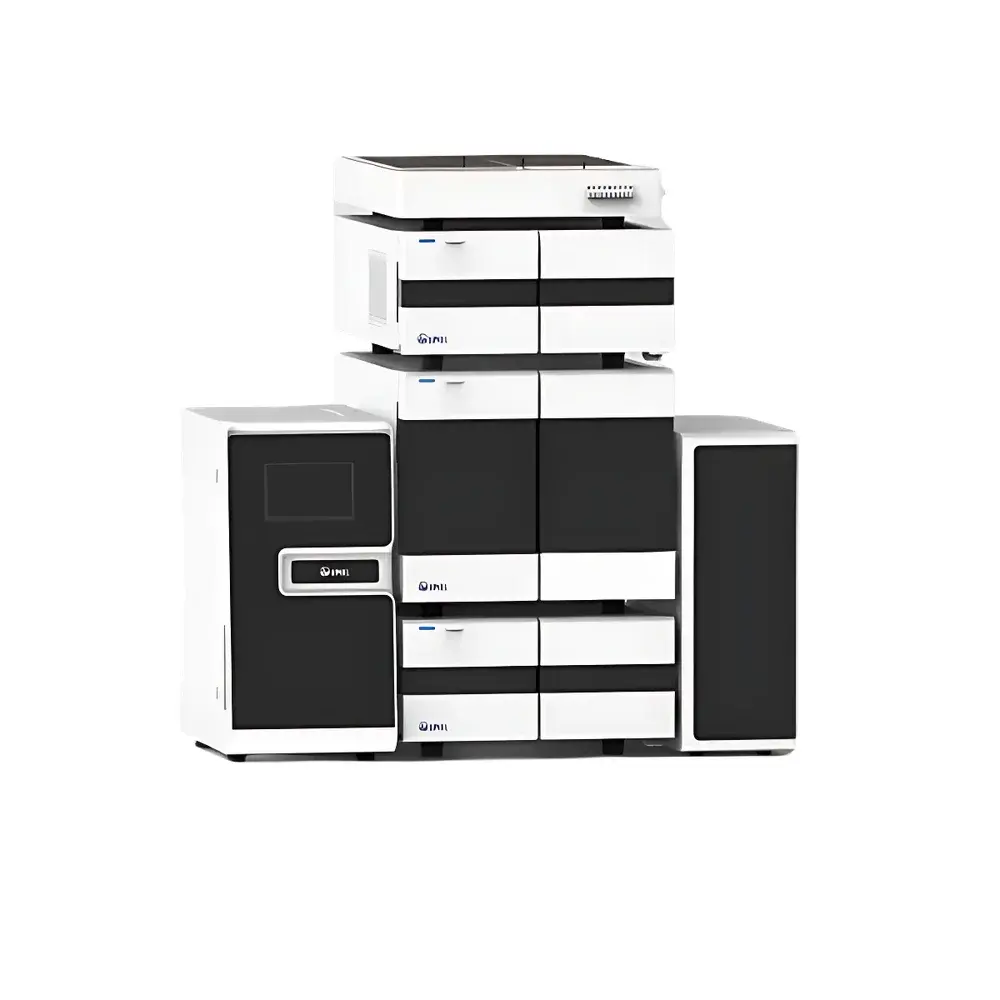
Beifen Ruili SY9230 Ion Chromatograph
| Brand | Beifen Ruili |
|---|---|
| Origin | Beijing, China |
| Model | SY9230 |
| Instrument Type | Laboratory Benchtop Ion Chromatograph |
| Application Scope | General-Purpose Anion and Cation Analysis |
| Pump Pressure Range | 0–35 MPa |
| Flow Rate Range | 0–9.999 mL/min |
| Eluent Flow Rate Accuracy | 0.1–5.0 mL/min |
| Max Operating Pressure | 35 MPa |
| Column Oven Temperature Range | Ambient +5 °C to 60 °C |
| Temperature Stability | ±0.2 °C |
| Eluent Concentration Range | 0.1–100 mM |
| Fluidic Path Material | Full-PEEK (Polyetheretherketone) |
| Eluent Generation | On-Demand Electrolytic Eluent Generator (EG) with Water-Only Input |
| Degassing | Integrated Low-Pressure Membrane Degasser + Gas-Liquid Separator |
| Safety Features | Real-Time Pressure Monitoring, Leak Detection, Eluent Reservoir Level Sensing, Auto-Shutdown Protocol |
| Consumables Monitoring | Column & Suppressor Usage Tracking with Auto-Recognition of New Units |
| Compliance Support | Designed for GLP/GMP environments |
Overview
The Beifen Ruili SY9230 Ion Chromatograph is a fully integrated, laboratory-grade benchtop system engineered for high-precision, routine anion and cation analysis in environmental, pharmaceutical, food safety, and industrial quality control laboratories. It operates on the fundamental principle of suppressed conductivity detection following ion-exchange chromatography—where analyte ions are separated on a high-efficiency, PEEK-compatible ion-exchange column under precisely controlled eluent composition, flow rate, and temperature. The system employs electrolytic eluent generation (EG) technology, eliminating the need for manual preparation or storage of chemical eluents. Instead, it synthesizes potassium hydroxide (for anion analysis) or methanesulfonic acid (for cation analysis) directly from deionized water and electricity—ensuring consistent eluent strength, minimal background conductivity, and exceptional baseline stability. Its all-PEEK fluidic path—including pump heads, tubing, injection valve, and column housing—minimizes metal ion leaching and ensures long-term compatibility with aggressive eluents across the full 0.1–100 mM concentration range.
Key Features
- Full-PEEK flow path architecture for ultra-low ion leaching, exceptional chemical resistance to strong acids/bases, and superior baseline noise performance (< 0.5 nS/cm RMS typical)
- Integrated electrolytic eluent generator (EG) enabling gradient elution with water-only input—reducing operator error, chemical handling risks, and consumables inventory
- Independent eluent reservoir compartment with “water-electrolyte separation” design, enhancing system reliability and simplifying maintenance
- Multi-stage degassing: low-pressure membrane degasser combined with a gas–liquid separator ensures complete bubble removal, critical for stable conductivity detection
- Auto-ranging conductivity detector with seamless gain switching—no manual range adjustment required across concentration spans from sub-ppb to ppm levels
- Column oven with precise thermal control (±0.2 °C over 35–60 °C range), minimizing retention time drift and improving inter-day reproducibility
- Real-time consumables monitoring: intelligent recognition of newly installed columns and suppressors, automatic method transfer, and usage-based predictive alerts
- Comprehensive safety suite: pressure fault detection, leak sensing, eluent level monitoring, and fail-safe shutdown protocol compliant with IEC 61010-1
Sample Compatibility & Compliance
The SY9230 supports aqueous samples containing common inorganic anions (F⁻, Cl⁻, NO₂⁻, Br⁻, NO₃⁻, PO₄³⁻, SO₄²⁻) and cations (Li⁺, Na⁺, NH₄⁺, K⁺, Mg²⁺, Ca²⁺), as well as small organic acids (acetate, formate) and amines. Sample introduction is compatible with standard 10–100 µL loop injections or automated injection via optional 100-position autosampler. The system meets essential regulatory expectations for analytical instrumentation used in GLP and GMP environments: its hardware architecture supports traceable method parameters, electronic signatures, and secure audit trails when paired with validated chromatography data systems (CDS). While the base instrument does not include embedded 21 CFR Part 11 compliance, it is designed to interface with third-party CDS platforms that provide full electronic record integrity, user access controls, and change history logging per FDA requirements.
Software & Data Management
Control and data acquisition are managed through Beifen Ruili’s IC Navigator software—a Windows-based application supporting method development, sequence definition, real-time monitoring, peak integration, and report generation. The software provides customizable calibration curves (linear, quadratic, or weighted), automatic peak identification using retention time windows and spectral libraries, and export formats compliant with ASTM E1784 (data exchange for chromatography). Raw data files adhere to open binary formats readable by third-party processing tools. Optional modules enable electronic signature capture, role-based user permissions, and configurable audit trail logging—including operator actions, parameter changes, and result modifications—with timestamps and IP/user attribution.
Applications
The SY9230 delivers robust performance across regulated and research-driven workflows: quantification of anions in drinking water per ISO 10304-1 and EPA Method 300.1; sulfate and chloride determination in pharmaceutical excipients per USP ; nitrate/nitrite profiling in infant formula per EU Commission Regulation (EU) No 609/2013; organic acid profiling in fermentation broths; and cation analysis in battery electrolytes and semiconductor process chemicals. Its stability under variable eluent concentrations and temperatures makes it suitable for method transfer between QC labs and R&D settings without requalification.
FAQ
What eluent types can the SY9230 generate internally?
The system generates KOH for anion analysis and MSA for cation analysis via on-demand electrolysis—no external eluent bottles required.
Is the column oven programmable for temperature gradients?
No—the oven maintains isothermal operation only; temperature programming is not supported.
Can the SY9230 be integrated into a LIMS environment?
Yes—via ASCII or CSV export, ODBC connectivity, or HL7-compliant middleware adapters for enterprise-level data ingestion.
What is the maximum backpressure tolerance during method development?
The system is rated for continuous operation up to 35 MPa, with active overpressure cutoff at 36.5 MPa.
Does the instrument support post-column derivatization?
No—this model is configured exclusively for suppressed conductivity detection; UV/Vis or fluorescence detection modules are not available.





