
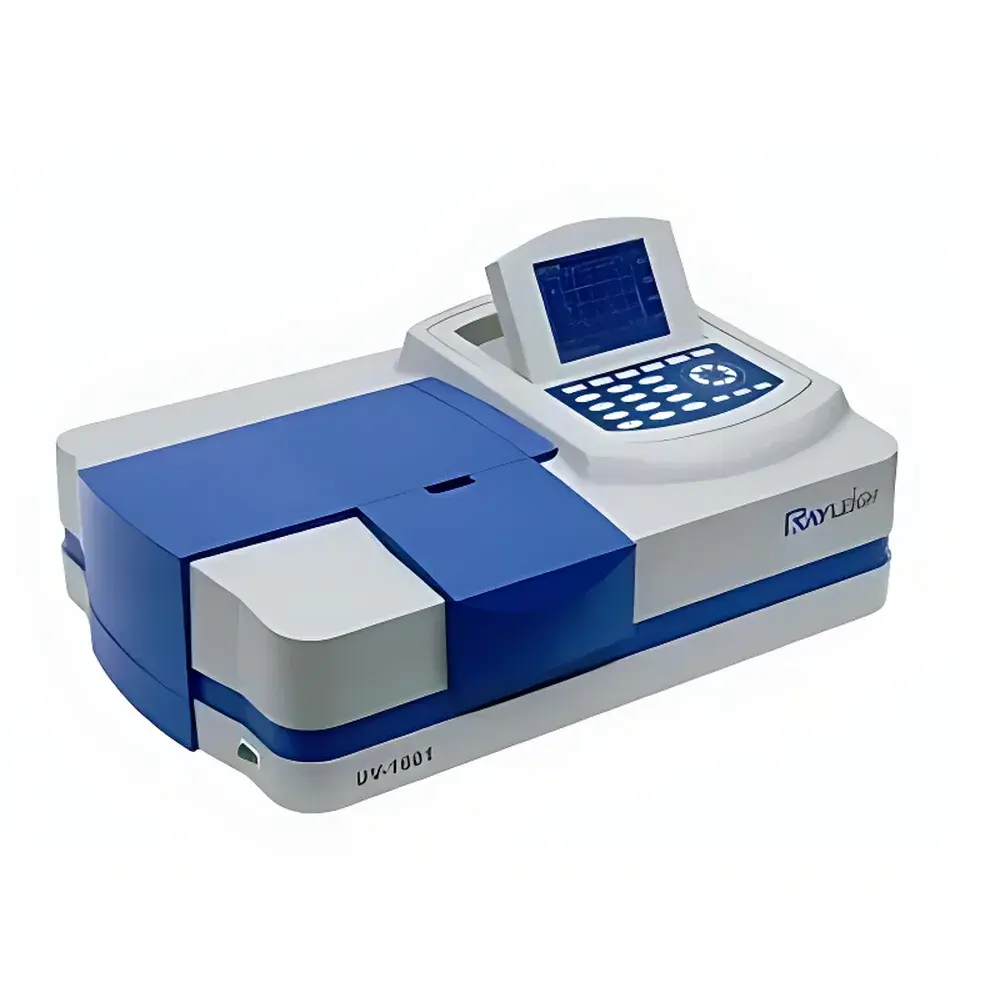
Beifen Ruili UV-1601 Proportional Monitoring Double-Beam UV-Vis Spectrophotometer
| Brand | Beifen Ruili |
|---|---|
| Origin | Beijing, China |
| Model | UV-1601 |
| Optical Design | Pseudo-Double-Beam |
| Detector | Photodiode Array (PDA) |
| Wavelength Range | 190–1100 nm |
| Wavelength Accuracy | ±0.3 nm |
| Spectral Bandwidth | 0.5 / 1.0 / 2.0 / 4.0 / 5.0 nm (5-step selectable) |
| Stray Light | ≤0.1% T (at 220 nm with NaI |
| Auto Wavelength Scanning | Yes |
| Dimensions | 630 × 470 × 210 mm |
| Weight | 26 kg |
| Power Supply | AC 220 V/50 Hz or 110 V/60 Hz |
| Power Consumption | 180 W |
| Interface | USB port, optional PC control, printer output |
| Data Retention | Non-volatile memory for parameters and measurements |
Overview
The Beifen Ruili UV-1601 Proportional Monitoring Double-Beam UV-Vis Spectrophotometer is engineered for precision absorbance, transmittance, and reflectance measurements across the ultraviolet, visible, and near-infrared spectral regions (190–1100 nm). Utilizing a pseudo-double-beam optical architecture—where beam splitting and real-time reference monitoring are achieved via proportional signal processing rather than physical beam division—the instrument delivers high photometric stability and baseline reproducibility without mechanical chopper complexity. This design minimizes photodetector fatigue and thermal drift, making it particularly suitable for extended kinetic assays, multi-sample screening, and regulated quality control environments where trace-level detection and long-term measurement fidelity are critical.
Key Features
- Pseudo-double-beam optical system with real-time proportional reference correction ensures robust baseline stability and eliminates zero-drift during prolonged measurements.
- Five-step adjustable spectral bandwidth (0.5, 1.0, 2.0, 4.0, and 5.0 nm), compliant with pharmacopeial requirements including USP , EP 2.2.25, and ChP General Chapter 0401 for assay validation and impurity profiling.
- High-fidelity wavelength accuracy of ±0.3 nm (verified against NIST-traceable holmium oxide and didymium filters), enabling reliable method transfer between laboratories.
- Low stray light performance (≤0.1% T at 220 nm using NaI and 360 nm using NaNO₂) supports accurate quantification of highly absorbing samples and high-concentration analytes in pharmaceutical and environmental matrices.
- Imported socket-type deuterium and tungsten-halogen lamps provide stable radiant output over extended operational lifetimes; lamp auto-identification and usage-hour tracking support GLP-compliant maintenance logging.
- Integrated 10-mm eight-position dual-lid sample holder accommodates standard cuvettes; optional wide-format 4-cell accessory supports pathlengths from 5 mm to 100 mm for dilute or highly scattering samples.
- Onboard non-volatile memory retains up to 500 measurement sets, method configurations, and calibration files—even after power interruption—ensuring continuity in teaching labs and production QC workflows.
Sample Compatibility & Compliance
The UV-1601 accepts standard quartz, glass, and plastic cuvettes (10 mm pathlength default) and supports custom cell geometries via its modular sample compartment. Its optical design and low stray light specification meet essential criteria for compliance with ISO 9001-based analytical process controls and align with key regulatory expectations for spectrophotometric instrumentation in GMP environments. While not inherently 21 CFR Part 11–compliant in standalone mode, the optional PC software package includes audit trail generation, electronic signature support, and user-access-level configuration—facilitating alignment with FDA and EMA data integrity principles when deployed in validated workflows.
Software & Data Management
The instrument operates via embedded firmware with intuitive soft-key navigation and a high-contrast LCD interface. For advanced operation, optional PC-based software enables full spectral acquisition, kinetic time-series analysis, multi-wavelength quantitative regression (including 2nd- and 3rd-order polynomial fitting), DNA/protein A260/A280 ratio calculation, and customizable report export (CSV, PDF, XML). All data files include embedded metadata: timestamp, operator ID (if logged), instrument serial number, lamp hours, and calibration verification status—supporting traceability in ISO/IEC 17025-accredited laboratories.
Applications
- Pharmaceutical QC: Active pharmaceutical ingredient (API) assay, dissolution testing, excipient interference studies, and cleaning validation swab extract analysis.
- Clinical & Diagnostic Labs: Enzyme kinetics (e.g., LDH, ALT), serum protein electrophoresis densitometry, and hemoglobin derivative quantification.
- Environmental Monitoring: Nitrate/nitrite, phosphate, COD, and heavy metal complexation assays per APHA Standard Methods and EPA guidelines.
- Food & Beverage: Colorimetric determination of antioxidants (e.g., DPPH scavenging), preservative content (sorbates, benzoates), and pigment stability under thermal/light stress.
- Academic Research & Teaching: Beer-Lambert law validation, ligand-binding stoichiometry, and spectral deconvolution exercises in undergraduate and graduate analytical chemistry curricula.
FAQ
What distinguishes “pseudo-double-beam” from true double-beam optics?
The UV-1601 uses a single-beam source split electronically—not optically—into sample and reference channels via rapid sequential scanning and proportional signal normalization. This eliminates moving parts (e.g., choppers or mirrors) while retaining most stability advantages of classical double-beam systems.
Is the instrument compatible with GLP/GMP documentation requirements?
Yes—when used with the optional PC software package, it supports electronic signatures, change-controlled method storage, and automated audit trails meeting ALCOA+ data integrity principles.
Can I perform DNA/RNA quantification directly on the instrument?
Yes—the onboard method library includes preconfigured A260/A280 and A260/A230 ratio calculations with concentration conversion based on standard extinction coefficients and pathlength correction.
Does the UV-1601 support regulatory-compliant wavelength calibration verification?
Yes—it includes built-in routines for verification using holmium oxide (241, 279, 287, 333, 360, 418, 460, 536 nm peaks) and didymium filters, with pass/fail reporting aligned with USP and Ph. Eur. 2.2.25.
What maintenance intervals are recommended for lamp replacement and optical alignment?
Deuterium lamp life is rated at ≥1,000 hours; tungsten lamp ≥2,000 hours. No user-accessible optical alignment is required—factory alignment is retained through thermal-stable monochromator housing and rigid optical bench construction.
Related Products



