
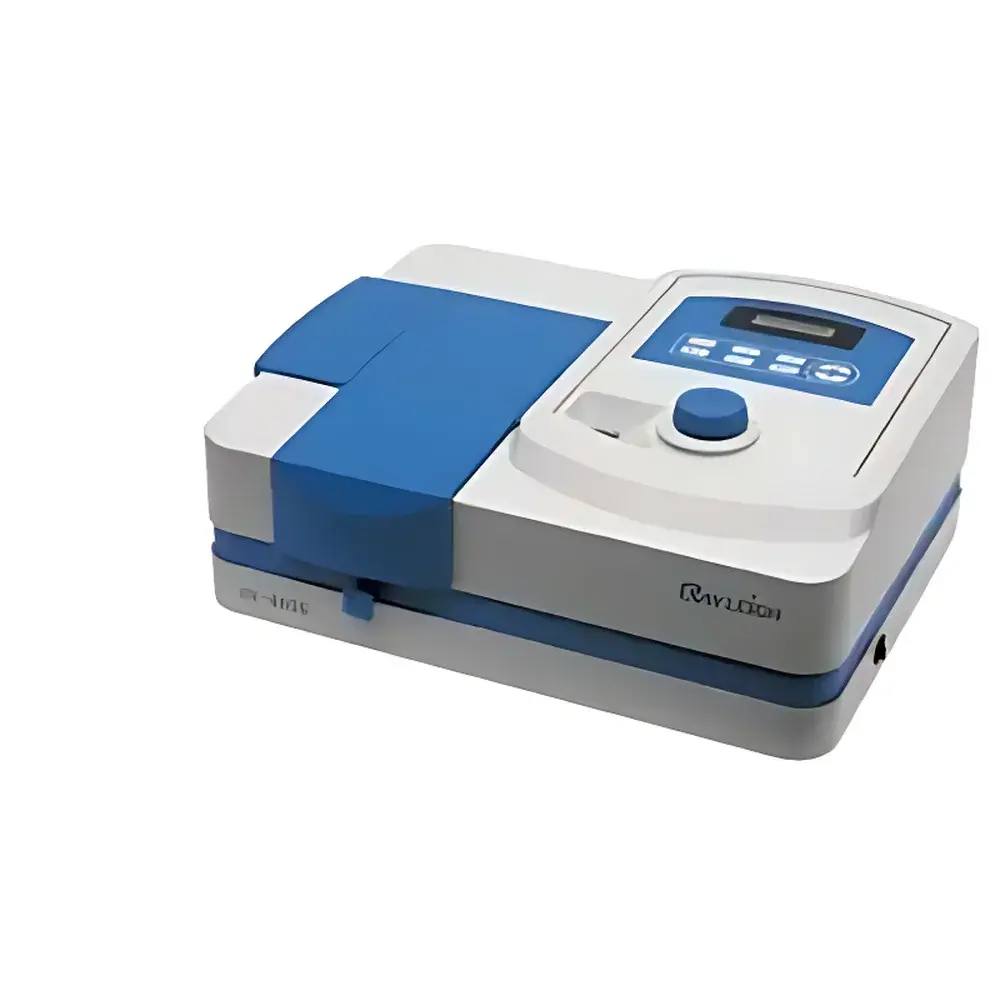
Beifen Ruili UV-9600 Single-Beam Ultraviolet-Visible Spectrophotometer
| Brand | Beifen Ruili |
|---|---|
| Origin | Beijing, China |
| Model | UV-9600 |
| Optical System | Single-beam |
| Detector | Photodiode Array |
| Wavelength Range | 190–1100 nm |
| Wavelength Accuracy | ±2.0 nm |
| Spectral Bandwidth | 1.0, 2.0, 4.0, 5.0 nm (selectable) |
| Stray Light | ≤0.05% T (at 220 nm with NaI |
| Display | 16×2 LCD |
| Light Sources | Plug-in deuterium lamp (optional), plug-in tungsten-halogen lamp |
| Power Supply | AC 220 V/50 Hz or 110 V/60 Hz |
| Power Consumption | 120 W |
| Dimensions (W×D×H) | 530 × 410 × 210 mm |
| Net Weight | 16 kg |
Overview
The Beifen Ruili UV-9600 is a single-beam ultraviolet-visible (UV-Vis) spectrophotometer engineered for routine quantitative and qualitative analysis in academic laboratories, quality control environments, and industrial R&D settings. It operates on the principle of Beer–Lambert absorption spectroscopy, measuring the attenuation of monochromatic light as it passes through a sample solution across the spectral range of 190 nm to 1100 nm. Its optical architecture employs a fixed-grating monochromator coupled with a photodiode array detector, enabling rapid spectral acquisition and stable baseline performance. Designed for robustness and operational simplicity, the UV-9600 supports both manual and automated workflows—particularly suited for applications requiring compliance with standard analytical protocols such as ASTM E275, ISO 6425, and USP for spectrophotometric system suitability.
Key Features
- Single-beam optical design optimized for cost-effective, high-reproducibility absorbance measurements in regulated and non-regulated environments
- Four selectable spectral bandwidths (1.0, 2.0, 4.0, and 5.0 nm) to balance resolution and signal-to-noise ratio based on analyte characteristics and matrix complexity
- Automated wavelength scanning and positioning with ±2.0 nm accuracy—verified using traceable NIST-standard reference materials (e.g., holmium oxide and didymium filters)
- Integrated dual-light-source management: automatic lamp switching between deuterium (UV) and tungsten-halogen (visible/NIR) sources ensures seamless coverage across the full 190–1100 nm range
- Wide-format sample compartment accommodating cuvettes from 5 mm to 100 mm pathlength, supporting both microvolume and macro-scale analysis configurations
- Onboard calibration routines including auto-zero and auto-100% transmittance functions, reducing operator dependency and improving inter-day measurement consistency
- Up to ten user-defined calibration curves stored in non-volatile memory, each retaining slope (K), intercept (B), correlation coefficient (r²), and standard sample point data
Sample Compatibility & Compliance
The UV-9600 accommodates standard quartz, glass, and plastic cuvettes (10 mm nominal pathlength recommended for most applications), as well as custom-length cells for specialized assays. Its stray light specification (≤0.05% T at 220 nm and 360 nm) meets the minimum requirements for pharmaceutical assay validation per ICH Q2(R2) guidelines when used with appropriate reference standards. While not inherently 21 CFR Part 11 compliant in standalone mode, the instrument’s RS-232 interface enables integration into validated PC-based data acquisition systems that support electronic signatures, audit trails, and user access controls—facilitating GLP/GMP-aligned documentation practices. All firmware operations are deterministic and repeatable, supporting IQ/OQ documentation during laboratory instrument qualification.
Software & Data Management
The UV-9600 supports direct instrument control via optional PC software compatible with Windows 10/11 platforms. This software provides extended functionality including kinetic time-scan profiling, multi-wavelength quantitation, derivative spectroscopy, and export of raw absorbance/transmittance data in CSV or ASCII formats for downstream statistical analysis (e.g., in MATLAB, JMP, or Python-based chemometrics pipelines). Measurement parameters—including wavelength, bandwidth, scan speed, and curve-fitting coefficients—are timestamped and exportable. Parallel or micro-printer output includes header information, numeric results, calibration curve metadata, and plotted standard points—supporting paper-based record retention where required by internal SOPs or regulatory audits.
Applications
- Quantitative determination of nucleic acids (A260/A280 ratios) and proteins (Bradford, Lowry, BCA assays)
- Pharmaceutical content uniformity testing and dissolution profile monitoring
- Water quality analysis (nitrate, phosphate, COD estimation via colorimetric methods)
- Enzyme kinetics studies requiring real-time absorbance tracking at defined wavelengths
- Educational laboratory instruction in analytical chemistry and physical biochemistry
- Industrial pigment and dye concentration verification in textile and coating formulations
FAQ
Is the UV-9600 compliant with FDA 21 CFR Part 11?
No—the instrument itself does not provide electronic signature capability, audit trail generation, or role-based access control. However, when connected to validated third-party software running on a secured Windows environment, it may be incorporated into a Part 11–compliant workflow.
What is the typical warm-up time before measurement stability is achieved?
Deuterium lamp stabilization requires approximately 20–30 minutes; tungsten-halogen lamp stabilization is achieved within 10 minutes. Instrument self-check and baseline drift correction are performed automatically during initialization.
Can the UV-9600 perform spectral scanning over the full 190–1100 nm range in a single run?
Yes—scanning is continuous and programmable. Users may define start/end wavelengths, step size (1 nm default), and scan speed (medium/fast modes available).
Does the instrument support GLP-compliant data archiving?
Raw data and calibration records can be exported and archived externally. Full GLP compliance requires supplementary documentation procedures, including instrument logbooks, preventive maintenance records, and analyst training verification.
Are NIST-traceable calibration standards included with the system?
No—calibration verification standards (e.g., holmium oxide filter, potassium dichromate solution) must be procured separately and certified according to ISO/IEC 17025-accredited providers.





