
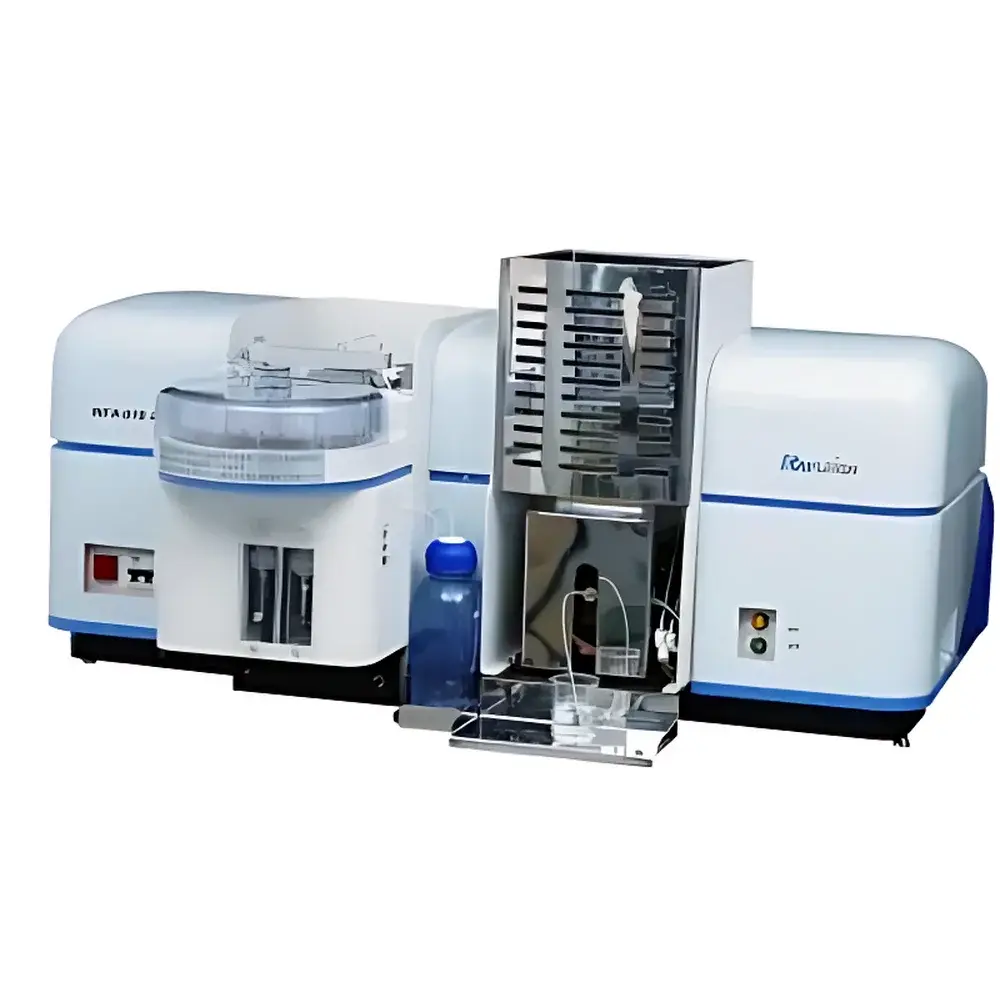
Beifen Ruili WFX-810 Zeeman Atomic Absorption Spectrophotometer
| Brand | Beifen Ruili |
|---|---|
| Origin | Beijing, China |
| Model | WFX-810 |
| Instrument Type | Flame and Graphite Furnace AAS |
| Monochromator | Plane Grating |
| Optical System | Double-Beam |
| Detector | Photomultiplier Tube (PMT) |
| Resolution | Resolves Mn 279.5 nm and 279.8 nm doublet with valley energy < 36% |
| Sensitivity | Flame mode — Cu 0.13 µg/mL per 1% absorption |
| Repeatability (RSD) | Flame RSD ≤ 0.9% |
| Detection Limit | Flame — Cu 0.010 µg/mL |
Overview
The Beifen Ruili WFX-810 Zeeman Atomic Absorption Spectrophotometer is a dual-atomization platform instrument engineered for high-precision elemental quantification in environmental, pharmaceutical, clinical, and industrial laboratories. It employs transverse Zeeman-effect background correction with a permanent magnet configuration—applied independently to both flame and graphite furnace atomizers—to deliver robust, broadband correction of structured and non-structured molecular absorption across the UV-Vis spectral range (190–900 nm). Unlike conventional single-beam or deuterium-corrected systems, the WFX-810 implements true dual-light-path optics: two independent light sources (hollow cathode lamps) feed parallel optical paths—one dedicated to flame atomization, the other to graphite furnace atomization—minimizing optical path length, reducing component count, and maximizing photon throughput and long-term photometric stability. Its double-beam architecture inherently compensates for source drift and lamp aging, ensuring baseline integrity without requiring extended warm-up periods.
Key Features
- Dual-atomizer integrated design: Flame and graphite furnace atomizers are physically fixed in parallel alignment—no mechanical repositioning required—ensuring reproducible optical coupling and eliminating alignment-induced measurement variance over time.
- Single-mirror switching mechanism: Rapid, motorized mirror translation enables seamless transition between flame and furnace modes without manual intervention or recalibration.
- Time-shared dual-lamp operation: An 8-position automatic lamp turret supports simultaneous installation of two HCLs; software-controlled sequential illumination eliminates lamp swapping and reduces downtime during multi-element analysis.
- Optimized optical train: High-efficiency plane grating monochromator coupled with low-noise, high-gain photomultiplier tube detector achieves superior signal-to-noise ratio (SNR), critical for trace-level detection in complex matrices.
- Integrated graphite furnace power supply: Co-located within the main chassis using multi-layer electromagnetic shielding, minimizing voltage drop, improving thermal stability of heating cycles, and reducing footprint by up to 30% versus modular configurations.
- Comprehensive hardware safety interlocks: Real-time monitoring of fuel gas pressure, air supply, flame status, argon purge flow, cooling water temperature/flow, and magnetic coil cooling ensures fail-safe operation compliant with IEC 61010-1 and ISO/IEC 17025 laboratory safety requirements.
Sample Compatibility & Compliance
The WFX-810 accommodates aqueous, organic, and digested solid samples across diverse regulatory workflows. Flame mode supports rapid analysis of major and minor elements (e.g., Ca, Mg, Fe, Zn) in drinking water (EPA Method 200.7), soil extracts (ASTM D5688), and food digestates. Graphite furnace mode enables ultra-trace quantification (sub-pg level) of toxic metals including Cd, Pb, As, and Cr in biological fluids (ISO 11885), pharmaceutical excipients (USP /), and semiconductor-grade reagents. All operational parameters—including lamp current, slit width, atomization temperature ramp profiles, and background correction settings—are fully configurable and audit-trail enabled. The system meets GLP/GMP data integrity expectations through secure user authentication, electronic signature support, and immutable method storage—fully compatible with 21 CFR Part 11-compliant LIMS integration when deployed with validated third-party software extensions.
Software & Data Management
Controlled via Windows-based application software (compatible with Windows 10/11 via virtualized XP runtime environment), the interface provides intuitive workflow navigation, real-time spectral visualization, and automated method development tools. Key functions include auto-wavelength scanning and peak centering, dynamic bandwidth selection (0.2–2.0 nm), gas flow optimization algorithms, and intelligent flame ignition sequencing. Quality control modules support precision tracking (RSD calculation per run), standard addition (Spike) validation, certified reference material (CRM) verification, and customizable reporting templates aligned with ISO/IEC 17025 clause 7.8. Raw absorbance data, calibration curves, and instrument logs are stored in vendor-neutral ASCII formats for external statistical analysis or regulatory submission.
Applications
- Environmental monitoring: Quantification of heavy metals in wastewater, sludge, and airborne particulate matter (PM2.5/PM10) per EPA SW-846 Methods 7000B and 7061A.
- Clinical toxicology: Measurement of blood lead (Pb), urinary cadmium (Cd), and serum copper (Cu) at clinically relevant thresholds (e.g., CDC reference levels).
- Pharmaceutical quality control: Elemental impurity screening in active pharmaceutical ingredients (APIs) and intermediates per ICH Q3D guidelines.
- Geochemical research: Multi-element profiling of rock digests and sediment cores using matrix-matched calibration strategies.
- Food safety: Routine surveillance of arsenic in rice, mercury in fish tissue, and nickel in stainless-steel food contact materials.
FAQ
Does the WFX-810 support hydride generation or cold vapor techniques?
No—the WFX-810 is configured exclusively for flame and electrothermal (graphite furnace) atomization. Hydride/cold vapor accessories are not supported in this model.
Is the Zeeman background correction applicable to both flame and furnace modes?
Yes—each atomizer operates under its own independent transverse magnetic field, enabling full-spectrum Zeeman correction without compromise in either mode.
What is the maximum ramp rate achievable in graphite furnace mode?
The integrated furnace power supply delivers programmable heating rates up to 2,000 °C/s, supporting fast pyrolysis and atomization protocols for volatile analytes.
Can the software generate 21 CFR Part 11-compliant audit trails?
Out-of-the-box logging meets basic traceability requirements; full Part 11 compliance requires deployment with validated third-party electronic lab notebook (ELN) or LIMS platforms.
Is routine maintenance limited to lamp replacement and graphite tube exchange?
Yes—optical alignment is factory-set and sealed; no user-accessible collimation or grating adjustment is required. Annual PM includes PMT gain verification, magnet cooling system inspection, and gas line leak testing.





