
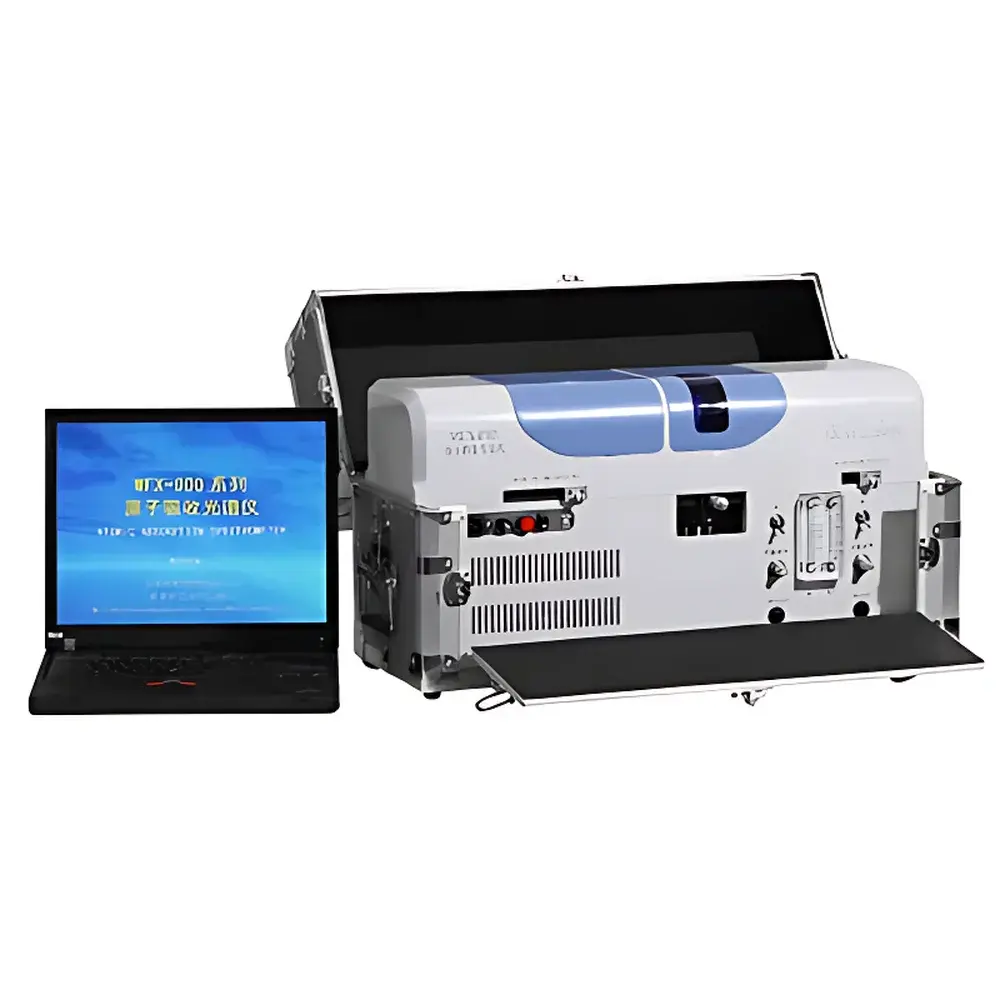
Beifen Ruili WFX-910 Portable Atomic Absorption Spectrometer
| Brand | Beifen Ruili |
|---|---|
| Origin | Beijing, China |
| Model | WFX-910 |
| Optical System | Single-beam |
| Detector Type | Solid-state CCD detector |
| Atomizer Type | Resistive-heated filament atomizer |
| Power Consumption | ~6% of conventional graphite furnace systems |
| Dimensions (H×W×D) | 335 mm × 610 mm × 230 mm |
| Weight | 18 kg |
| Compliance | Designed for field-deployable environmental monitoring per ISO 8288, EPA Method 7000B principles |
| Software | Embedded acquisition and quantification interface with calibration curve generation and QC flagging |
Overview
The Beifen Ruili WFX-910 Portable Atomic Absorption Spectrometer represents a paradigm shift in elemental analysis infrastructure—engineered to extend flame- and electrothermal atomic absorption spectroscopy (AAS) beyond the controlled confines of the laboratory. Unlike conventional benchtop AAS systems requiring stable AC power, climate-controlled environments, and extensive sample preparation workflows, the WFX-910 implements resistive-heated filament atomization coupled with a compact single-beam optical path and solid-state CCD-based spectral detection. This architecture enables direct, field-deployable quantification of trace metals in aqueous matrices without reliance on grid electricity or centralized instrumentation facilities. Its development was supported under the “11th Five-Year Plan” National Science & Technology Support Program (Project No. 2006BAK02A01), targeting robust, low-infrastructure analytical capability for environmental water quality surveillance.
Key Features
- Resistive-heated filament atomizer: Consumes only ~6% of the electrical power required by standard graphite furnace systems—enabling operation via portable battery packs or solar-charged DC sources in off-grid locations.
- CCD-based monochromator-free detection: Eliminates moving optical components (e.g., gratings, slits, or motorized mirrors), enhancing mechanical reliability and reducing alignment drift over time and transport-induced vibration.
- True portable form factor: Total system mass is 18 kg; footprint measures 610 mm × 230 mm × 335 mm—designed for transport in standard field vehicle trunks or backpack-compatible carrying cases with integrated shock absorption.
- Single-beam optical architecture: Optimized for rapid signal acquisition at fixed wavelengths, minimizing optical path complexity while maintaining linearity and repeatability across routine environmental concentration ranges (sub-ppb to low-ppm).
- No manual optical alignment or mechanical calibration required: Factory-aligned optical train and firmware-compensated detector response ensure consistent performance across deployment cycles without technician intervention.
Sample Compatibility & Compliance
The WFX-910 is validated for direct analysis of minimally pretreated aqueous samples—including surface water, groundwater, wastewater effluents, and drinking water sources—without digestion or matrix-matching dilution in most cases. It supports quantitative determination of As, Cd, Cr, Cu, Pb, Se, and Tl at wavelengths < 370 nm, aligning with key regulatory analyte lists defined in ISO 8288 (water quality — determination of metals by flame AAS) and U.S. EPA Method 7000B (atomic absorption spectrophotometry). While not certified for GLP/GMP-regulated pharmaceutical testing, its embedded data logging includes timestamped measurement records, operator ID fields, and calibration verification logs—supporting basic audit readiness for environmental field reporting under national water monitoring protocols.
Software & Data Management
The instrument integrates an embedded Linux-based control interface with touchscreen navigation. Acquisition software provides real-time absorbance plotting, multi-point calibration curve fitting (linear and quadratic), limit-of-detection estimation, and automatic QC flagging (e.g., signal-to-noise ratio 5%). All raw spectra and processed results are stored internally on encrypted microSD cards (supplied) with optional USB export. Data files conform to ASTM E1382-compliant ASCII format for interoperability with LIMS platforms and third-party statistical tools. No cloud connectivity or remote telemetry is implemented—preserving data sovereignty during sensitive field deployments.
Applications
- Rapid assessment of heavy metal contamination in flood-affected or disaster-response water supplies.
- Seasonal monitoring of mining-adjacent streams where lab turnaround delays compromise mitigation timing.
- Regulatory compliance screening for small municipal utilities lacking in-house ICP-MS or graphite-furnace AAS capacity.
- Educational field courses in environmental science, providing students hands-on exposure to fundamental AAS principles under realistic sampling conditions.
- Baseline surveys in developing-region watersheds where infrastructure limitations preclude sustained lab-based monitoring programs.
FAQ
Can the WFX-910 analyze soil or sediment extracts?
Yes—provided extracts are filtered to ≤0.45 µm and acidified to pH < 2; however, matrix interferences may require method-specific spike recovery validation.
Does it support hydride generation for As or Se?
No—the system is optimized for direct filament atomization and does not include gas–liquid separation modules or sodium borohydride delivery hardware.
What is the typical detection limit for Cd in deionized water?
Under field-optimized conditions (3-s integration, 3-replicate averaging), sub-0.1 µg/L is routinely achieved; exact values depend on lamp stability and ambient thermal noise.
Is firmware upgradable in the field?
Yes—via microSD card using signed binary packages distributed through authorized Beifen Ruili service channels.
How is wavelength selection handled without a traditional monochromator?
Predefined spectral windows corresponding to target element lines (e.g., Cd 228.8 nm, Pb 283.3 nm) are hard-coded into the CCD readout register; no user-selectable scanning is supported.






