
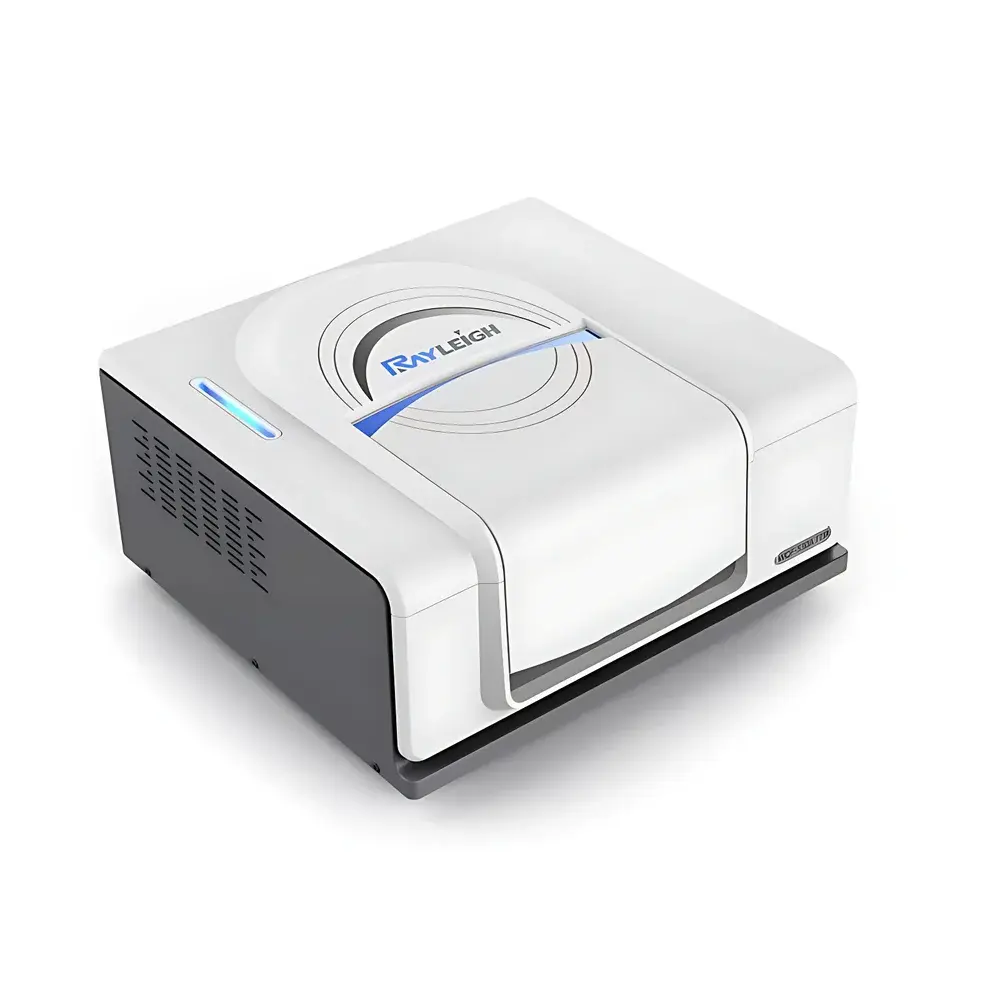
Beifen Ruili WQF-530A Fourier Transform Infrared (FTIR) Spectrometer
| Brand | Beifen Ruili |
|---|---|
| Origin | Beijing, China |
| Model | WQF-530A |
| Instrument Type | Laboratory FTIR Spectrometer |
| Wavenumber Range | 350–7800 cm⁻¹ |
| Resolution | <0.85 cm⁻¹ (upgradable to ≤0.4 cm⁻¹) |
| Signal-to-Noise Ratio (S/N) | >20,000:1 (upgradable to 55,000:1) |
| Wavenumber Accuracy | <0.1 cm⁻¹ |
| Detector | DLATGS (Deuterated Triglycine Sulfate) with Temperature Stabilization |
| Scan Speed | Microprocessor-controlled, user-selectable |
| Data Interface | Ethernet (RJ-45), USB 2.0 |
| Software Compliance | 21 CFR Part 11-ready audit trail, electronic signature support |
| Operating System Compatibility | Windows 10/11 (64-bit) |
Overview
The Beifen Ruili WQF-530A Fourier Transform Infrared (FTIR) Spectrometer is a laboratory-grade analytical instrument engineered for high-fidelity molecular identification and quantitative analysis across diverse sample matrices. Based on the Michelson interferometer architecture with corner-cube retroreflectors, the system acquires interferograms via rapid-scan or step-scan acquisition modes, followed by real-time Fourier transformation to generate high-resolution infrared absorption spectra. Its optical design incorporates a thermally stabilized DLATGS detector and precision-aligned fixed-mirror interferometry—ensuring long-term spectral reproducibility and minimal baseline drift. The instrument operates across a broad mid-infrared range (350–7800 cm⁻¹), enabling detection of fundamental vibrational modes in organic functional groups (e.g., C=O, O–H, N–H, C–Cl), inorganic bonds (e.g., Si–O, P=O), and crystalline lattice vibrations. Designed for routine QC, R&D, and regulatory-compliant environments, the WQF-530A meets foundational requirements for method validation under ISO/IEC 17025, USP , and ASTM E1421 standards.
Key Features
- Corner-cube Michelson interferometer with two-dimensional precision adjustment mechanism for fixed mirror alignment—enhancing interference fringe stability and minimizing phase error over extended operation cycles.
- Thermally regulated DLATGS detector housed in a temperature-controlled chamber—reducing thermal noise and improving signal consistency across ambient fluctuations (±0.5 °C stability).
- High-fidelity 24-bit analog-to-digital conversion with low-noise front-end amplification—supporting dynamic range exceeding 100 dB and enabling accurate quantitation of trace components.
- Ethernet (RJ-45) as primary communication interface—facilitating centralized instrument management, remote diagnostics, and integration into LIMS or ELN platforms without proprietary drivers.
- MainFTOS Suite software platform with full 21 CFR Part 11 compliance: role-based access control, immutable audit trails, electronic signatures, and automated data integrity checks for GxP-regulated workflows.
- Real-time self-diagnostic engine monitoring internal interferometer humidity/temperature, scan progress, network connectivity status, and detector health—displayed via intuitive GUI dashboard.
- Modular hardware architecture supporting resolution upgrades (to ≤0.4 cm⁻¹) and S/N enhancement (to 55,000:1) through firmware and detector optimization—extending operational lifecycle without full system replacement.
Sample Compatibility & Compliance
The WQF-530A accommodates solid, liquid, and gaseous samples using standard accessories including KBr pellet press, ATR (Attenuated Total Reflectance) diamond/ZnSe crystals, gas cells (path lengths 0.1–10 m), and liquid transmission cells (CaF₂ or BaF₂ windows). It supports common sample preparation protocols per ASTM E1252 (FTIR qualitative analysis), ASTM E168 (general techniques), and ISO 18384 (spectral library search criteria). All firmware and software modules are validated for GLP/GMP environments and align with CFDA’s Guidelines for Computerized Systems in Pharmaceutical Quality Control Laboratories. Electronic records generated meet ALCOA+ principles (Attributable, Legible, Contemporaneous, Original, Accurate, Complete, Consistent, Enduring, Available) for regulatory submissions.
Software & Data Management
MainFTOS Suite provides a unified interface for instrument control, spectral acquisition, processing (baseline correction, normalization, derivative calculation), multivariate analysis (PCA, PLS), and spectral library matching (NIST, SDBS, polymer, pharmaceutical libraries). Data files adhere to JCAMP-DX v6.00 format for cross-platform compatibility. Audit trail logs capture user ID, timestamp, parameter changes, data export events, and software updates—retained for ≥36 months with automatic archiving. Integration with third-party platforms (e.g., Thermo Fisher OMNIC, PerkinElmer Spectrum) is supported via ASCII export and API-enabled batch scripting. All digital signatures comply with ICH E6(R3) and FDA guidance on electronic records and signatures.
Applications
- Petrochemical QA/QC: Identification of hydrocarbon isomers, oxidation products, and additive concentrations in lubricants and fuels per ASTM D7213 and IP 540.
- Pharmaceutical raw material verification: Polymorph screening, excipient compatibility studies, and counterfeit drug detection per USP and Ph. Eur. 2.2.24.
- Environmental monitoring: Quantification of VOCs, PFAS compounds, and microplastics in water/soil extracts using GC-FTIR hyphenation or direct ATR analysis.
- Forensic analysis: Fiber, paint chip, and explosive residue characterization in accordance with SWGMAT and ENFSI best practices.
- Materials science: Surface functionalization assessment of nanomaterials, polymer degradation kinetics, and thin-film thickness estimation via interference fringe analysis.
FAQ
What is the minimum resolvable wavenumber separation at the default resolution setting?
The instrument achieves <0.85 cm⁻¹ nominal resolution (measured at 1583 cm⁻¹ using the CO line of a low-pressure CO gas cell), satisfying routine identification needs per ISO 8573-5 and ASTM E1421.
Does the system support external triggering for time-resolved or reaction-monitoring applications?
Yes—TTL-compatible trigger input/output ports enable synchronization with external devices such as reaction controllers, gas dosing systems, or UV-Vis spectrometers for kinetic FTIR studies.
Can spectral libraries be customized or extended beyond the included databases?
Users may import proprietary spectra in JCAMP-DX format, define custom search parameters (e.g., region masking, threshold weighting), and generate application-specific libraries with version-controlled metadata.
Is remote software update capability available without physical access to the instrument?
Firmware and MainFTOS Suite updates are delivered via secure HTTPS download; installation requires administrator authentication and generates a verifiable checksum log entry in the audit trail.
How is detector performance maintained during extended daily operation?
The DLATGS detector operates within a closed-loop thermal stabilization module maintaining ±0.3 °C setpoint accuracy; continuous internal calibration against reference blackbody sources ensures consistent responsivity across shifts and seasons.





