
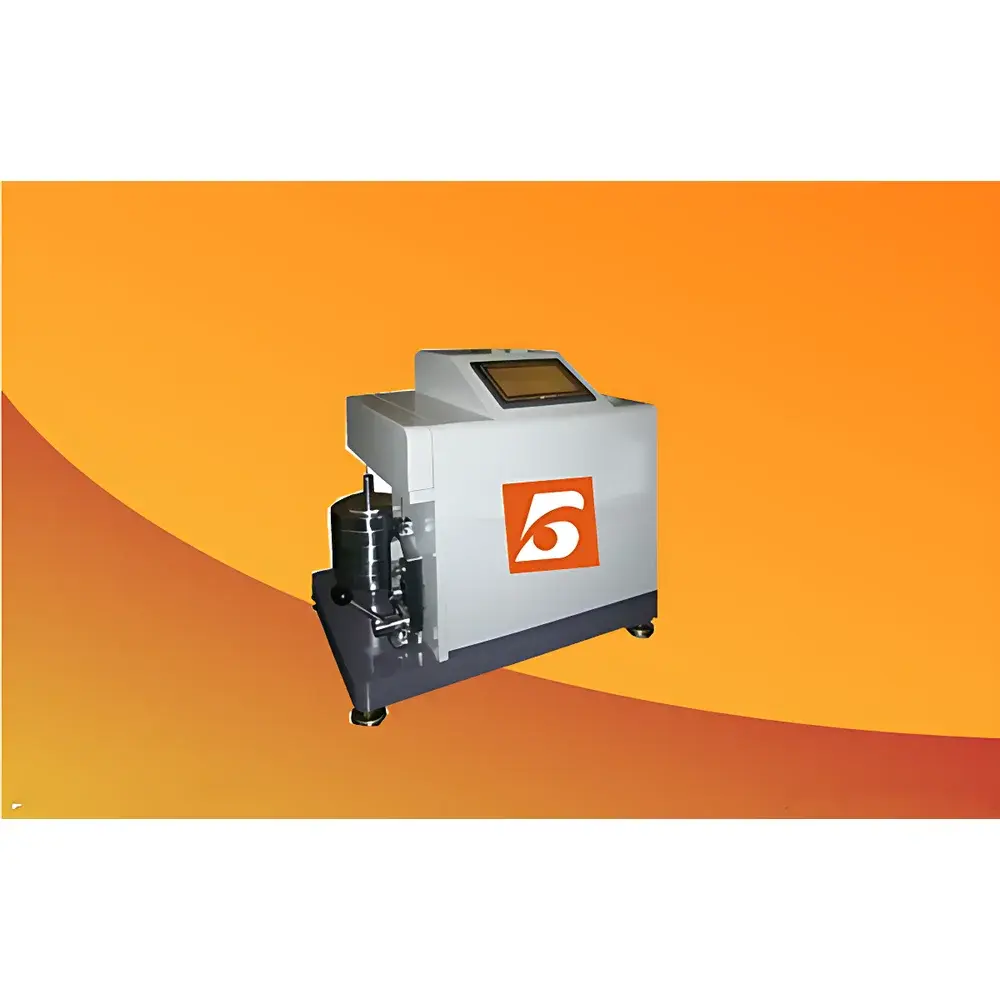
Beiguang Jingyi M200 GB3960 Sliding Friction and Wear Tester
| Brand | Beiguang Jingyi / All Precision Instrument |
|---|---|
| Origin | Beijing, China |
| Manufacturer Type | Direct Manufacturer |
| Country of Origin | China |
| Model | M200 |
| Price | USD 4,950 (FOB Beijing) |
| Test Load | 2000 N |
| Load Indication Error | ≤ ±2% (at ≥10% FS) |
| Load Repeatability Error | ≤ 2% (at ≥10% FS) |
| Friction Torque Range | 0–15 N·m |
| Torque Indication Error | ≤ ±3% (at ≥10% FS) |
| Torque Repeatability Error | ≤ 3% (at ≥10% FS) |
| Lower Specimen Shaft Speed | 200 / 400 rpm (stepless adjustment) |
| Upper Specimen Shaft Speed | 180 / 360 rpm |
| Axial Travel of Upper Shaft | ±4 mm |
| Time Control Range | 1 s – 9999 min (digital display) |
| Revolution Count Range | 1 – 999999 (digital display) |
| Standard Counterpart Ring | 45# steel, through-hardened to HRC 40–45, OD 40 mm (arbitration), surface roughness Ra ≤ 0.8 µm, concentricity < 0.01 mm, chamfer 0.5 × 45° |
Overview
The Beiguang Jingyi M200 GB3960 Sliding Friction and Wear Tester is a precision-engineered tribological evaluation system designed in strict compliance with the Chinese national standard GB/T 3960–2016 (“Determination of Coefficient of Friction and Wear Rate of Plastics under Dry Sliding Conditions”). It operates on the principle of controlled sliding contact between a stationary flat specimen and a rotating hardened steel ring under defined normal load, speed, duration, and environmental conditions. The instrument quantifies frictional resistance via real-time torque measurement and evaluates wear performance through post-test dimensional analysis (e.g., wear scar width) or gravimetric mass loss. Its dual-shaft kinematic architecture enables independent control of upper and lower rotational axes—supporting both ASTM D1894-compliant coefficient-of-friction (COF) testing and ISO 7148-1–aligned wear rate assessment for polymeric, composite, and coated materials used in packaging, automotive interiors, medical device housings, and industrial bearing surfaces.
Key Features
- High-fidelity load application system with 2000 N maximum capacity and calibrated accuracy ≤ ±2% across ≥10% full scale—ensuring traceable force delivery per ISO 7500-1 Class 2 requirements.
- Dual-speed, stepless-adjustment lower shaft (200/400 rpm) and synchronized upper shaft (180/360 rpm) enable precise replication of relative sliding velocity profiles specified in GB/T 3960, ASTM D3702, and DIN 53375.
- Integrated digital timer (1 s–9999 min) and revolution counter (1–999999) support time-based and cycle-based test protocols with ±1% counting accuracy.
- ±4 mm axial travel of the upper specimen holder accommodates minor surface irregularities while maintaining consistent contact geometry and eliminating parasitic bending moments.
- Modular fixture design includes standardized M3×0.35 countersunk screws and alignment washers—ensuring repeatable specimen mounting without axial play, as mandated by Clause 6.2 of GB/T 3960.
- Hardened 45# steel reference rings (HRC 40–45, Ø40 mm for arbitration, Ø≥36 mm for routine use) are supplied with certified concentricity (<0.01 mm) and surface finish (Ra ≤ 0.8 µm), meeting the geometric tolerances required by GB/T 3960 Annex A.
Sample Compatibility & Compliance
The M200 accepts flat, rigid specimens (e.g., films, sheets, molded plaques) with dimensions conforming to GB/T 3960: thickness 3–6 mm, planar deviation < 0.02 mm, free of bubbles, delamination, or machining marks. Each test set requires ≥3 replicates. Environmental conditioning follows GB/T 2918–1998 (equivalent to ISO 291): 23 ± 5 °C and 50 ± 10 % RH for ≥4 h prior to testing. The system supports both static upper-specimen / rotating-ring configurations (standard COF mode) and dynamic dual-motion modes for advanced wear mechanism studies. All mechanical and metrological performance parameters comply with JJG 1003–2018 (Chinese verification regulation for tribometers) and are compatible with GLP audit documentation requirements—including raw data logging, operator ID tagging, and timestamped event records.
Software & Data Management
While the base M200 operates via dedicated digital front-panel controls, optional PC-based acquisition software (sold separately) provides real-time torque waveform visualization, automatic calculation of average/peak COF (µ = M / F·R), volumetric wear rate (mm³/N·m), and statistical reporting per ISO 20623:2021. Data export is supported in CSV and XLSX formats for integration into LIMS environments. Audit-trail functionality meets FDA 21 CFR Part 11 expectations when configured with user authentication, electronic signatures, and immutable log files—enabling direct use in regulated packaging validation workflows under ICH Q5E and ISO 11607-1.
Applications
- Quantitative COF screening of plastic films (LDPE, PET, BOPP) for high-speed packaging line compatibility.
- Wear resistance validation of antimicrobial polymer coatings on medical trays per ISO 10993-6 biocompatibility guidance.
- Comparative tribology of recycled vs. virgin polyolefin blends in sustainable packaging development.
- Frictional stability assessment of lubricated vs. dry-running polymer gears under variable load/speed profiles.
- Supporting material selection for food-contact surfaces where stick-slip behavior affects filling accuracy and seal integrity.
FAQ
What is the standard counterpart ring specification per GB/T 3960?
The reference ring must be made from 45# steel, fully hardened to HRC 40–45, with nominal outer diameter 40 mm for arbitration tests and minimum usable diameter 36 mm. Surface roughness shall not exceed Ra 0.8 µm, and concentricity error must remain below 0.01 mm.
Can the M200 perform tests at loads other than 2000 N?
Yes—the loading system supports adjustable normal forces from 10 N to 2000 N, with calibration verified across the full range. Common alternate loads include 100 N (thin films), 500 N (rigid composites), and 1000 N (engineering thermoplastics).
Is environmental chamber integration available?
The M200 frame is designed for third-party environmental chamber retrofitting (e.g., -20 °C to +80 °C, 10–95 % RH). Chamber interface requires custom mounting brackets and feedthroughs for torque sensor cabling; technical drawings available upon request.
How is wear quantified when using mass loss methodology?
Specimens are weighed pre- and post-test on an analytical balance (0.1 mg resolution) after solvent cleaning (ethanol/acetone) and 1-h stabilization in standard lab conditions. Wear volume is calculated as Δm / ρ, where ρ is material density in g/cm³.
Does the system meet international regulatory requirements for packaging validation?
Yes—when operated with documented SOPs, calibrated traceable standards (NIST-traceable load cells and torque sensors), and version-controlled firmware, the M200 satisfies evidence-generation requirements for ISO 13485, FDA 21 CFR Part 820, and EU MDR Annex I §10.2 for material performance verification.
Related Products





