


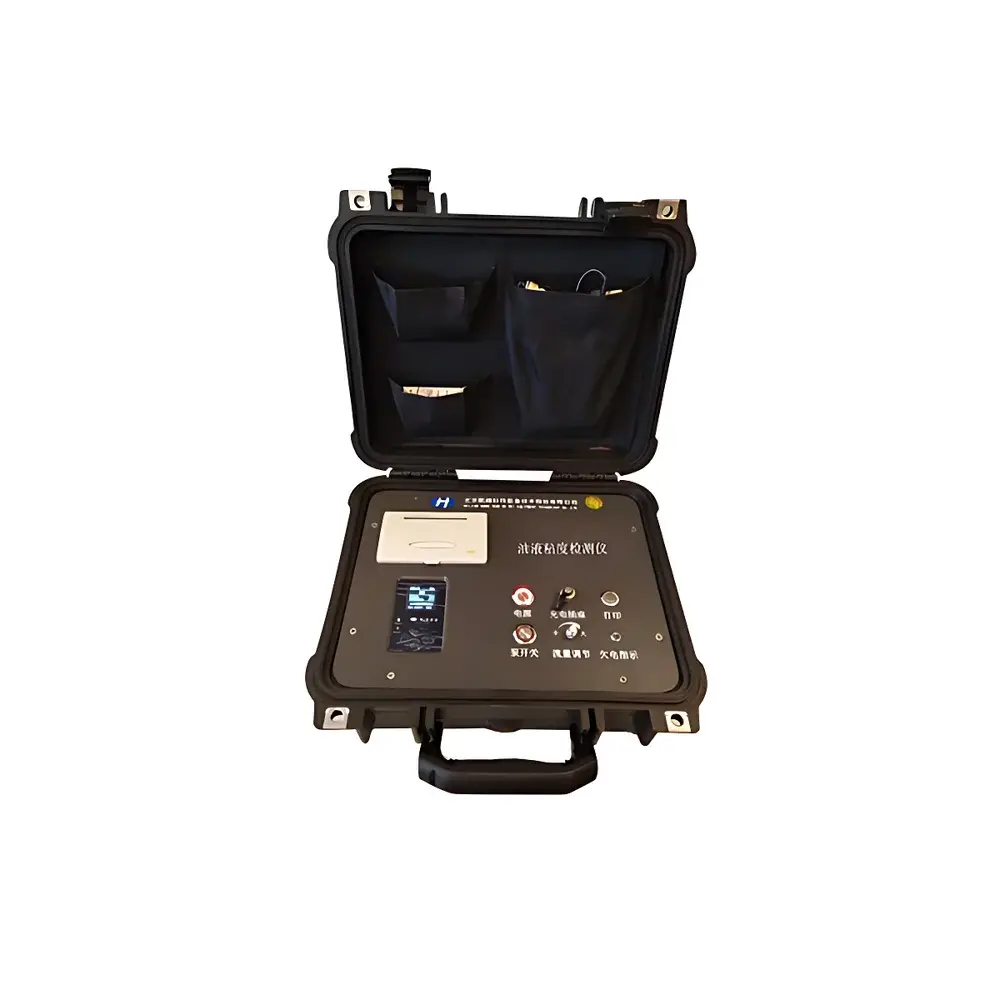
Beijing Hangfeng KLD-3/4/5 Portable Online Oil Contamination Analyzer
| Brand | Beijing Hangfeng |
|---|---|
| Origin | Beijing, China |
| Model | KLD-3 / KLD-4 / KLD-5 |
| Detection Parameter | Particle Count & Contamination Level (NAS 1638) |
| Sample Volume | 10 mL |
| Compliance Standard | NAS 1638 |
| Power Supply | Integrated Rechargeable Battery |
| Display | Color LCD with Numeric and Graphical Output |
| Data Output | Built-in Thermal Printer |
| Application Focus | Lubricating Oil Condition Monitoring |
| Category | Petroleum-Specialized Analytical Instrument for In-Service Oil Analysis |
Overview
The Beijing Hangfeng KLD-3/4/5 Portable Online Oil Contamination Analyzer is an industrial-grade, field-deployable particle counting instrument engineered for real-time assessment of particulate contamination in lubricating oils and hydraulic fluids. It operates on the principle of light extinction (also known as opacity or direct imaging particle counting), where oil samples pass through a precisely dimensioned flow cell illuminated by a stable laser diode. Particles suspended in the fluid interrupt the light beam proportionally to their cross-sectional area, generating pulse signals that are classified into standardized size channels (e.g., ≥4 µm, ≥6 µm, ≥14 µm, ≥21 µm, ≥38 µm, ≥70 µm) per NAS 1638 requirements. Unlike laboratory-based offline analyzers requiring sample transport and controlled environments, the KLD series supports both portable handheld use and semi-permanent online installation via optional flow adapters—enabling continuous or periodic in-situ monitoring without system shutdown.
Key Features
- Laser-based light extinction detection with high signal-to-noise ratio and minimal optical drift over extended operation cycles
- Integrated rechargeable lithium-ion battery supporting ≥8 hours of continuous measurement, suitable for remote field inspections and mobile maintenance teams
- Real-time color LCD display presenting numeric contamination codes (NAS classes), cumulative particle counts per size bin, and trend graphs across sequential measurements
- Built-in thermal printer delivering immediate hard-copy reports compliant with internal QA documentation protocols
- Compact ergonomic housing (W × H × D ≈ 220 × 120 × 65 mm), IP54-rated enclosure for resistance to dust and incidental splashing in industrial settings
- Calibration traceability aligned with ISO 21501-4:2018 for liquid-borne particle counters; factory calibration verified using NIST-traceable latex sphere suspensions
Sample Compatibility & Compliance
The KLD analyzer is validated for use with mineral-based, synthetic, and semi-synthetic lubricants—including turbine oils, hydraulic fluids (ISO L-HM, L-HV), gear oils (ISO L-CKD), and compressor oils—within viscosity ranges of 10–460 cSt at 40 °C. Sample introduction is performed via gravity-fed or low-pressure syringe-driven aspiration (10 mL nominal volume), eliminating need for external pumps or pressurized loops. All reported contamination levels conform strictly to the NAS 1638 classification system, enabling direct comparison with OEM equipment specifications and predictive maintenance thresholds. The device meets electromagnetic compatibility (EMC) requirements per IEC 61326-1 and safety standards under IEC 61010-1 for electrical equipment used in measurement, control, and laboratory applications.
Software & Data Management
While the KLD-3/4/5 operates autonomously via its embedded firmware, optional PC connectivity (USB 2.0) enables export of ASCII-formatted data logs (.csv) containing timestamp, sample ID, particle counts per channel, NAS code, and operator notes. These files support integration into enterprise CMMS or oil analysis databases. Firmware supports user-defined report templates and audit trail logging (operator ID, calibration date, last verification result), aligning with GLP-aligned workflows and facilitating FDA 21 CFR Part 11 readiness when paired with secure networked data repositories. No cloud dependency or proprietary software installation is required for basic functionality.
Applications
- On-site condition monitoring of critical rotating equipment (turbines, compressors, gearboxes) during routine maintenance windows
- Verification of filtration efficiency before and after filter change-outs in hydraulic power units
- Acceptance testing of new oil batches prior to system fill
- Troubleshooting abnormal wear patterns identified via ferrography or elemental spectroscopy
- Supporting ISO 4406:2017 and NAS 1638-based reliability-centered maintenance (RCM) programs
- Field validation of cleanliness levels following flushing procedures in newly commissioned systems
FAQ
Does the KLD series require annual recalibration?
Yes. For metrological continuity, recalibration against certified reference materials is recommended every 12 months—or after 500 sample measurements—per ISO/IEC 17025 guidance.
Can it measure water content quantitatively?
No. While the instrument detects presence of free and emulsified water via dielectric perturbation in the flow cell, it does not provide ppm-level moisture concentration; dedicated Karl Fischer or FTIR-based analyzers are required for quantitative water analysis.
Is the device compatible with aviation hydraulic fluids (e.g., MIL-PRF-5606, MIL-PRF-83282)?
Yes, provided viscosity remains within operational range and fluid is optically transparent at 650 nm wavelength; validation testing with specific fluid lots is advised prior to deployment.
What is the minimum detectable particle size?
The system resolves particles ≥4 µm(c) with statistical confidence ≥95% per ISO 21501-4:2018, assuming optimal sample clarity and laminar flow conditions.
Can multiple users be assigned unique access profiles?
No. The embedded interface supports a single operator mode; role-based access control requires integration with external asset management platforms.




