
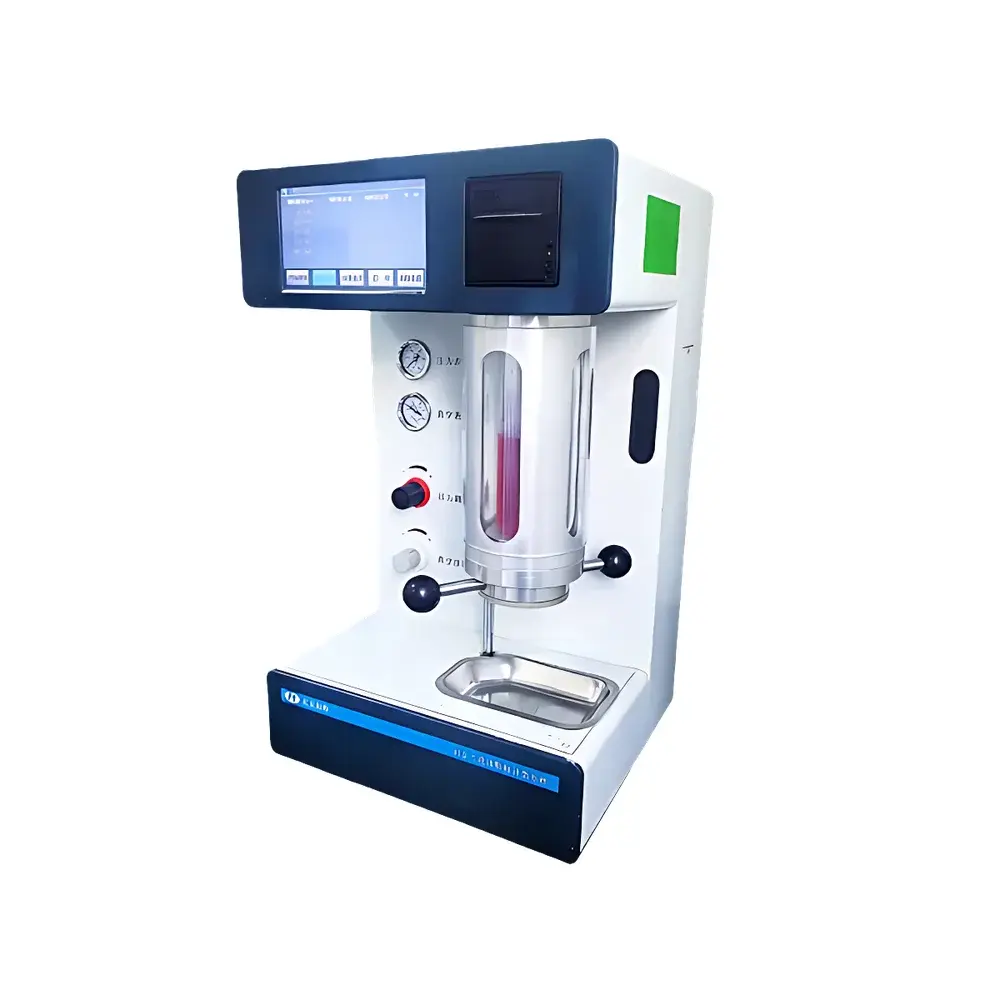
Beijing Hangfeng KLD-T Desktop Optical Particle Counter
| Brand | Beijing Hangfeng |
|---|---|
| Origin | Beijing, China |
| Instrument Type | Optical Particle Counter (Light Obscuration Principle) |
| Model | KLD-T |
| Sample Compatibility | Hydraulic oil, lubricating oil, transformer oil (insulating oil), turbine oil (steam turbine oil), gear oil, engine oil, aviation kerosene, organic solvents, polymer solutions |
| Detection Principle | Light obscuration (optical blockage) with custom-designed flow cell and precision optical assembly |
| Sampling Method | Dual-mode pressure control (positive/negative pressure chamber for degassing and high-viscosity fluid handling) |
| User Interface | Built-in bilingual toggle (Chinese/English) |
| Data Storage | Onboard memory for traceable measurement records |
| Connectivity | RS-232 serial interface and Bluetooth 4.0 for host PC communication |
| Calibration & Standards | User-configurable particle size channels |
| Regulatory Context | Designed to support GLP-compliant workflows |
Overview
The Beijing Hangfeng KLD-T Desktop Optical Particle Counter is an engineered solution for quantitative solid particulate contamination analysis in liquid media, operating on the internationally standardized light obscuration (LO) principle—also known as the optical blockage or photometric shadow method. In this technique, particles suspended in a flowing liquid stream pass through a precisely defined laser-illuminated sensing zone. Each particle interrupts the incident light beam proportionally to its cross-sectional area, generating a voltage pulse whose amplitude correlates directly with particle size. The instrument’s custom-fabricated flow cell—optimized for minimal wall effects, laminar flow stability, and low carryover—is coupled with high-stability laser diodes and low-noise photodetectors to ensure resolution down to 2 µm (ISO 11171 traceable calibration). Designed for routine quality control and condition monitoring in industrial maintenance, power generation, aerospace lubrication management, and pharmaceutical excipient testing, the KLD-T delivers repeatable, NIST-traceable particle counts per unit volume (e.g., particles/mL ≥4 µm(c), ≥6 µm(c), ≥14 µm(c)), aligned with ISO 4406:2017, NAS 1638 Class Code reporting, and SAE AS4059F severity level classification.
Key Features
- Optimized optical architecture featuring ISO 11171–compliant calibration verification capability and built-in reference standard validation routines
- Dual-mode sampling chamber supporting both positive-pressure delivery (for low-viscosity oils) and vacuum-assisted negative-pressure aspiration (enabling effective degassing of dissolved air and reliable analysis of viscous fluids up to 300 cSt at 40 °C)
- Real-time particle sizing across user-defined channels (e.g., 2–5 µm, 5–15 µm, 15–25 µm, >25 µm), with configurable threshold logic for multi-standard reporting
- Bilingual GUI with hardware-based language toggle—no software reinstallation required—ensuring operational continuity in multinational laboratory or field-service environments
- On-device non-volatile memory storing ≥10,000 test records with timestamp, operator ID, sample ID, viscosity correction flag, and environmental metadata (temperature, pressure if external sensor connected)
- RS-232 serial port compliant with EIA/TIA-232-F electrical specifications and Bluetooth 4.0 Class 2 radio module (up to 10 m range) for secure, cable-free data transfer to Windows/Linux-based analysis stations
Sample Compatibility & Compliance
The KLD-T is validated for use with hydrocarbon-based and synthetic lubricants—including hydraulic fluids (HM, HVLP), turbine oils (ISO-L-TG), gear oils (EP formulations), jet fuels (Jet A-1, JP-8), and insulating liquids (mineral and ester-based transformer oils). It also accommodates polar organic solvents (e.g., acetone, THF, DMF) and polymer solutions (e.g., PVDF, PEEK dispersions) where insoluble particulates must be quantified per USP , Ph. Eur. 2.9.19, or internal QC specifications. All firmware and data handling protocols are structured to support audit readiness under Good Laboratory Practice (GLP) and Good Manufacturing Practice (GMP) frameworks. Exported CSV or XML datasets include digital signatures, operator authentication logs, and instrument calibration status flags—facilitating integration into 21 CFR Part 11–validated laboratory information management systems (LIMS).
Software & Data Management
The KLD-T operates autonomously but interfaces seamlessly with Beijing Hangfeng’s optional ParticleView™ Desktop Suite (v3.2+), a Windows-native application enabling advanced statistical trend analysis, ISO cleanliness code mapping, histogram generation, and automated report generation in PDF or Excel format. Raw pulse data (amplitude vs. time) can be exported for third-party spectral deconvolution or machine learning–based anomaly detection. Firmware updates are delivered via signed binary packages with SHA-256 hash verification. Audit trail functionality records all parameter changes, calibration events, and user logins with immutable timestamps—meeting requirements for regulated environments requiring full data provenance.
Applications
- Condition-based oil analysis in wind turbine gearboxes and hydraulic pitch-control systems
- Acceptance testing of new lubricants prior to commissioning in gas turbine engines
- In-process monitoring of insulating oil filtration efficiency in substation maintenance
- Final-fill verification of sterile-filtered polymer solutions used in medical device manufacturing
- Root-cause investigation of servo-valve failures linked to particulate-induced wear
- Validation of offline filtration units according to ISO 11500 and ASTM D7647 protocols
FAQ
Does the KLD-T require annual recalibration by the manufacturer?
No—users may perform routine performance verification using ISO 11171–traceable latex sphere suspensions (e.g., 4.5 µm, 10 µm, 25 µm); full recalibration is recommended every 24 months or after major optical component service.
Can the instrument measure particles in water-glycol hydraulic fluids?
Yes—provided the fluid refractive index contrast with particles is sufficient (>0.02 RIU difference) and viscosity remains within the specified operating range (0.8–300 cSt); optional wetted-material kits (Hastelloy C-276 flow cell) are available for aggressive aqueous formulations.
Is Bluetooth pairing compatible with iOS or Android mobile devices?
Bluetooth is configured exclusively for PC-to-instrument bridging; mobile platforms are not supported for direct control or real-time data streaming.
How does the system handle air bubbles during sampling?
The negative-pressure chamber actively removes entrained microbubbles prior to entry into the sensing zone; additionally, the firmware applies dynamic pulse-shape discrimination to reject transient signals characteristic of gaseous cavitation.
What documentation is provided for regulatory submissions?
Factory calibration certificate (with uncertainty budget), ISO 11171 verification report, electrical safety test record (IEC 61010-1), and software validation summary (IQ/OQ protocol templates included).



