
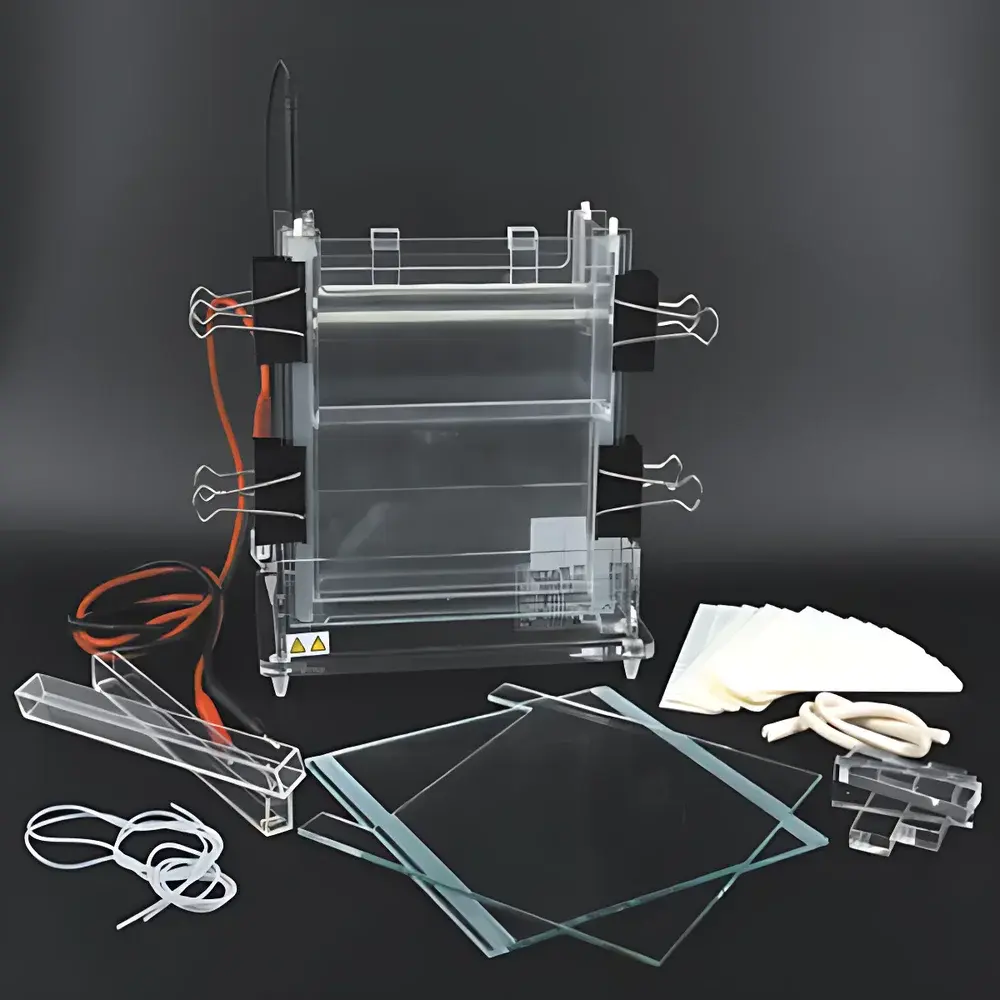
Beijing Liuyi DYCZ-24A Dual Vertical Electrophoresis Apparatus (Model 121-2410)
| Brand | Beijing Liuyi / LY |
|---|---|
| Origin | Beijing, China |
| Manufacturer Type | Authorized Distributor |
| Instrument Category | Domestic |
| Model No. | 121-2410 |
| Instrument Type | Protein Electrophoresis System |
| Gel Plate Dimensions | 170 × 170 mm |
| Overall Dimensions (L × W × H) | 240 × 150 × 240 mm |
| Buffer Capacity | 600 mL |
| Sample Comb Options | 20- and 26-well, 1.0 mm and 1.5 mm thickness |
| Weight | 6 kg |
Overview
The Beijing Liuyi DYCZ-24A Dual Vertical Electrophoresis Apparatus (Model 121-2410) is a compact, benchtop vertical electrophoresis system engineered for reproducible SDS-PAGE and native PAGE of proteins under controlled thermal conditions. Designed around the classic slab-gel electrophoresis principle—where charged protein analytes migrate through a polyacrylamide matrix under an applied DC electric field—the DYCZ-24A supports simultaneous dual-gel operation, enabling parallel sample analysis or comparative experimental setups without cross-contamination. Its integrated cooling mechanism mitigates Joule heating during high-voltage runs, preserving gel integrity and band resolution—critical for downstream applications such as Western blotting, mass spectrometry sample preparation, and quantitative densitometry.
Key Features
- Dual vertical gel configuration: accommodates two independent 170 × 170 mm gels in a single run, improving throughput and inter-gel comparability.
- Active thermal management: built-in ice-chilling slots (two included) allow direct placement of ice packs or cold blocks adjacent to the gel cassette assembly, maintaining buffer temperature below 20 °C during extended electrophoresis (e.g., overnight low-voltage runs).
- Modular comb and spacer system: includes four comb variants (20- and 26-well, 1.0 mm and 1.5 mm thickness) and corresponding pre-assembled glass plates with bonded spacers—ensuring consistent gel thickness and minimizing leakage during polymerization.
- Robust sealing architecture: silicone-based sealing strips, precision-machined acrylic gel cassettes, and 12 adjustable clamps provide uniform pressure distribution across the entire gel interface, eliminating buffer leakage and ensuring stable current delivery.
- Compact footprint and ergonomic design: overall dimensions of 240 × 150 × 240 mm (W × D × H) enable seamless integration into standard biosafety cabinets or shared lab benches without compromising accessibility.
Sample Compatibility & Compliance
The DYCZ-24A is optimized for protein separation in denaturing (SDS-PAGE) and non-denaturing (native PAGE) formats using standard acrylamide/bis-acrylamide gels (8–20% T), gradient gels, and specialized matrices including Tris-Glycine, Tris-Tricine, and Bis-Tris systems. It supports common molecular weight standards (e.g., broad-range and low-MW protein ladders) and is compatible with Coomassie Brilliant Blue R-250, silver staining, and fluorescent dyes (e.g., SYPRO Ruby). While not certified to ISO/IEC 17025 or FDA 21 CFR Part 11 out-of-the-box, its mechanical repeatability, standardized gel geometry, and traceable component sourcing support GLP-aligned workflows when operated within documented laboratory procedures and maintenance logs.
Software & Data Management
The DYCZ-24A operates as a standalone electrophoresis platform with no embedded microprocessor or digital control interface. All operational parameters—including voltage (typically 100–200 V), current (up to 50 mA per gel), and run duration—are managed externally via a programmable power supply (not included). This analog architecture ensures compatibility with any CE- or UL-listed constant-voltage or constant-current power source meeting IEC 61010-1 safety standards. Users are advised to record run parameters manually or integrate with third-party data acquisition systems supporting analog voltage/current logging for audit-ready documentation.
Applications
- High-resolution separation of complex protein mixtures from cell lysates, tissue homogenates, or purified fractions.
- Verification of recombinant protein expression, purification efficiency, and post-translational modification status (e.g., phosphorylation shifts).
- Quality control of monoclonal antibodies and biosimilars during upstream and downstream process development.
- Preparative electrophoresis for excision and extraction of target bands prior to in-gel digestion and LC-MS/MS analysis.
- Teaching laboratories requiring robust, serviceable equipment for undergraduate and graduate-level biochemistry instruction.
FAQ
What types of gels can be cast in the DYCZ-24A?
Standard discontinuous SDS-PAGE gels (stacking/resolving), native PAGE, gradient gels, and Tris-Tricine systems for low-MW peptides—all using commercially available acrylamide reagents and standard protocols.
Is the system compatible with pre-cast gels?
No—the DYCZ-24A is designed exclusively for hand-cast slab gels using its supplied glass plates, combs, and sealing components.
Does the apparatus include a power supply?
No. A separate DC power supply capable of delivering up to 300 V and 100 mA total output is required and must be selected based on application-specific voltage/current requirements.
Can the unit be used for DNA electrophoresis?
While technically feasible for large DNA fragments (>1 kb) in low-percentage agarose or polyacrylamide gels, the DYCZ-24A is optimized for protein resolution; dedicated horizontal or vertical nucleic acid systems offer superior sensitivity and throughput for routine DNA/RNA analysis.
What maintenance is required for long-term reliability?
Routine cleaning of glass plates and combs with 70% ethanol after each use; periodic inspection of sealing strips for compression fatigue; replacement of worn clamps or degraded silicone gaskets every 12–18 months under typical academic lab usage.





