
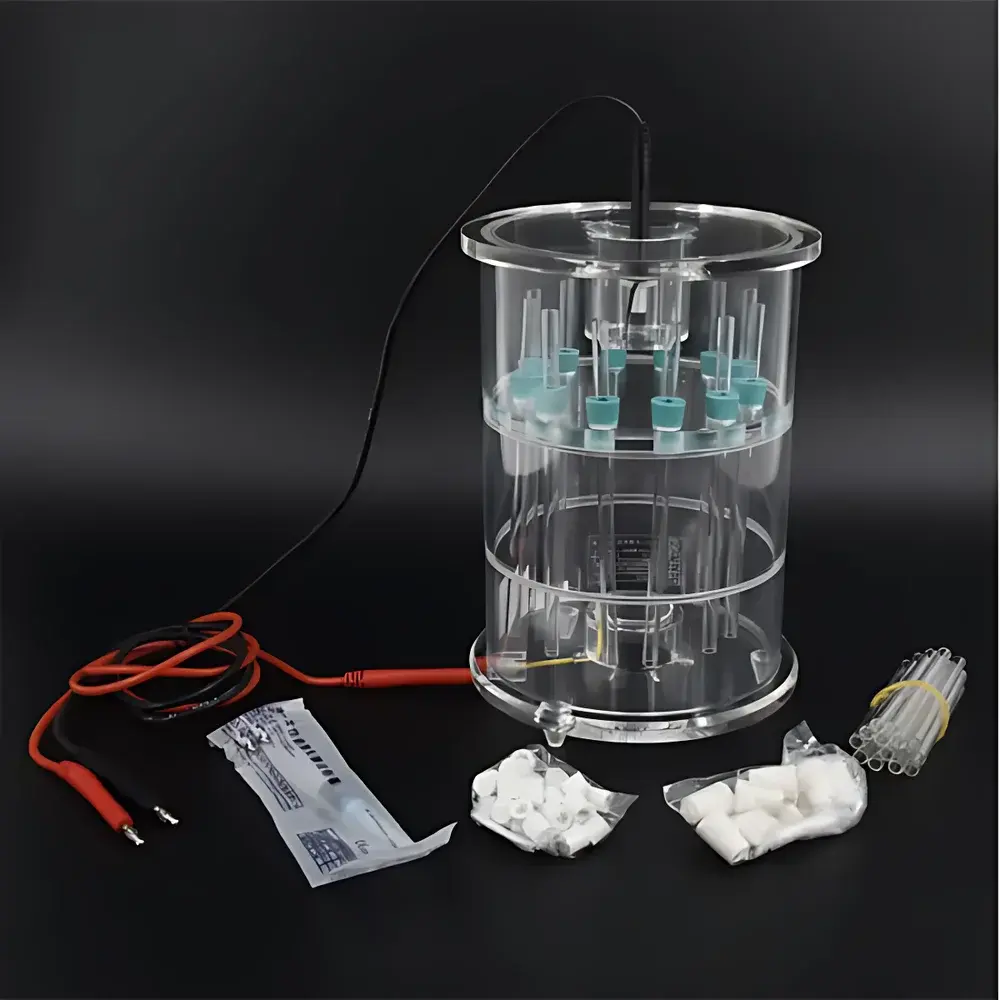
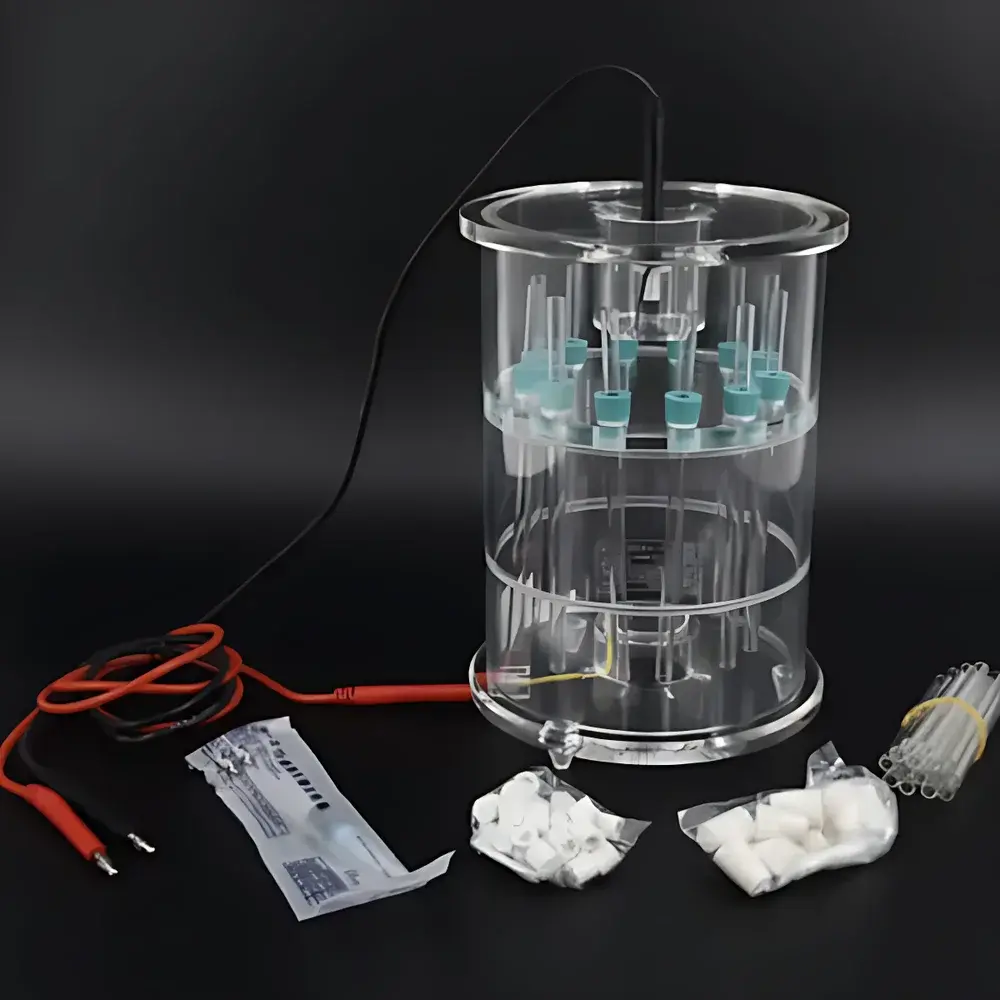
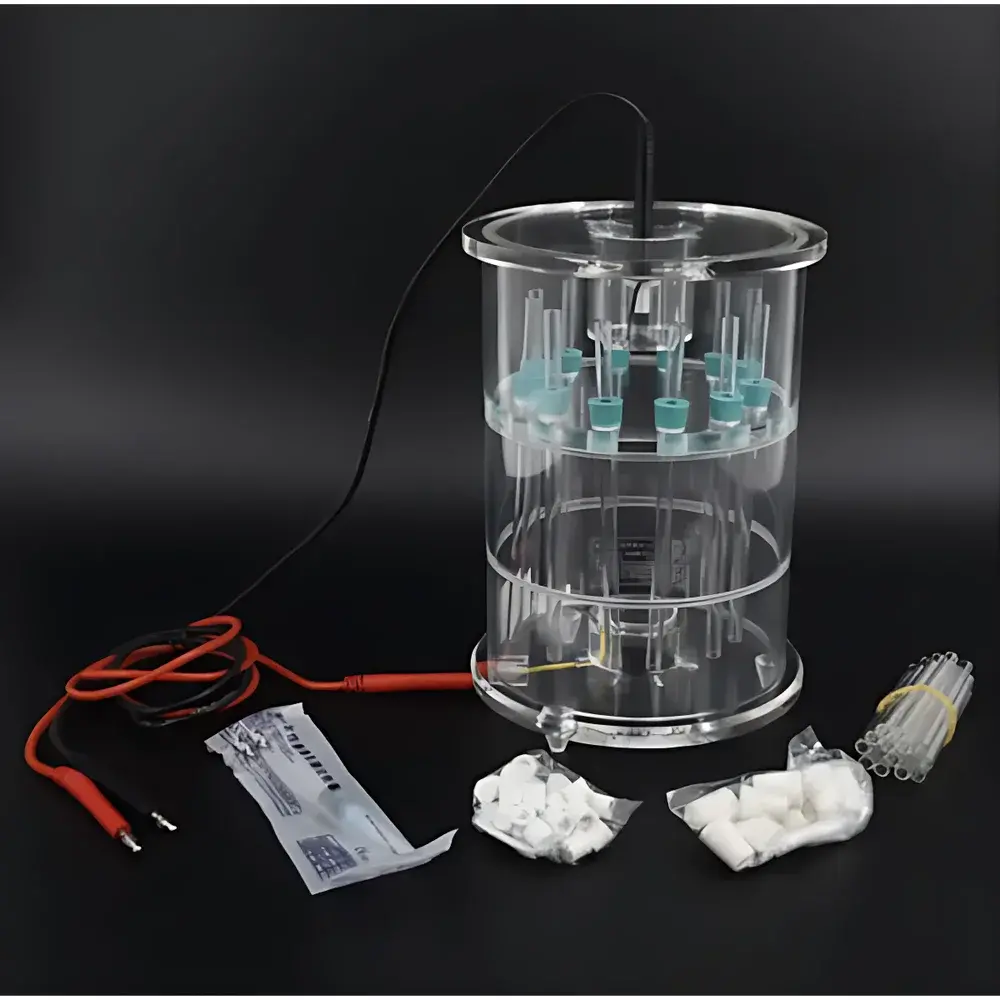
Beijing Liuyi DYCZ-27B Disc Electrophoresis Apparatus (Model 121-2720)
| Brand | Beijing Liuyi (LY) |
|---|---|
| Origin | Beijing, China |
| Instrument Type | Isoelectric Focusing (IEF) Electrophoresis Apparatus |
| Gel Format | Compatible with φ5 mm × 80 mm glass capillary tubes |
| Sample Capacity | 12 sample tubes |
| Dimensions (L×W×H) | 170 × 170 × 235 mm |
| Buffer Volume Capacity | 1000 mL |
| Tube Specifications | φ5 mm inner diameter |
| available lengths | 90 mm and 170 mm |
| Weight | 2 kg |
Overview
The Beijing Liuyi DYCZ-27B Disc Electrophoresis Apparatus (Model 121-2720) is a dedicated vertical tube-based electrophoresis system engineered for high-resolution separation of biomolecules—including proteins, enzymes, and nucleic acids—using discontinuous buffer systems and isoelectric focusing (IEF) principles. Unlike slab-gel electrophoresis, this apparatus employs cylindrical glass capillary tubes arranged radially within a dual-chamber vertical configuration, enabling the formation of sharp, disc-shaped (circular cross-sectional) zones under controlled electric field gradients. The system operates on classical discontinuous electrophoresis theory: stacking gel layers concentrate samples into narrow bands before entering the resolving gel, thereby enhancing resolution and reproducibility. Its design ensures uniform electrode-to-tube center distances across all 12 positions, minimizing field distortion and inter-tube migration variability—a critical requirement for quantitative IEF and comparative proteomic analysis.
Key Features
- Optimized dual-chamber vertical electrophoresis tank with platinum wire electrodes embedded in a corrosion-resistant lid assembly
- Precision-machined silicone rubber grommets: 12 perforated grommets for active tube insertion and 12 non-perforated grommets for sealing unused ports, ensuring consistent buffer containment and thermal stability
- Standardized φ5 mm inner-diameter low-alkali borosilicate glass tubes (90 mm and 170 mm lengths supplied), selected for minimal ion exchange, dimensional consistency, and optical clarity for post-run visualization
- Integrated cooling efficiency via large buffer reservoir (1000 mL total capacity) and compact footprint (170 × 170 × 235 mm), facilitating stable temperature control during extended runs (e.g., overnight IEF)
- Dedicated accessories including JMS 5 mm syringes for precise gel loading, 30 reusable gel-casting grommets, and matched electrode leads with secure alligator clips
Sample Compatibility & Compliance
The DYCZ-27B supports native, denaturing (SDS), and isoelectric focusing electrophoresis in tube format—making it suitable for first-dimension separation in two-dimensional electrophoresis (2-DE) workflows. It accommodates standard biochemical sample volumes (20–100 µL per tube) and common running buffers (e.g., Tris-Glycine, Tris-HCl/Ampholyte systems). While not certified to ISO/IEC 17025 or FDA 21 CFR Part 11 out-of-the-box, its mechanical repeatability, dimensional fidelity, and buffer volume consistency support GLP-aligned documentation practices when paired with validated protocols. Users routinely employ this system in academic teaching labs, core facility pre-screening, and method development for downstream MS-compatible protein fractionation.
Software & Data Management
As a hardware-only electrophoresis platform, the DYCZ-27B does not include embedded firmware or proprietary software. All operational parameters—including voltage (typically 200–1000 V DC), current limit, and run duration—are set externally via compatible power supplies (e.g., Beijing Liuyi DYY-6C or equivalent constant-voltage units). Post-electrophoresis analysis relies on standard imaging systems (UV transilluminators, CCD-based gel doc stations) and open-format image analysis tools (ImageJ, AlphaView SA, TotalLab Quant). Experimental metadata—including tube position, buffer composition, and run conditions—is manually logged to ensure traceability in regulated environments.
Applications
- First-dimension isoelectric focusing in two-dimensional polyacrylamide gel electrophoresis (2D-PAGE) for proteome mapping
- Teaching laboratory demonstrations of discontinuous electrophoretic theory, stacking/resolving gel dynamics, and pI-based protein separation
- Enzyme isoform profiling (e.g., lactate dehydrogenase, esterase) under native conditions
- Quality control of recombinant protein preparations where charge heterogeneity must be resolved prior to HPLC or mass spectrometry
- Method optimization for capillary electrophoresis assay development, leveraging tube geometry as a scalable analog
FAQ
What buffer systems are compatible with the DYCZ-27B?
Tris-Glycine, Tris-HCl, and carrier ampholyte-based IEF buffers (pH 3–10 or narrow-range) are routinely used. Ensure buffer conductivity remains within 1–5 mS/cm to avoid excessive Joule heating.
Can I use polymerized acrylamide gels in the supplied 5 mm tubes?
Yes—the 90 mm and 170 mm tubes are designed for both gradient and homogeneous polyacrylamide gel casting using standard TEMED/APS initiation chemistry.
Is temperature control integrated into the unit?
No built-in Peltier or water-jacketed cooling is provided; stable ambient lab temperature (18–22°C) and adequate buffer volume are relied upon for thermal management.
How is electrical safety ensured during operation?
The unit features insulated electrode housings, recessed platinum wires, and CE-compliant creepage/clearance distances—intended for use only with grounded, current-limited DC power supplies rated ≤1500 V.
Are replacement tubes and grommets available as consumables?
Yes—part numbers 144-0106 (5×90 mm), 144-0107 (5×170 mm), 412-7203 (perforated), and 412-7204 (non-perforated) are stocked globally through authorized distributors.





