
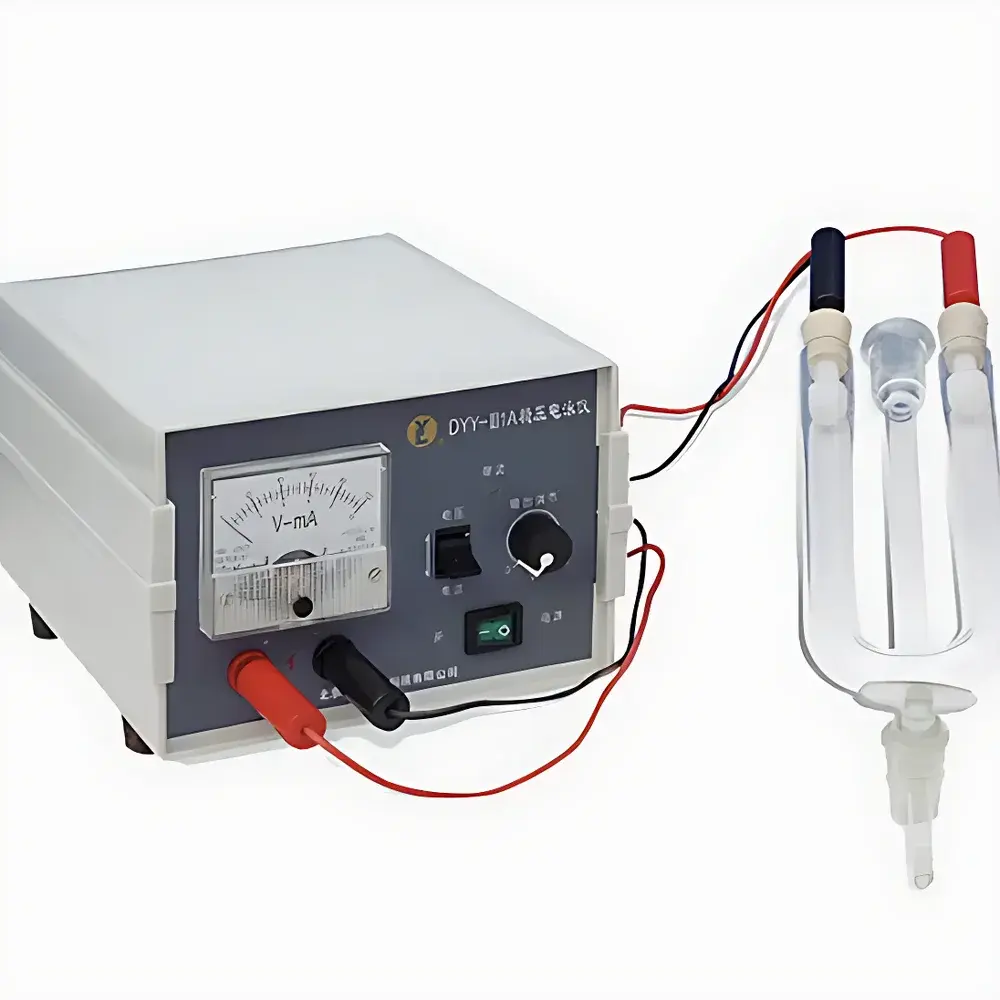
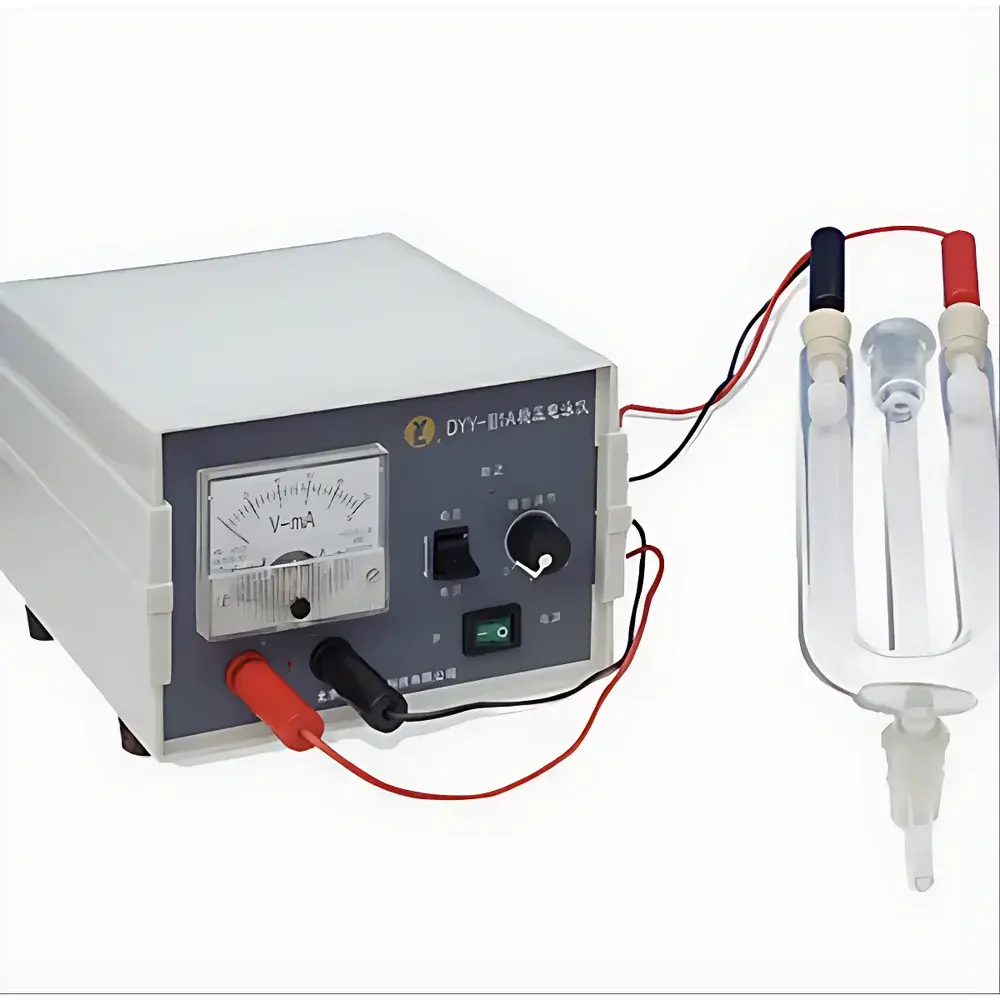
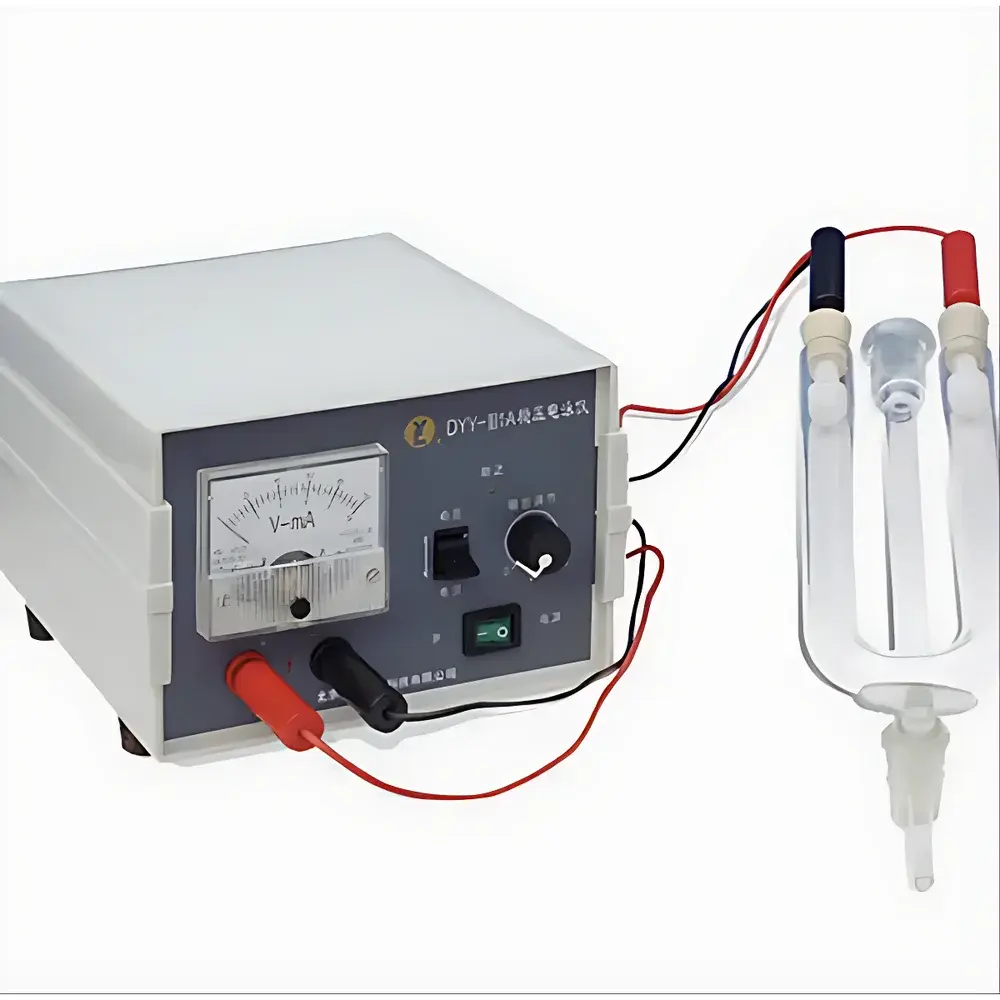
Beijing Liuyi DYCZ-41B U-Tube Electrophoresis Apparatus
| Brand | Beijing Liuyi (LY) |
|---|---|
| Origin | Beijing, China |
| Instrument Type | U-Tube Electrophoresis Apparatus |
| Voltage/Current Range | 0–100 V, 50 mA |
| Dimensions (L×W×H) | 80 × 60 × 280 mm |
| Weight | 0.5 kg |
| Power Supply Compatibility | DYY-1C DC power supply (0–100 V, 50 mA, regulated output) |
| Electrode Type | Multi-turn platinum electrodes |
| Accessories | Graduated U-tube with filling funnel and drain valve, electrophoresis leads, power cord |
Overview
The Beijing Liuyi DYCZ-41B U-Tube Electrophoresis Apparatus is a benchtop educational and research instrument engineered for the quantitative measurement of electrophoretic mobility and zeta potential (ζ-potential) of colloidal particles in aqueous or low-conductivity suspensions. It operates on the principle of classical electrophoresis within a vertically oriented, calibrated U-shaped capillary cell—enabling direct visualization and manual tracking of particle migration under a controlled DC electric field. Unlike slab-gel or capillary electrophoresis systems, the DYCZ-41B employs a macro-scale U-tube geometry optimized for pedagogical clarity and fundamental electrokinetic characterization of coarse colloids, clay slurries, metal oxide dispersions, and polymer latexes. Its design conforms to standard undergraduate physical chemistry laboratory protocols—particularly those aligned with experiment #20, “Optical and Electrical Properties of Sol,” as specified in widely adopted general chemistry curricula across Chinese universities. The apparatus requires external DC power (e.g., DYY-1C unit), ensuring stable voltage regulation and current limiting essential for reproducible mobility calculations.
Key Features
- Calibrated borosilicate glass U-tube with integrated scale markings (0–100 mm range), enabling precise displacement measurement of the liquid meniscus during electrophoretic migration
- Dual multi-turn platinum electrodes mounted at opposing limbs of the U-tube—designed for uniform field distribution and minimal polarization effects at low voltages (≤100 V)
- Integrated filling funnel and precision drain valve for rapid, bubble-free sample loading and controlled fluid exchange between runs
- Analog pointer-style voltmeter for real-time voltage monitoring—compatible with manual data recording and error analysis training
- Compact footprint (80 × 60 × 280 mm) and lightweight construction (0.5 kg)—optimized for shared teaching labs and portable demonstration setups
- Modular interface: compatible with standard DYY-1C regulated DC power supply (output: 0–100 V, 50 mA; dimensions: 240 × 170 × 120 mm; weight: 1.5 kg)
Sample Compatibility & Compliance
The DYCZ-41B supports aqueous and polar organic dispersions with conductivity ≤5 mS/m, including hydrophilic colloids (e.g., Fe₂O₃, SiO₂, TiO₂), clay suspensions (kaolinite, bentonite), and synthetic latex particles (0.1–10 µm nominal diameter). Sample volume per run: 3–5 mL. The U-tube configuration inherently avoids gel matrix interference, making it suitable for systems where polyacrylamide or agarose embedding would alter surface charge or hinder mobility. While not designed for GLP-compliant regulatory testing, its operational parameters align with foundational methodology described in ISO 13099-2 (Colloidal systems — Methods for determining zeta-potential — Part 2: Optical methods) and ASTM D4187 (Standard Test Method for Zeta Potential of Colloidal Dispersions). All wetted components are chemically inert (borosilicate glass, platinum, PTFE-sealed valves), supporting compatibility with mild acids, bases, and surfactants used in colloid stabilization studies.
Software & Data Management
The DYCZ-41B is a manually operated, analog instrument with no embedded microcontroller or digital interface. Data acquisition relies on timed visual observation of meniscus displacement using a stopwatch and ruler—reinforcing core experimental skills in uncertainty propagation, linear regression of mobility vs. field strength, and Smoluchowski equation derivation (ζ = μ·η/ε, where μ = electrophoretic mobility, η = viscosity, ε = permittivity). Instructors may integrate the apparatus into modern lab workflows via optional digital tools: high-resolution USB microscopes for frame-by-frame meniscus tracking, spreadsheet-based calculation templates (Excel, LibreOffice Calc), and export-ready CSV logs for statistical validation. No proprietary software is required; no firmware updates or driver installations are applicable. The system meets basic requirements for audit-trail documentation under educational QA frameworks when paired with standardized lab notebooks and instructor-signed calibration logs.
Applications
- Undergraduate physical chemistry laboratories: hands-on verification of Helmholtz-Smoluchowski theory and Debye-Hückel-Onsager relationships
- Zeta potential screening of mineral processing slurries to optimize flocculant dosage and sedimentation kinetics
- Surface charge characterization of nanomaterials synthesized in teaching labs (e.g., citrate-stabilized Au nanoparticles)
- Comparative electrophoretic mobility studies under varying pH, ionic strength, or surfactant concentration
- Qualitative assessment of colloidal stability via isoelectric point (IEP) estimation through mobility sign reversal
- Method development for non-invasive electrokinetic analysis in resource-limited or field-deployable settings
FAQ
What power supply is required for operation?
The DYCZ-41B must be used with an externally supplied, regulated DC power source such as the DYY-1C (0–100 V, 50 mA constant-voltage output). No internal power regulation is provided.
Can this apparatus measure zeta potential quantitatively?
Yes—when combined with known suspension viscosity (η), dielectric constant (ε), and measured electrophoretic mobility (μ), zeta potential is calculated using the Smoluchowski approximation, valid for particles >1 µm in low-conductivity media.
Is the U-tube resistant to common solvents?
The tube is made of borosilicate glass and is compatible with water, ethanol, methanol, and dilute aqueous acids/bases (pH 2–12); prolonged exposure to strong oxidizers (e.g., concentrated HNO₃) or HF is not recommended.
How is electrode polarization minimized during measurement?
Multi-turn platinum electrodes provide high surface area and low overpotential; operation at ≤50 V and intermittent voltage application (e.g., 60 s ON / 30 s OFF) further reduces polarization artifacts.
Are replacement parts available for long-term educational use?
Yes—U-tubes (P/N 414-1200), platinum electrodes (P/N 414-1201), funnels (P/N 414-1203), and drain valves (P/N 414-1204) are stocked as individual service items with documented dimensional specifications and material certifications.




