
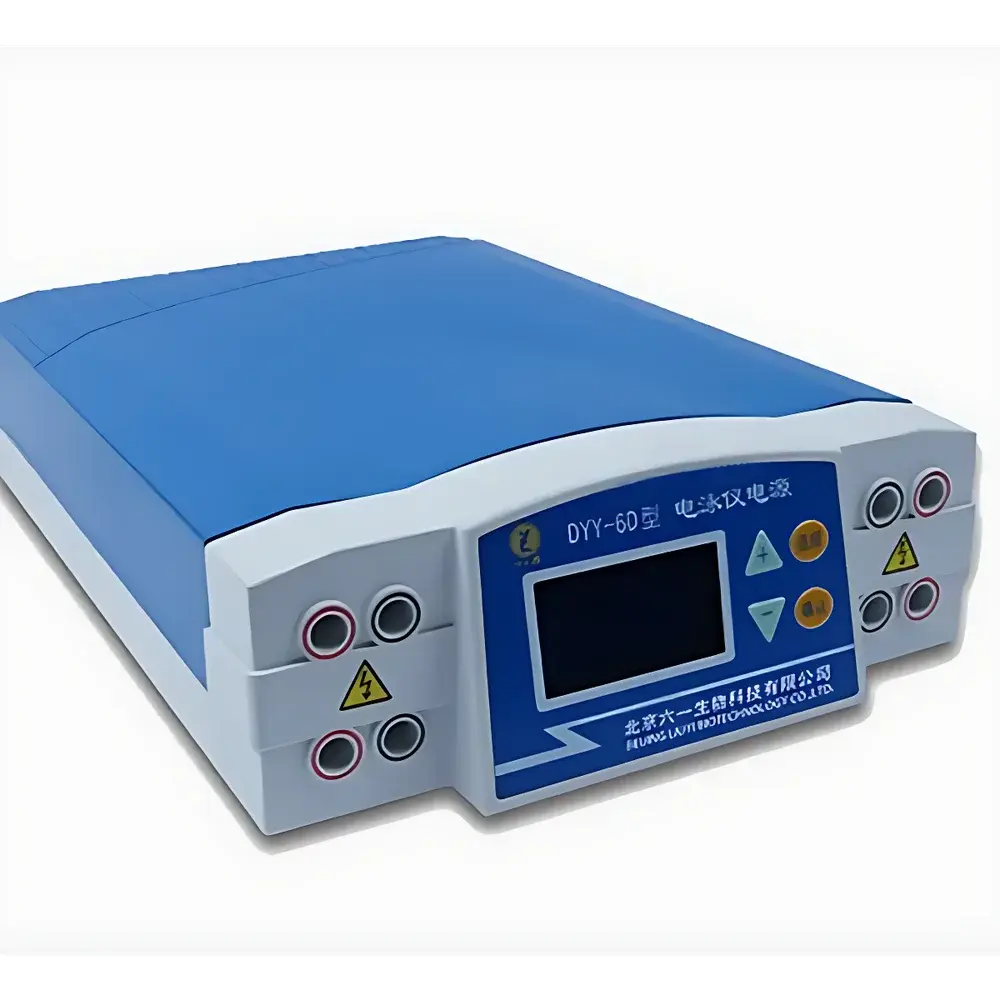
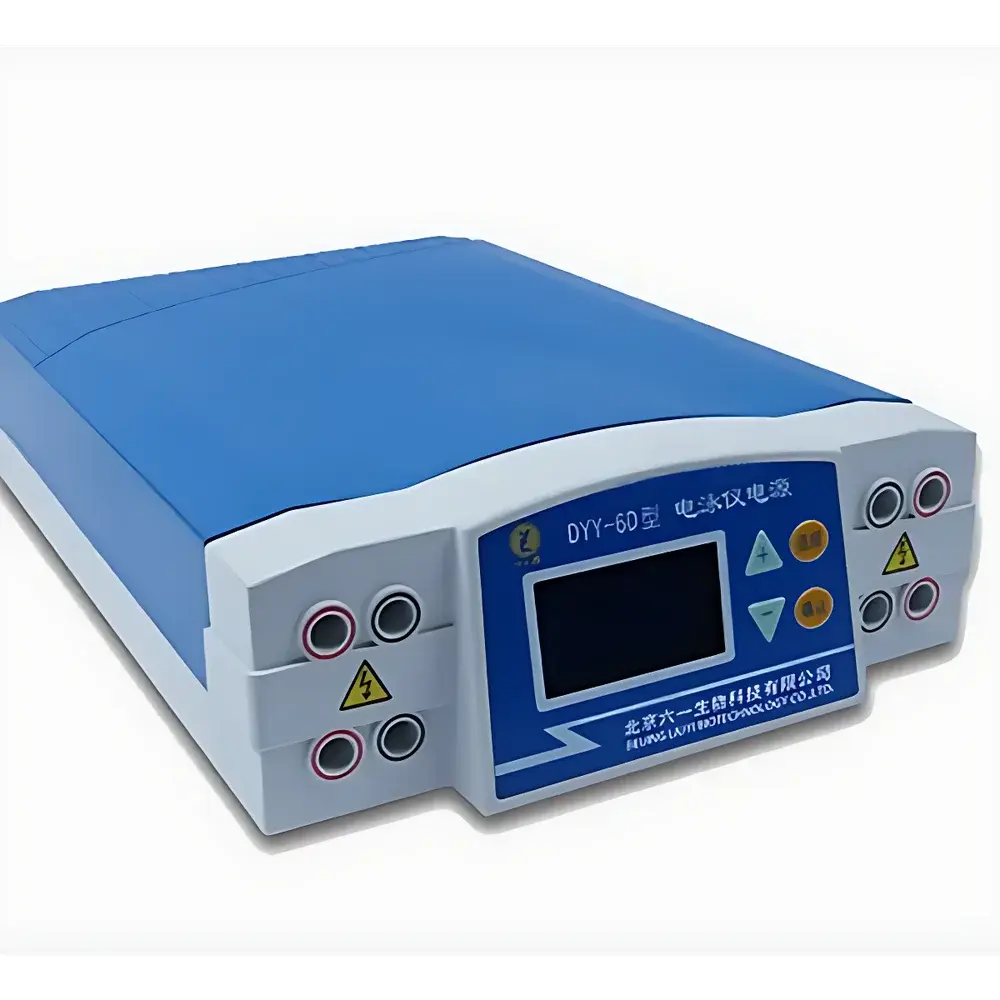
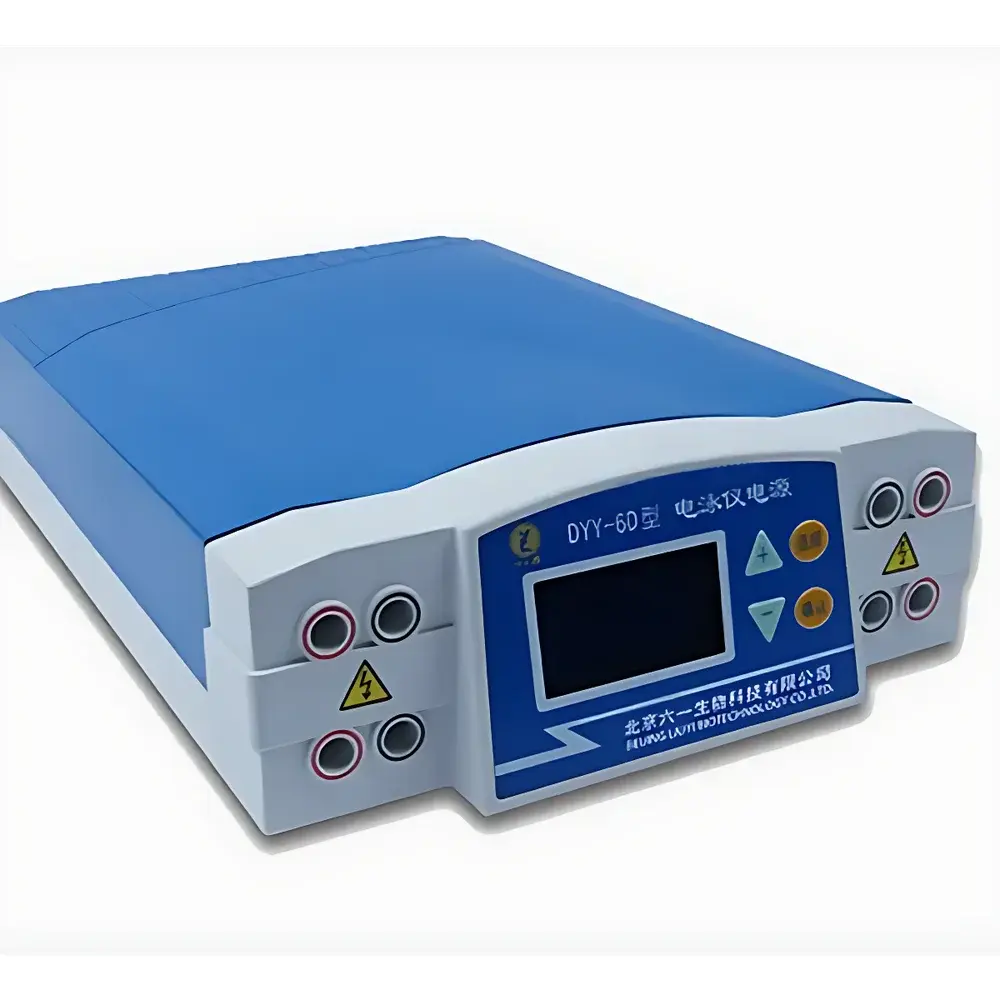
Beijing Liuyi DYY-6D Computer-Controlled Triple-Constant Electrophoresis Power Supply
| Brand | Beijing Liuyi (LY) |
|---|---|
| Origin | Beijing, China |
| Model | DYY-6D |
| Output Channels | 4 independent parallel outputs |
| Voltage Range | 6–600 V (1 V resolution) |
| Current Range | 4–600 mA (1 mA resolution) |
| Power Range | 1–300 W (1 W resolution) |
| Display | Large LCD showing real-time voltage, current, power, and timer |
| Memory Capacity | 10 programmable 3-step protocols |
| Operation Modes | Single-step, multi-step, and auto-recovery after power interruption |
| Safety Features | Over-voltage, over-current, over-power, and short-circuit protection with audible/visual alarm |
| Standby Current Maintenance | Yes |
| Dimensions (W×D×H) | 246 × 360 × 80 mm |
Overview
The Beijing Liuyi DYY-6D is a microprocessor-controlled, triple-constant (constant voltage, constant current, constant power) electrophoresis power supply engineered for reproducible and flexible nucleic acid and protein separation in academic, clinical, and industrial life science laboratories. Designed around a robust linear power architecture—distinct from switch-mode alternatives—the DYY-6D delivers low-noise, ripple-free DC output critical for high-resolution gel electrophoresis, including SDS-PAGE, native PAGE, agarose gel electrophoresis, and horizontal or vertical blotting systems. Its triple-constant operating logic enables automatic mode switching during run progression (e.g., transitioning from constant current to constant voltage as resistance changes), ensuring consistent migration kinetics across variable gel matrices and buffer conductivities. The unit complies with IEC 61010-1 safety standards for laboratory electrical equipment and meets electromagnetic compatibility (EMC) requirements per EN 61326-1 for use in shared instrumentation environments.
Key Features
- Four independent parallel DC outputs—enabling simultaneous operation of multiple electrophoresis tanks without cross-channel interference
- Large backlit LCD display showing real-time voltage, current, power, and countdown timer—no secondary interface required for monitoring
- Triple-constant control algorithm with seamless auto-switching between voltage-, current-, and power-regulated modes based on load feedback
- 10-user-programmable protocols, each supporting up to three sequential steps with individually defined parameters and transition logic
- Power-fail recovery function: automatically resumes the pre-interruption step and timer upon grid restoration, preserving experimental integrity
- Low-ripple linear regulation ensures minimal thermal drift and electroendosmotic artifact—critical for high-molecular-weight DNA separation and quantitative band analysis
- Integrated safety suite: hardware-based over-voltage, over-current, over-power, and short-circuit detection with immediate shutdown and visual/audible alert
- Maintenance current mode: applies a user-defined low-current offset (e.g., 1–5 mA) post-run to prevent gel drying or buffer depletion during extended transfers
Sample Compatibility & Compliance
The DYY-6D supports standard electrophoresis formats including mini-gel units (e.g., Bio-Rad Mini-PROTEAN, Thermo Fisher Owl E1), large-format vertical slab gels (up to 20 × 20 cm), horizontal agarose systems (e.g., Horizon 11–14 series), and semi-dry and wet transfer apparatuses. It is compatible with common running buffers (TAE, TBE, Tris-Glycine, CAPS) across pH 6.0–9.5 and conductivity ranges of 1–25 mS/cm. While not certified for GMP production environments, the device satisfies GLP documentation requirements through its non-volatile protocol memory and deterministic output behavior. All operational parameters are traceable via front-panel logs; no proprietary software is required for audit-ready recordkeeping.
Software & Data Management
The DYY-6D operates as a standalone instrument with no external PC dependency. Protocol storage, execution, and status logging occur entirely within the onboard microcontroller’s EEPROM—ensuring data persistence across power cycles without battery backup. Each stored method includes full parameter sets (V/I/W limits, ramp rates, step durations, and termination conditions), accessible via intuitive rotary encoder navigation. For labs requiring electronic records, manual transcription of displayed values into LIMS or ELN platforms is supported by the unambiguous, high-contrast LCD readout. No USB, Bluetooth, or Ethernet connectivity is provided—minimizing cybersecurity surface area and eliminating driver compatibility concerns.
Applications
- Denaturing and native protein electrophoresis (SDS-PAGE, BN-PAGE, Zymography)
- Agarose and polyacrylamide nucleic acid separation (genomic DNA, plasmid prep QC, PCR product verification)
- Preparative electrophoresis for downstream extraction and mass spectrometry sample prep
- Electroblotting onto PVDF or nitrocellulose membranes (wet, semi-dry, and tank transfer)
- Isotachophoresis and free-flow electrophoresis auxiliary power staging
- Teaching laboratory use—robust construction, clear visual feedback, and intuitive multi-step programming support pedagogical workflows
FAQ
Does the DYY-6D support constant power mode for gradient gels?
Yes—constant power regulation maintains consistent joule heating across gels with spatially varying resistance, reducing band distortion in gradient polyacrylamide systems.
Can protocols be exported or backed up externally?
No—protocols reside exclusively in internal EEPROM. Manual documentation is recommended for long-term archival.
Is the unit suitable for high-voltage applications such as DNA sequencing gels?
It supports up to 600 V, sufficient for most standard sequencing and pulsed-field electrophoresis pre-steps, though dedicated PFGE systems require specialized pulsing circuitry not present in this model.
What maintenance is required?
None beyond periodic cleaning of ventilation grilles and verification of output accuracy using a calibrated multimeter—no consumables or firmware updates are specified.
How does the small-current maintenance function operate?
After completion of the main program, the unit delivers a user-specified low-current output (1–10 mA range) for a defined duration, preventing buffer exhaustion during overnight transfers without risking membrane damage.





