
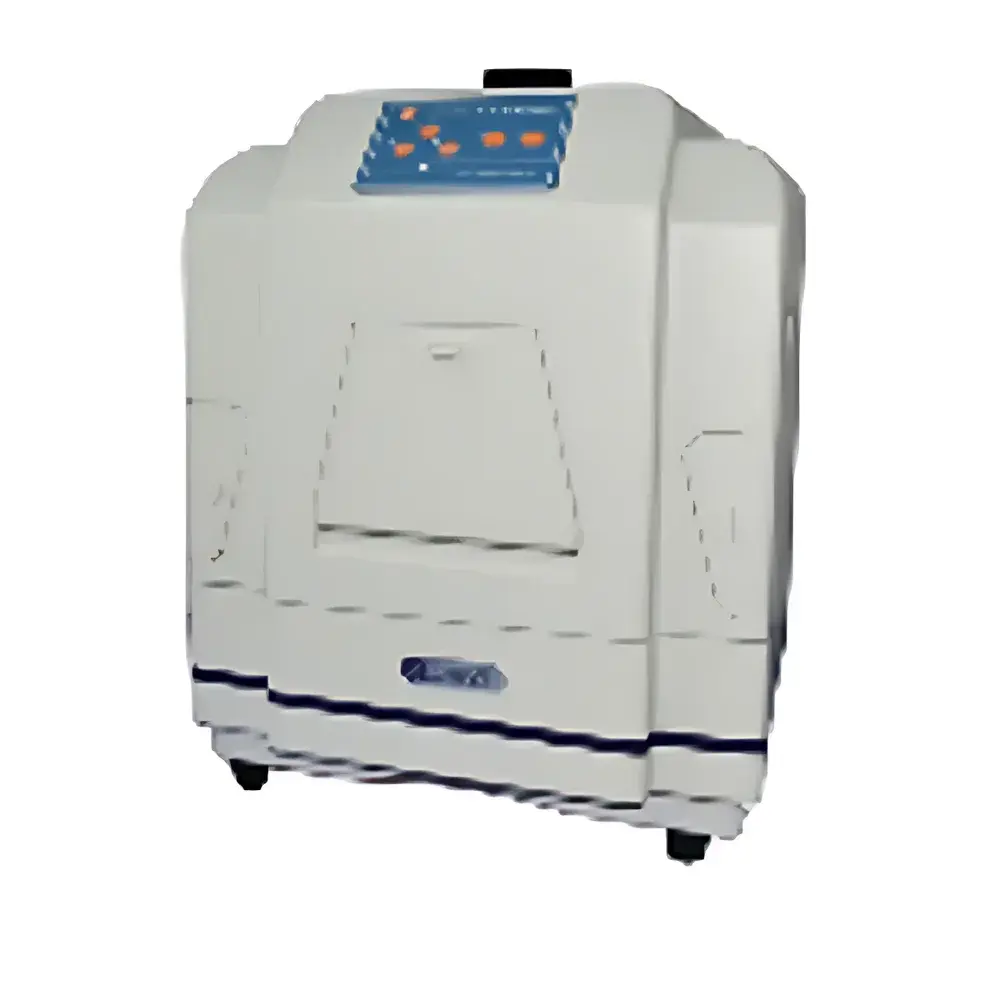
Beijing Liuyi WD-9413A Gel Imaging System
| Brand | Beijing Liuyi (LY) |
|---|---|
| Origin | Beijing, China |
| Manufacturer Type | Authorized Distributor |
| Product Category | Domestic |
| Model | WD-9413A |
| Imaging Mode | Visible-light and UV Transillumination/Reflectance |
| CCD Resolution | 3072 × 2304 pixels |
| Bit Depth | 8-bit |
| Detection Sensitivity | >1 pg double-stranded DNA stained with ethidium bromide (EB) |
| Signal-to-Noise Ratio | ≥66 dB |
| UV Transillumination Wavelengths | 302 nm (primary), 254 nm & 365 nm (reflective) |
| UV Illumination Area | 252 × 252 mm |
| White Light Transillumination Area | 260 × 175 mm |
| Dimensions (W × D × H) | 430 × 456 × 755 mm |
Overview
The Beijing Liuyi WD-9413A Gel Imaging System is a benchtop, darkroom-free imaging platform engineered for high-fidelity visualization, documentation, and quantitative analysis of nucleic acid and protein electrophoresis gels. It operates on the principle of fluorescence excitation and emission capture: UV transillumination (302 nm) excites intercalating dyes such as ethidium bromide (EB), SYBR® Safe, or GoldView™ bound to DNA/RNA, while reflective UV (254 nm and 365 nm) enables detection of proteins or nucleic acids stained with UV-absorbing reagents. A high-resolution 8-bit CCD sensor (3072 × 2304 pixels) captures emitted light with ≥66 dB signal-to-noise ratio, ensuring reliable detection down to sub-nanogram quantities of EB-stained dsDNA. The system’s integrated dark box eliminates ambient light interference, enabling reproducible imaging under standard laboratory lighting conditions—critical for GLP-compliant documentation and routine QC workflows in molecular biology, diagnostics, and academic research labs.
Key Features
- Dark-box enclosure with dual-side access ports for precise gel excision without exposure to ambient light
- Modular drawer-style UV transilluminator with auto-shutoff after 15 minutes at 302 nm—reducing photodamage and enhancing operator safety per IEC 62471 photobiological safety guidelines
- Dual-wavelength reflective UV sources (254 nm and 365 nm) compatible with a broad spectrum of fluorescent and chromogenic stains
- Real-time live preview and motorized auto-focus functionality for rapid image optimization prior to acquisition
- Optimized optical path with high-transmission UV bandpass filter, ensuring maximum sensitivity for EB, SYBR®, and GoldView™
- Native support for TIFF, JPEG, BMP, GIF, and PCX file formats—facilitating interoperability with third-party analysis tools and LIMS environments
Sample Compatibility & Compliance
The WD-9413A accommodates standard agarose and polyacrylamide gels (up to 252 × 252 mm), as well as Western blot membranes and colony plates. Its white-light transilluminator (260 × 175 mm) supports Coomassie- and silver-stained protein gels, while UV reflectance enables direct visualization of UV-absorbing samples without secondary staining. The system meets essential electrical safety requirements per GB 4793.1 (equivalent to IEC 61010-1) and incorporates thermal cutoff protection in the lamp housing. Though not FDA 21 CFR Part 11–certified out-of-the-box, its software architecture supports audit-trail-enabling configurations when deployed with validated IT infrastructure—making it suitable for ISO/IEC 17025-accredited testing laboratories conducting nucleic acid quantification per ISO 13485 or CLIA-aligned protocols.
Software & Data Management
The included professional analysis software provides comprehensive, standards-aligned data processing capabilities across one-dimensional (1D), two-dimensional (2D), and comparative electrophoresis modalities. It delivers calibrated densitometry with background subtraction, lane and band auto-detection (including curved lane recognition), and migration distance normalization. Quantitative outputs include molecular weight estimation (via linear, exponential, or spline-based calibration curves), relative band intensity (% volume), net/peak area integration, and normalized concentration calculation. For genetic profiling, the software supports AFLP, RFLP, and PCR-based clustering with dendrogram generation. 2D module features spot matching across replicates, pI/MW interpolation from internal standards, and differential expression heatmaps. All results export natively to Microsoft Excel (.xlsx) with full metadata retention—including acquisition parameters, user ID, timestamp, and instrument serial number—enabling traceable data lineage per ALCOA+ principles.
Applications
- Quantitative analysis of PCR, RT-PCR, and qPCR products in diagnostic and validation workflows
- Molecular weight determination and purity assessment of recombinant proteins via SDS-PAGE
- Genotyping and fragment analysis in plant breeding, forensic science, and microbial strain typing
- Colony counting and blue-white screening in plasmid cloning pipelines
- Dot/slot blot hybridization signal quantification for gene expression studies
- Documentation and reporting for ISO 15189 or CAP-accredited clinical molecular laboratories
FAQ
Does the WD-9413A support chemiluminescence imaging?
No—the system is optimized for UV and visible-light fluorescence and absorbance detection only. Chemiluminescent signals require cooled CCD or EMCCD sensors with extended exposure capability, which are not included in this configuration.
Can the software generate PDF reports compliant with GLP documentation standards?
Yes—reports can be exported as PDF with embedded timestamps, user authentication logs, and raw image thumbnails. Full GLP compliance requires local validation of the software installation and associated IT controls.
Is the camera interchangeable with other models?
The system integrates a calibrated OEM digital camera module; substitution with third-party DSLRs is not supported due to proprietary driver integration and optical alignment dependencies.
What UV safety certifications does the dark box meet?
The enclosure conforms to GB/T 14710 (Environmental Adaptability of Medical Electrical Equipment) and includes interlocked UV shutoff upon lid opening, satisfying Class 1 UV hazard classification per IEC 62471.
Does the system support multi-user permission levels?
The base software operates in single-user mode. Role-based access control and electronic signatures require integration with external LIMS or custom middleware deployment.
Related Products




