
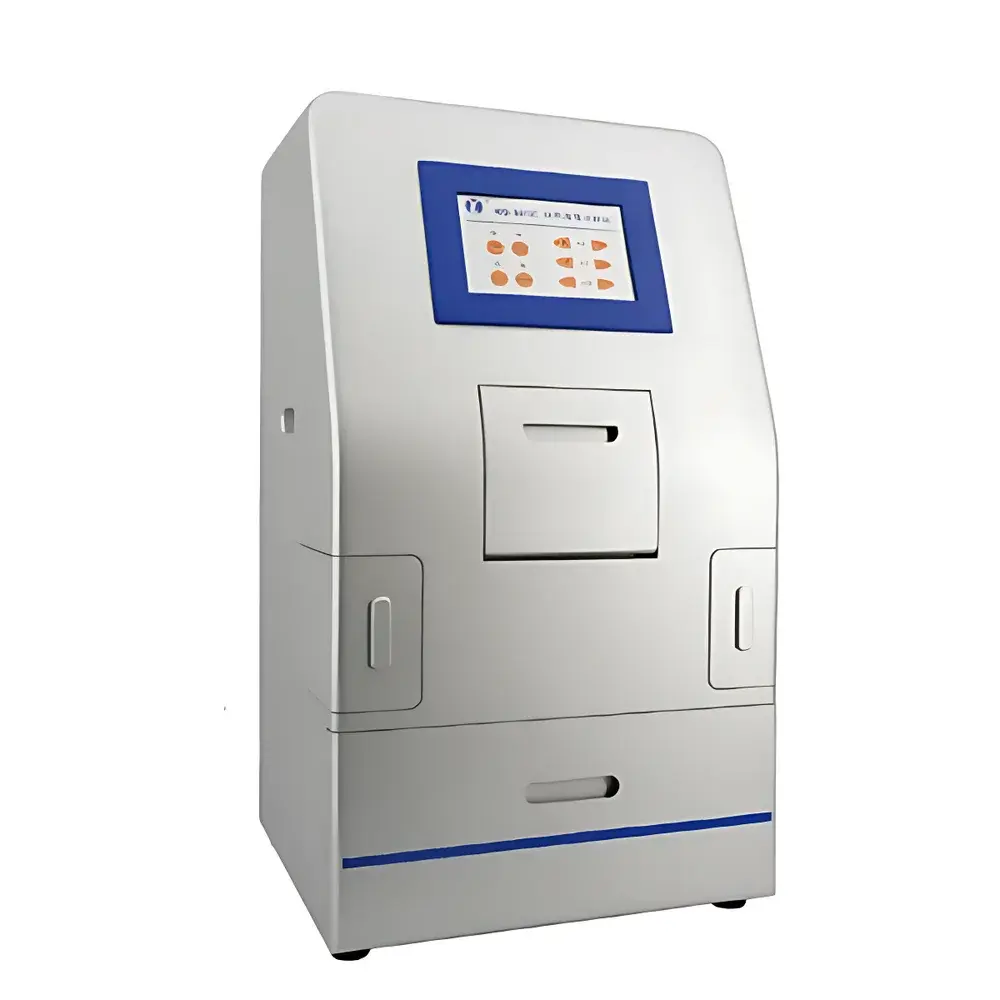
Beijing Liuyi WD-9413C Gel Documentation and Analysis System
| Brand | Beijing Liuyi (LY) |
|---|---|
| Origin | Beijing, China |
| Manufacturer Type | Authorized Distributor |
| Product Category | Domestic |
| Model | WD-9413C |
| Imaging Mode | Visible-Light Gel Imaging System |
| CCD Resolution | 1.3 MP (optional upgrade to 5 MP or 6.4 MP) |
| Bit Depth | 8-bit |
| Dynamic Range | 62 dB |
| CCD Sensor Size | 1/4″ |
| Signal-to-Noise Ratio | 62 dB |
| Lens | Professional 6× Motorized Optical Zoom Lens |
Overview
The Beijing Liuyi WD-9413C Gel Documentation and Analysis System is a dedicated benchtop instrument engineered for high-fidelity visualization, digital capture, and quantitative analysis of nucleic acid and protein gels under UV transillumination (302 nm), UV reflectance (254 nm / 365 nm), and visible-light white-light transmission (260 × 175 mm). Based on solid-state monochrome CCD imaging technology and optimized optical path design, the system delivers reproducible, low-noise digital images suitable for publication-grade documentation and compliance-critical laboratory workflows. Its integrated dark chamber architecture eliminates dependency on external darkrooms, enabling consistent operation in standard laboratory lighting conditions—critical for routine QC, teaching labs, and GLP-aligned research environments.
Key Features
- Motorized 6× optical zoom lens with remote-controlled focus, aperture, and zoom adjustment via both front-panel interface and PC software—ensuring precise framing without physical contact or vibration-induced blur.
- High-sensitivity 1/4″ monochrome CCD sensor (1.3 MP default; optional 5 MP or 6.4 MP modules available) with 5.2 µm × 5.2 µm pixel pitch and programmable exposure time (1–2000 ms), supporting hard integration for low-light signal stability.
- Dual-mode illumination: UV transilluminator (302 nm, 252 × 252 mm active area) with EB-optimized multi-layer interference filter (M52 × 0.75 thread); UV reflectance sources (254 nm & 365 nm); and white-light transmission panel with switchable UV/white-light conversion screen.
- Real-time preview and auto-focus functionality—reducing operator variability and accelerating image acquisition across multiple gel batches.
- USB 2.0 interface ensures plug-and-play compatibility with Windows platforms (Win98 through Windows 10/11); no internal PC hardware modification required, simplifying IT maintenance and audit readiness.
- Integrated dual-control architecture: independent operation from control panel or host PC—including UV lamp activation, lens parameter adjustment, and exposure initiation—enhancing workflow flexibility and safety compliance.
Sample Compatibility & Compliance
The WD-9413C supports standard electrophoretic formats including agarose, polyacrylamide (PAGE), SDS-PAGE, native PAGE, and 2D gels. It accommodates minigels (up to 15 × 15 cm), large-format gels (up to 25 × 25 cm), and blot membranes. All UV components meet IEC 61000-4 electromagnetic compatibility standards. The system’s optical design minimizes stray light and ensures uniform illumination intensity across the imaging field—essential for accurate densitometric quantification per ISO/IEC 17025 guidelines. While not FDA 21 CFR Part 11–certified out-of-the-box, its software architecture supports audit-trail-enabling configurations when deployed with validated IT infrastructure and documented SOPs.
Software & Data Management
The bundled professional analysis software provides a unified environment for image acquisition, processing, and quantitative interpretation. Core capabilities include:
- Image enhancement: brightness/contrast/gamma adjustment, grayscale normalization, rotation, mirroring, cropping, and scaling—preserving original pixel integrity via non-destructive editing layers.
- 1D electrophoresis analysis: automatic lane detection (including curved lanes), band identification, molecular weight calibration using reference ladders, integrated density calculation (net/peak area, relative %, intensity, migration distance in pixels), and contour overlay for iso-molecular-weight alignment.
- Specialized modules: colony counting (blue-white screening), dot/slot blot quantification, and spot detection for 2D gels.
- Data export: direct export to Microsoft Excel (.xls/.xlsx) with full metadata retention—including acquisition parameters, annotation layers, and calibration curves—for traceability and regulatory reporting.
- File format support: TIFF (lossless), JPEG, BMP, and GIF—enabling seamless integration into LIMS, ELN, and publication pipelines.
Applications
The WD-9413C serves core applications in molecular biology, biochemistry, and biotechnology laboratories: DNA fragment sizing and purity assessment post-PCR or restriction digestion; protein expression profiling and post-translational modification analysis; RNA integrity evaluation (e.g., RIN estimation via ribosomal band ratios); quality control of cloning constructs; verification of CRISPR editing outcomes; and educational demonstration of electrophoretic principles. Its robustness and ease of use make it particularly suited for shared-resource facilities, undergraduate teaching labs, and contract research organizations requiring standardized, repeatable gel documentation.
FAQ
Is the WD-9413C compatible with third-party analysis software such as ImageJ or Quantity One?
Yes—TIFF output preserves raw pixel data and metadata, allowing import into open-source or commercial platforms. However, advanced features (e.g., auto-lane detection, molecular weight interpolation) require the native software.
What safety measures are implemented for UV exposure?
The dark chamber fully encloses UV sources; interlock switches deactivate lamps upon door opening. Optional UV-blocking acrylic shields and protective eyewear comply with ANSI Z87.1 standards.
Can the system perform fluorescence imaging (e.g., SYBR Safe, Cy dyes)?
No—the standard configuration lacks excitation filters and long-pass emission optics required for fluorescence. Fluorescence-capable variants (e.g., WD-9413F) are available separately.
Does the software support multi-user permissions or electronic signatures?
Out-of-the-box, it does not include role-based access control or digital signature modules. These can be implemented via enterprise-level deployment with middleware integration.
What is the recommended maintenance schedule?
Annual calibration of UV intensity uniformity and CCD dark-current drift is advised. Lens cleaning with optical-grade solvents and filter inspection every 6 months ensure sustained image fidelity.
Related Products




