
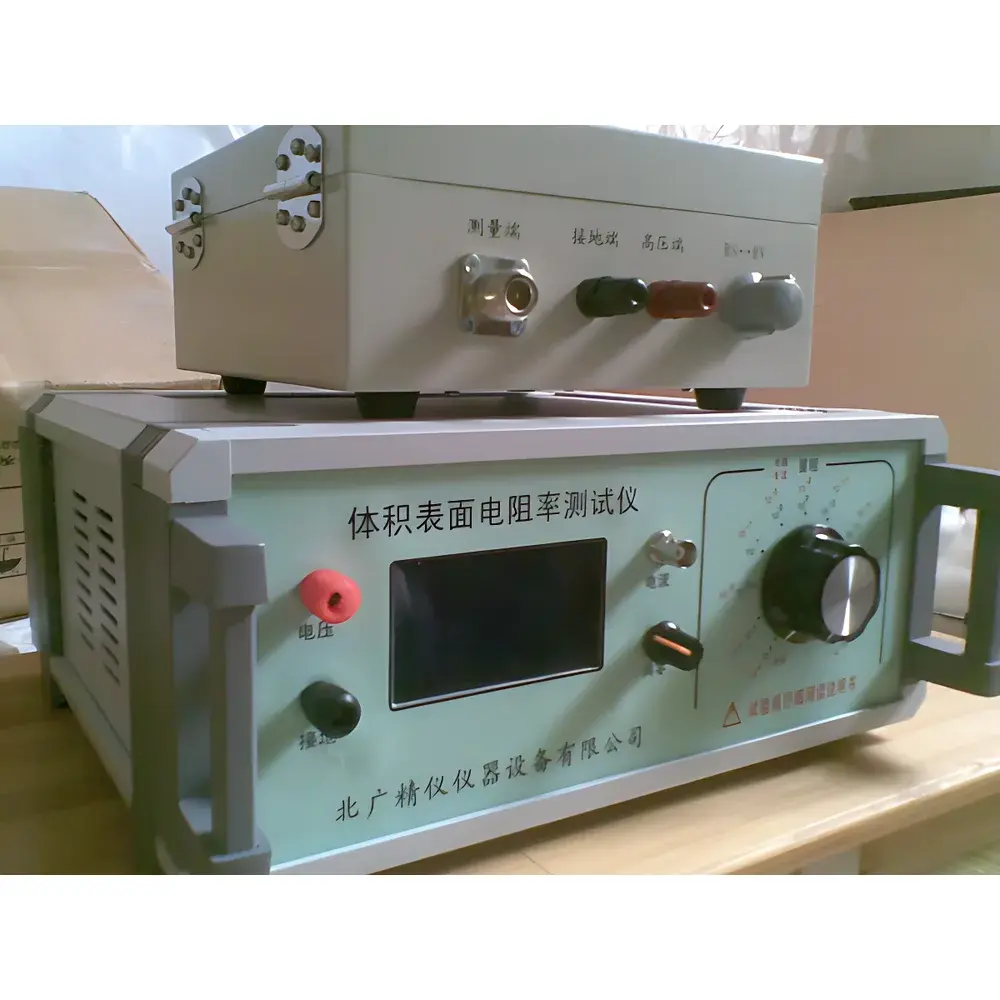
Beijing North Guang BEST-121 Volume & Surface Resistivity Tester for Solids, Liquids, and Powders
| Brand | North Guang Precision Instrument |
|---|---|
| Origin | Beijing, China |
| Manufacturer Type | Direct Manufacturer |
| Product Category | Domestic (China-made) |
| Model | BEST-121 |
| Price | USD 2,800 (approx.) |
Overview
The Beijing North Guang BEST-121 Volume & Surface Resistivity Tester is a precision electrometric instrument engineered for high-accuracy measurement of electrical resistance and extremely low current in insulating and antistatic materials. It operates on the principle of constant-voltage DC resistivity measurement—applying calibrated test voltages across a defined electrode configuration to determine volume resistivity (ρ, in Ω·cm) and surface resistivity (σs, in Ω/sq) per ASTM D257 and IEC 62631-3-1. The instrument employs a guarded two-terminal or three-terminal measurement architecture with active feedback compensation to minimize leakage errors and ensure stable readings over 14 decades of resistance (10⁴ Ω to 10¹⁸ Ω) and 12 decades of current (2 × 10⁻⁴ A to 1 × 10⁻¹⁶ A). Its dual digital LCD display simultaneously presents both resistance value and measured current, eliminating manual calculation and enabling real-time correlation between applied field and conduction response—an essential capability for evaluating charge dissipation kinetics in electrostatic control materials and dielectric characterization workflows.
Key Features
- Wide resistance range: 1 × 10⁴ Ω to 1 × 10¹⁸ Ω, subdivided into ten auto-ranging or manual-selectable decades
- Ultra-low current measurement capability: 2 × 10⁻⁴ A to 1 × 10⁻¹⁶ A, suitable for dark current and leakage current analysis
- Six programmable DC test voltages: 10 V, 50 V, 100 V, 250 V, 500 V, and 1000 V (±10% accuracy), compliant with standard test protocols for insulating materials
- Integrated dual-display interface showing resistance (Ω) and current (A) concurrently—no scaling factor required
- Compact benchtop design (300 × 280 × 150 mm), lightweight (3.0 kg), low power consumption (~10 W, AC 220 V / 50 Hz)
- Temperature- and humidity-stable operation: –10 °C to +50 °C ambient, RH < 90% non-condensing
- Meets or exceeds performance requirements of GB/T 1410–2006 (equivalent to ASTM D257–14 and IEC 60093)
Sample Compatibility & Compliance
The BEST-121 supports standardized resistivity testing across heterogeneous sample forms—including solid slabs, molded polymer parts, liquid electrolytes, conductive pastes, and free-flowing powders—when used with appropriate electrode fixtures (e.g., concentric ring electrodes for surface resistivity, guarded parallel plate electrodes for volume resistivity). Its design conforms to international standards governing insulating material evaluation: ASTM D257 (Standard Test Methods for DC Resistance or Conductance of Insulating Materials), IEC 62631-3-1 (Dielectric and resistive properties of solid insulating materials — Part 3-1: Determination of resistive properties — Resistivity), and GB/T 1410–2006 (Chinese national standard for volume and surface resistivity testing). For regulated environments, the instrument’s fixed-voltage output, traceable calibration path, and stable analog front-end support GLP-compliant documentation when paired with external data logging systems. While not natively 21 CFR Part 11 compliant, its deterministic analog signal chain and unambiguous digital readout facilitate audit-ready manual recordkeeping in QC laboratories.
Software & Data Management
The BEST-121 operates as a standalone hardware instrument with no embedded firmware-based software or USB/RS-232 connectivity. All measurements are displayed directly on its high-contrast LCD screen; no proprietary drivers, cloud platforms, or PC interfaces are included. This architecture ensures operational reliability, electromagnetic immunity, and long-term maintenance simplicity—particularly advantageous in industrial QA labs where IT policy restricts peripheral device integration. Users may manually record results in LIMS or Excel using standardized templates aligned with ISO/IEC 17025 reporting conventions. Optional third-party data acquisition modules (e.g., USB-based digital multimeters with SCPI support) can be interfaced externally for automated logging, provided voltage compliance and guarding integrity are preserved during integration.
Applications
- Quality assurance of ESD-control products: antistatic footwear, conductive flooring, polymer packaging films, and rubber conveyor belts
- Volume and surface resistivity mapping of insulating ceramics, laminates, and composite substrates in electronics manufacturing
- Material development for battery separators, solid-state electrolytes, and dielectric thin films
- Research-grade characterization of photoconductive decay, trap-assisted conduction, and space-charge-limited current (SCLC) in organic semiconductors
- Low-current metrology: dark current profiling of photodiodes, leakage current screening of capacitors, and ion-conduction studies in ionic liquids
- Academic and industrial validation of resistivity models under variable environmental conditions (optional external climate chamber integration)
FAQ
What standards does the BEST-121 comply with?
It meets GB/T 1410–2006 and is functionally aligned with ASTM D257–14 and IEC 62631-3-1 for volume and surface resistivity determination.
Can it measure both volume and surface resistivity on the same sample?
Yes—when used with standardized electrode configurations (e.g., ASTM D257-compliant guarded electrodes), it delivers traceable values for both parameters.
Is temperature or humidity control built into the instrument?
No—the BEST-121 itself does not regulate environmental conditions, but its specifications permit operation within –10 °C to +50 °C and RH < 90%; external climate chambers may be integrated for controlled-condition testing.
Does it support automated data export?
Not natively—the unit lacks digital communication ports; however, external DAQ systems can capture displayed values via optical character recognition or analog voltage output (if added via custom modification).
What is the typical calibration interval recommended?
Annual calibration against NIST-traceable reference resistors (e.g., 10⁶ Ω to 10¹² Ω standards) is recommended for ISO/IEC 17025-compliant use.



