
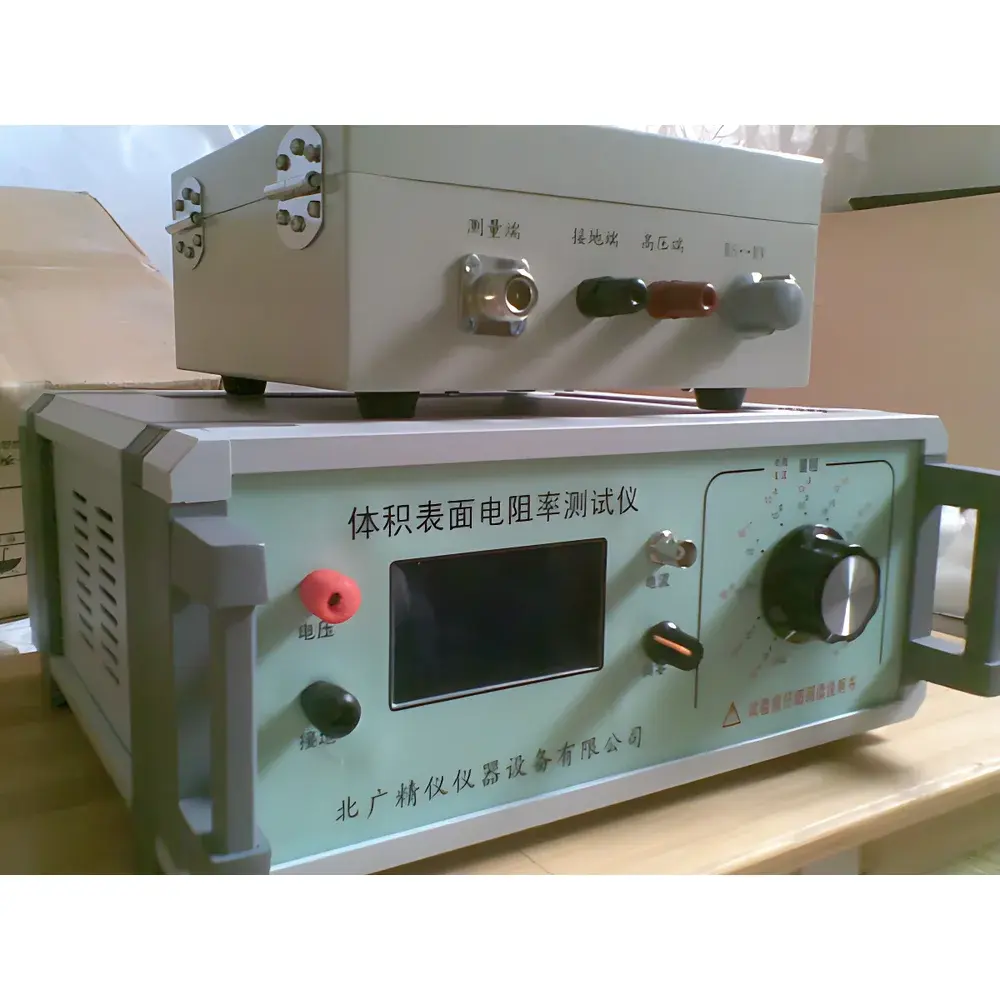
Beijing North Guang Precision Instruments BEST-121 Digital High-Resistance & Ultra-Low-Current Meter
| Brand | Beijing North Guang Precision Instruments |
|---|---|
| Origin | Beijing, China |
| Manufacturer Type | OEM/ODM Manufacturer |
| Country of Origin | China |
| Model | BEST-121 |
| Pricing | Upon Request |
| Resistance Range | 1×10⁴ Ω to 1×10¹⁸ Ω |
| Current Range | 2×10⁻⁴ A to 1×10⁻¹⁶ A |
| Test Voltages | 10 V, 50 V, 100 V, 250 V, 500 V, 1000 V (selectable) |
| Accuracy | ±1% (for R < 10¹⁰ Ω) |
| Display | Dual 3½-digit LED (resistance and current) |
| Power Supply | AC 220 V, 50 Hz, ~5 W |
| Dimensions | 285 mm × 245 mm × 120 mm |
| Weight | ~2.5 kg |
| Operating Environment | 0–40 °C, RH < 80% |
Overview
The Beijing North Guang Precision Instruments BEST-121 Digital High-Resistance & Ultra-Low-Current Meter is a precision electrometric instrument engineered for direct, simultaneous measurement of volume resistivity, surface resistivity, and conductivity of solid, powdered, and liquid dielectric materials. It operates on the fundamental principle of Ohm’s Law (R = V/I), employing a high-stability voltage source and a low-noise, feedback-compensated picoammeter circuit to measure current across a known applied DC bias. The instrument integrates digital signal processing with guarded electrode architecture to minimize leakage currents and electrostatic interference—critical for reliable characterization of insulating and antistatic materials where surface contamination, humidity, and stray capacitance significantly influence readings. Designed for compliance with international standard test methodologies, the BEST-121 supports traceable, repeatable measurements under controlled laboratory conditions, serving as a primary tool in quality control labs, R&D facilities, and certification testing environments for electrostatic discharge (ESD)-sensitive components and compliant flooring systems.
Key Features
- Wide resistance measurement range: 1×10⁴ Ω to 1×10¹⁸ Ω—enabling evaluation from moderately conductive polymers to ultra-high-purity insulators.
- Ultra-low current detection capability: down to 1×10⁻¹⁶ A, supporting dark current analysis of photodiodes and leakage studies in thin-film dielectrics.
- Multi-step DC test voltage selection (10 V, 50 V, 100 V, 250 V, 500 V, 1000 V), all internally regulated and switchable without external accessories.
- Dual-parameter real-time display: independent 3½-digit LED readouts for resistance (Ω) and current (A), eliminating manual calculation or scaling factors.
- Guarded input architecture with triaxial cabling support to suppress surface leakage and improve measurement integrity on high-impedance samples.
- Compact benchtop form factor (285 × 245 × 120 mm) with low power consumption (~5 W), suitable for shared lab spaces and portable metrology setups.
- Stable thermal design and auto-zeroing circuitry ensure long-term drift < 0.5% per hour under nominal operating conditions (23 ± 2 °C).
Sample Compatibility & Compliance
The BEST-121 is compatible with standardized electrode fixtures—including concentric ring electrodes for surface resistivity (ASTM F150), parallel plate electrodes for volume resistivity (IEC 62631-3-1), and powder resistivity cells per ASTM D257 Annex A5. It fully satisfies the electrical measurement requirements of GB/T 1410–2006 (equivalent to IEC 60093), ASTM D257–14, and ISO 3915:2010 for resistive property determination. When configured with calibrated reference resistors and operated within its specified environmental envelope (0–40 °C, RH < 80%), the system meets GLP documentation requirements for raw data recording and instrument calibration traceability. While not inherently 21 CFR Part 11 compliant, its analog output and stable analog-to-digital conversion architecture allow integration into validated LIMS or ELN platforms via optional analog voltage output modules.
Software & Data Management
The BEST-121 operates as a standalone instrument with no embedded firmware-based data logging. However, its analog output (0–2 V corresponding to log₁₀(R)) and RS-232 interface (optional add-on module) enable connection to third-party acquisition software such as LabVIEW, MATLAB, or custom Python-based DAQ scripts. Users may configure automated voltage sweeps, timed sampling intervals, and pass/fail threshold alerts using external controllers. All measurement records—including applied voltage, measured current, calculated resistance, timestamp, and operator ID—can be exported in CSV format for audit-ready reporting. For GMP-regulated environments, supplementary validation documentation (IQ/OQ protocols) and calibration certificates (traceable to NIM, China) are available upon request.
Applications
- ESD control verification: quantitative assessment of electrical resistance in antistatic footwear, workbench mats, and raised access flooring per ANSI/ESD S20.20 and IEC 61340-4-1.
- Insulation material qualification: volume resistivity testing of epoxy resins, silicone elastomers, and polyimide films used in aerospace and medical device encapsulation.
- Powder resistivity analysis: characterization of conductive carbon black fillers, metal oxide powders, and battery electrode slurries during formulation development.
- Research-grade leakage current profiling: dark current measurement of photodetectors, Schottky barrier diodes, and organic semiconductor thin films.
- Academic materials science: correlation of resistivity with crystallinity, doping concentration, and environmental aging in polymer nanocomposites.
FAQ
What electrode configurations are supported for solid vs. powder measurements?
The BEST-121 accepts industry-standard electrode fixtures: two-probe collinear probes for bulk solids, three-terminal guarded electrodes for surface resistivity, and dedicated powder resistivity cells with adjustable compaction pressure per ASTM D257 Annex A5.
Is the instrument supplied with calibration certificates?
Yes—each unit ships with a factory calibration report (traceable to National Institute of Metrology, China) covering resistance accuracy at six voltage points and current linearity across three decades.
Can the BEST-121 measure time-dependent resistivity (e.g., dielectric absorption)?
No—it performs static DC measurements only. For time-resolved polarization/depolarization current analysis, a dedicated electrometer with programmable step-voltage sequencing (e.g., Keysight B2987A) is recommended.
Does it meet FDA or ISO 13485 requirements for medical device testing?
The instrument itself is not certified to ISO 13485, but its measurement methodology and documented calibration chain comply with clause 7.6 of ISO 13485 when used within an audited QMS framework.
How often should recalibration be performed?
Annual recalibration is recommended for routine QC use; biannual calibration is advised for applications requiring ≤±5% uncertainty at >10¹⁵ Ω.



