
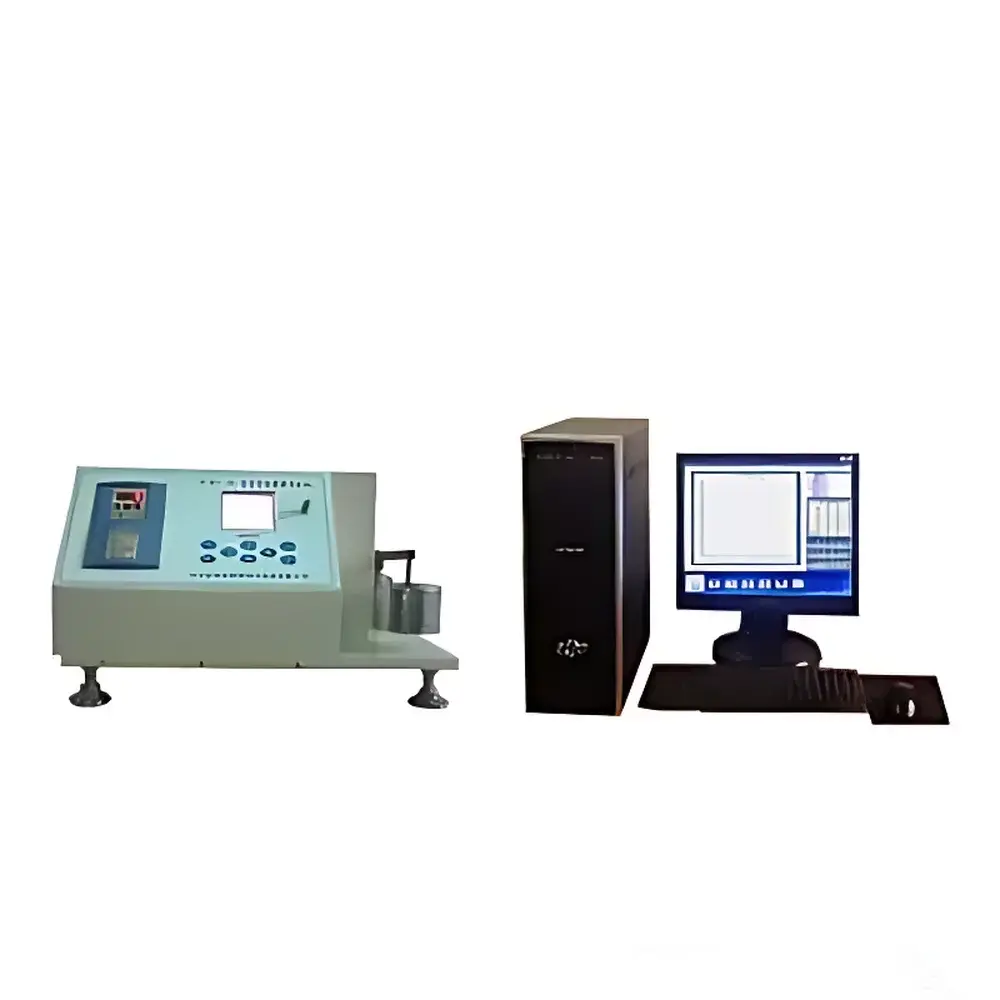
Beijing North Guang Precision Instruments M-200 Tribological Tester
| Brand | Beijing North Guang Precision Instruments |
|---|---|
| Origin | Beijing, China |
| Manufacturer Type | Direct Manufacturer |
| Model | M-200 |
| Pricing | Available Upon Request |
| Compliance | GB/T 3960–2016 (Plastics — Determination of Coefficient of Friction and Wear Rate under Sliding Conditions) |
| Load Capacity | Up to 2000 N |
| Rotational Speed Range | 0–400 rpm (infinitely variable, dual-speed motor drive) |
| Friction Torque Measurement Range | 0–15 N·m |
| Torque Accuracy | ±3% FS (full scale, ≥10% FS) |
| Normal Load Accuracy | ±2% FS (≥10% FS) |
| Sample Dimensions | 30 mm × 7 mm × 6 mm ± 0.1 mm |
| Counter Range | 1 s – 9999 min (time), 1 – 999999 revolutions |
| Sensor Resolution | 1% FS |
| Weight | ~45 kg |
Overview
The Beijing North Guang Precision Instruments M-200 Tribological Tester is a benchtop, microprocessor-controlled sliding wear and friction measurement system engineered for standardized evaluation of tribological performance in polymeric, elastomeric, and composite materials. It operates on the principle of controlled sliding contact between two solid surfaces—typically a rotating lower specimen (disk or ring) and a stationary or counter-rotating upper specimen (pin or block)—under precisely regulated normal load, rotational speed, and environmental conditions. The instrument implements the methodology defined in GB/T 3960–2016, which aligns closely with international practices such as ASTM D3702 (Standard Test Method for Wear Characteristics of Plastic Materials Using a Pin-on-Disk Apparatus) and ISO 7148-1 (Plain Bearings — Materials — Part 1: Metallic Bearing Materials). Its dual-speed induction motor architecture enables programmable slip ratios (e.g., 10% nominal slip at 200/180 rpm configuration), allowing systematic investigation of mixed lubrication regimes and transition from boundary to partial hydrodynamic friction behavior.
Key Features
- Microcontroller-based 16-bit electronic control system with integrated real-time data acquisition and automatic test sequencing.
- Dual-speed motor drive (2880/1440 rpm) coupled via precision gear trains to deliver selectable lower-shaft speeds (200/400 rpm) and upper-shaft speeds (180/360 rpm), enabling precise slip ratio control without external frequency inverters.
- High-stiffness cast iron frame with left-mounted torque sensing assembly, central lower-specimen shaft module, and right-side upper-specimen actuation unit—including eccentric cam mechanism for axial displacement compensation (±4 mm).
- Calibrated high-accuracy torque sensor (0–15 N·m, ±3% FS) mounted on the lower-shaft support arm; force transduction based on pendulum deflection and displacement sensor feedback (LVDT or potentiometric).
- Modular loading system using calibrated compression springs and fine-thread adjustment nuts, supporting static normal loads from 196 N (20 kgf) up to 2000 N (204 kgf); optional extension to 392 N available via auxiliary weights (4 × 1 kg + 1 × 4 kg standard set).
- LCD-based local control panel with digital display of time, revolutions, torque, and load; supports standalone operation without PC connection.
- Integrated thermal management design ensures mechanical stability during extended-duration tests (up to 9999 minutes), minimizing thermal drift in torque and load signals.
Sample Compatibility & Compliance
The M-200 accommodates standard rectangular specimens measuring 30 mm × 7 mm × 6 mm ± 0.1 mm, compatible with GB/T 3960–2016, ASTM D3702–2021, and ISO 7148-1:2018 dimensional requirements. Optional configurations support alternative geometries including pins (Ø6 mm × 12 mm), disks (Ø40 mm × 10 mm, with 0.5 × 45° chamfer and <0.01 mm concentricity tolerance), and custom fixtures for thin films or fiber-reinforced composites. All mechanical interfaces comply with ISO 2768-mK general tolerances. The system meets GLP-ready operational criteria: full audit trail capability via HX proprietary software, timestamped raw data export (CSV, TXT), and manual calibration certificate documentation per ISO/IEC 17025 traceability principles. While not inherently 21 CFR Part 11 compliant, the data acquisition architecture supports third-party validation packages for regulated QA/QC environments.
Software & Data Management
The HX专用 computer control system provides synchronized acquisition of time, rotational count, applied load, friction torque, and derived metrics including coefficient of friction (μ = M / (r × Fn)) and volumetric wear rate (mm³/N·m). Real-time plotting includes time–torque, time–coefficient of friction, and revolution–wear depth curves. Raw datasets are stored in structured ASCII format with metadata headers (test ID, operator, date/time stamp, calibration IDs). Export functions support direct integration into MATLAB, Python (pandas), or LIMS platforms. Software includes built-in statistical tools for repeatability assessment (e.g., %RSD across triplicate runs) and automated pass/fail reporting against user-defined specification limits. Firmware updates are delivered via USB interface; no cloud dependency or subscription model.
Applications
- Quantitative ranking of polymer formulations (e.g., PTFE-, MoS₂-, or glass-fiber-filled nylons) for bearing, seal, and bushing applications.
- Evaluation of surface treatments (plasma etching, fluorination, DLC coating) on elastomers and thermoplastics.
- Accelerated wear screening of biomedical polymers (UHMWPE, PEEK) under simulated joint-loading profiles.
- Validation of lubricant additive packages in grease-based systems using pin-on-disk geometry.
- Teaching laboratories for undergraduate mechanical engineering courses covering tribology fundamentals, friction physics, and wear mechanisms (adhesion, abrasion, fatigue).
- QC release testing of incoming raw materials in automotive and aerospace supply chains where GB/T 3960 compliance is contractually mandated.
FAQ
What standards does the M-200 comply with?
The M-200 is designed and verified per GB/T 3960–2016 and functionally equivalent to ASTM D3702 and ISO 7148-1 for pin-on-disk and block-on-ring sliding configurations.
Can the system operate unattended for long-duration tests?
Yes — it features automatic shutdown upon reaching preset time or revolution counts, with non-volatile memory retention of final torque and load values even after power interruption.
Is calibration documentation included?
Each unit ships with a factory calibration certificate referencing traceable standards (NIM or CNAS-accredited labs), including torque sensor linearity, load cell hysteresis, and encoder resolution verification reports.
What maintenance is required for long-term accuracy?
Annual verification of torque sensor zero drift and load spring elasticity is recommended; gear train lubrication every 500 operational hours; no consumables beyond standard wear specimens and calibration weights.
Does the system support custom test protocols beyond GB/T 3960?
Yes — the HX software allows user-defined ramp profiles for load, speed, and dwell time, enabling simulation of transient service conditions such as start-stop cycling or stepwise load escalation.



