
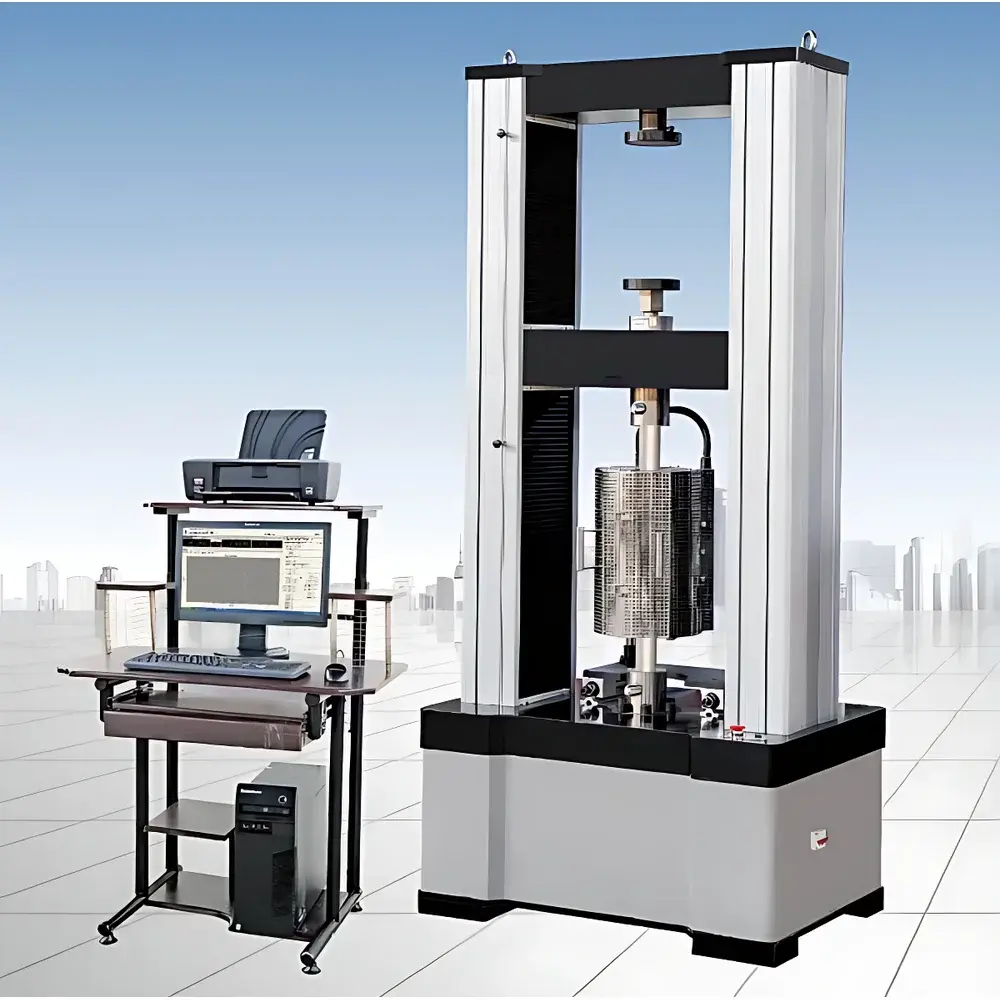
Beijing North Guang Precision Instruments BWN-50KN Microcomputer-Controlled Electromechanical Universal Testing Machine
| Key | Brand: Beijing North Guang Precision Instruments |
|---|---|
| Origin | Beijing, China |
| Manufacturer Type | Direct Manufacturer |
| Model | BWN-50KN |
| Instrument Type | Electromechanical Universal Testing Machine |
| Max Test Load | 5 kN |
| Force Accuracy Class | Class 1 (per GB/T 16491–2008) |
| Effective Force Range | 2–100% FS |
| Force Resolution | 1/300,000 |
| Force Indication Error | ±1% |
| Speed Range | 0.05–500 mm/min (infinitely variable) |
| Speed Accuracy | Better than ±1% of indicated value |
| Displacement Measurement Range | 0–950 mm |
| Displacement Resolution | 0.001 mm |
| Displacement Accuracy | Better than ±1% of indicated value |
| Compliance | GB/T 2611–2007, GB/T 16491–2008 |
| Standard Fixtures | Wedge-type tensile grips & compression platens |
| Sensor Support | Up to 4 load cells and 8 extensometers |
| Software | Integrated test control, real-time data acquisition, ASTM/ISO/GB-compliant analysis modules, automated report generation, audit-trail-capable data management |
Overview
The Beijing North Guang Precision Instruments BWN-50KN is a microcomputer-controlled electromechanical universal testing machine engineered for high-reproducibility mechanical property characterization of nonmetallic materials. It operates on the principle of servo-motor-driven axial loading, where precise force application and displacement measurement are achieved through a dual-space frame architecture—supporting both tensile (upper grip) and compressive (lower platen) configurations. The system conforms strictly to GB/T 2611–2007 (General Technical Requirements for Testing Machines) and GB/T 16491–2008 (Electronic Universal Testing Machines), ensuring metrological traceability and alignment with internationally recognized mechanical testing frameworks. Its core mechanical transmission employs high-precision ABBA ball screws coupled with HST-series synchronous timing belts, delivering zero-backlash motion control, low acoustic emission, and rapid dynamic response—critical for capturing transient deformation behavior during quasi-static and rate-dependent tests.
Key Features
- Dual-space structural design: Independent upper tensile zone and lower compression zone enable seamless transition between test modes without hardware reconfiguration.
- Servo-controlled actuation: Panasonic AC servo motor and driver provide closed-loop speed and position regulation across the full 0.05–500 mm/min range, with speed accuracy better than ±1% of setpoint.
- High-fidelity measurement subsystem: WY-90A optical encoder (0.001 mm displacement resolution) and calibrated load cell(s) (5 kN nominal capacity, Class 1 accuracy per GB/T 16491) ensure synchronized force–displacement data capture at up to 1 kHz sampling rate.
- Modular sensor architecture: Supports up to four interchangeable load cells and eight electronic extensometers, allowing users to switch between force ranges (e.g., 100 N to 100 kN) and strain measurement methods (contact vs. non-contact) without recalibration overhead.
- Comprehensive protection suite: Dual-stage limit switches (mechanical + software-defined), overload cutoff (3–5% over full scale), overcurrent/overvoltage monitoring, emergency stop, and programmable displacement bounds prevent hardware damage and ensure operator safety.
- Robust mechanical construction: Heavy-duty cast-iron base, reinforced column assembly, and precision-ground guideways minimize frame compliance and parasitic deflection—essential for accurate modulus and yield point determination.
Sample Compatibility & Compliance
The BWN-50KN accommodates specimens ranging from thin polymer films (<0.1 mm thickness) to rigid ceramic tiles (up to 950 mm height), with standard wedge-action tensile grips and parallel-faced compression platens included. Optional accessories include peel fixtures, shear adapters, bending jigs, and environmental chambers (e.g., high-temperature furnace up to 500 °C with French Tecumseh refrigeration integration). All test procedures adhere to harmonized standards including ISO 527 (plastics tensile), ISO 604 (rigid plastics compression), ASTM D638/D695, GB/T 1040 (tensile properties of plastics), and GB/T 7742 (fabric tear resistance). Data integrity complies with GLP and GMP documentation requirements; audit trails, user authentication, and electronic signature support align with FDA 21 CFR Part 11 readiness when deployed in regulated QC environments.
Software & Data Management
The proprietary Windows-based software platform provides full lifecycle test management—from method definition and real-time curve visualization to post-test analysis and regulatory reporting. It integrates over 40 preconfigured test standards (ASTM, ISO, GB, JIS), enabling one-click selection of calculation routines for Young’s modulus, yield strength (0.2% offset), ultimate tensile strength, elongation at break, Poisson’s ratio, and stress relaxation. Raw data is stored in an encrypted relational database with timestamped metadata, supporting SQL-based queries, batch comparison overlays, and customizable report templates (PDF, Excel, XML). All calibration events, user actions, and system errors are logged automatically. Software validation documentation—including IQ/OQ protocols and traceable uncertainty budgets—is available upon request for laboratory accreditation (e.g., ISO/IEC 17025).
Applications
This system serves as a primary mechanical characterization tool across R&D, quality assurance, and production validation workflows. Typical applications include tensile testing of thermoplastics (PP, PET, PC), elastomer elongation and hysteresis profiling, compressive strength evaluation of foams and composites, interlaminar shear testing of fiber-reinforced laminates, flexural modulus determination of engineering ceramics, and peel adhesion assessment of pressure-sensitive tapes. End-user sectors span aerospace component suppliers (e.g., composite skin bonding verification), medical device manufacturers (polymer suture tensile validation), automotive Tier-1 suppliers (rubber bushing durability), packaging R&D labs (film puncture resistance), and academic materials science departments conducting structure–property correlation studies.
FAQ
What standards does the BWN-50KN comply with?
It meets GB/T 2611–2007 and GB/T 16491–2008, and supports implementation of ASTM D638, ISO 527, ISO 604, GB/T 1040, and other widely adopted mechanical test standards.
Can the system be used for high-temperature mechanical testing?
Yes—when integrated with the optional high-temperature chamber (up to 500 °C), the system maintains force and displacement measurement fidelity under thermal load, with active cooling via Tecumseh compressor and PID-controlled heating elements.
Is the software compliant with FDA 21 CFR Part 11?
The software includes configurable audit trail, electronic signature, and role-based access control features; full Part 11 compliance requires site-specific validation executed by the end user or authorized service partner.
How many load cells can be connected simultaneously?
The system supports up to four load cells, enabling rapid range switching without manual recalibration—ideal for labs handling diverse material classes with varying stiffness and strength profiles.
Does the system support extensometer inputs?
Yes—eight channels for electronic extensometers are provided, supporting both clip-on and non-contact (video or laser) strain measurement modalities with sub-micron resolution.



