
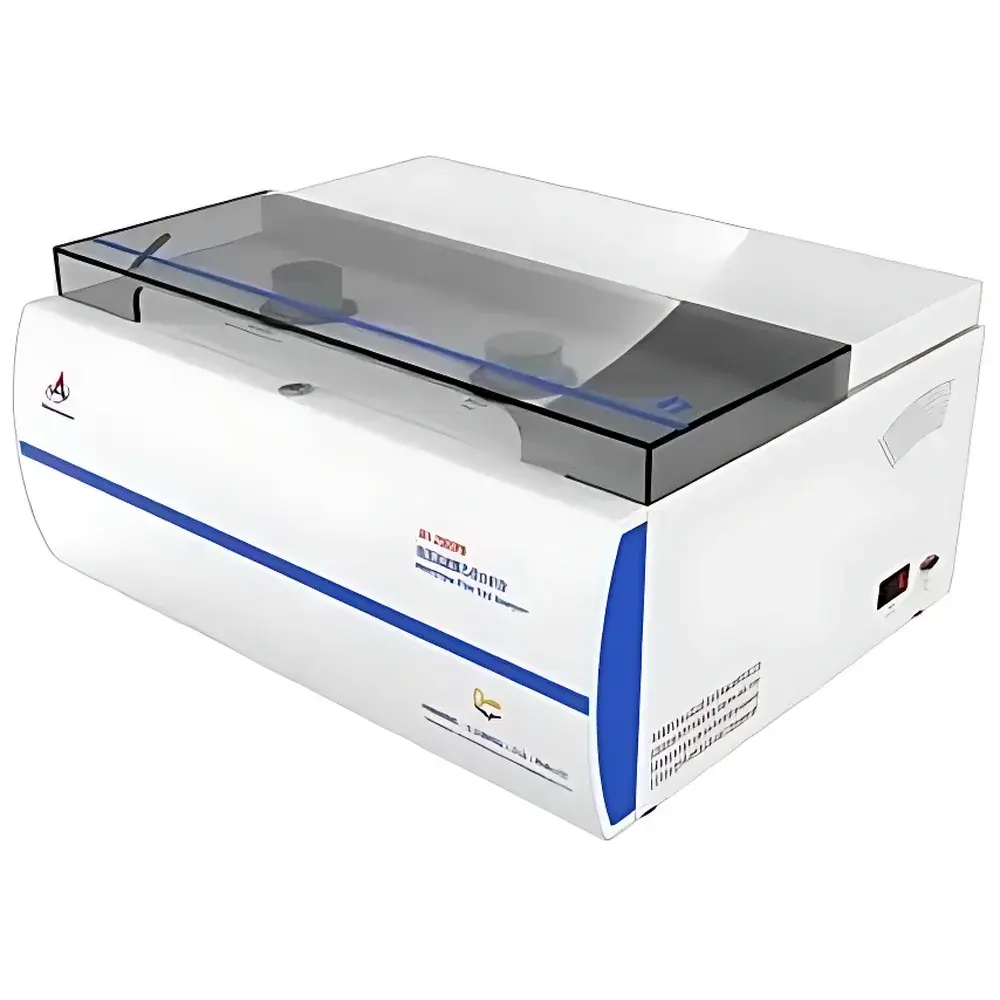
Beishide 3H-2000PB2 Capillary Flow Porometer
| Key | Brand: Beishide Instrument |
|---|---|
| Origin | Beijing, China |
| Manufacturer Type | Direct Manufacturer |
| Product Category | Domestic |
| Model | 3H-2000PB2 |
| Pricing | Available Upon Request |
Overview
The Beishide 3H-2000PB2 Capillary Flow Porometer is a fully automated, high-precision instrument engineered for the quantitative characterization of through-pore structure in porous membranes and filtration media. It operates on the principle of capillary flow porometry (also known as bubble point or pressure-scan porosimetry), a standardized method grounded in Washburn’s equation and Young–Laplace capillary pressure theory. When a sample is pre-wetted with a non-volatile, low-surface-tension liquid (e.g., isopropanol, water, or perfluoroether), the liquid resides stably within pores due to capillary forces. A controlled gas pressure is then incrementally applied to the upstream side; as pressure exceeds the capillary entry pressure for a given pore size, gas displaces the wetting liquid, initiating measurable gas flow. The resulting pressure–flow curve—combined with a dry membrane reference curve—enables rigorous derivation of maximum pore size (bubble point), minimum pore size (intrusion pressure at near-zero flow), mean flow pore size, pore size distribution (PSD), and gas permeability. This methodology is widely cited in ASTM F316-22 (Standard Test Methods for Pore Size Characteristics of Membrane Filters by Bubble Point and Forward Flow), ISO 4003:1977, and USP for integrity testing and quality control of filtration materials.
Key Features
- Fully automated operation with integrated vacuum-assisted wetting system—reduces sample equilibration time by >50% versus manual immersion
- Dual high-resolution mass flow sensors with auto-ranging capability: low-range (0–10 mL/min) and high-range (0–1000 mL/min) channels ensure linear response across orders of magnitude in flow rate
- Two calibrated pressure transducers (0–10 bar and 0–100 bar) with automatic range switching and real-time pressure validation
- Modular sample chamber design accommodates discs (up to Ø100 mm), flat sheets, tubular modules, and custom geometries—including dedicated fixtures for battery separator strips and hollow-fiber bundles
- Stainless-steel fluidic path with metal-to-metal sealing: rated for ≥100 bar operational pressure, chemically inert to common wetting liquids (alcohols, fluorinated solvents, aqueous surfactant solutions)
- Embedded voice-guided interface with multilingual prompt support and real-time status feedback (e.g., “Wetting cycle complete”, “Pressure ramp initiated”)
- Second-level timestamped operational log: records all hardware events, sensor readings, valve actuations, and error flags for full GLP/GMP traceability
- Patented thermal drift compensation algorithm and active zero-point stabilization for long-duration tests (>8 h)
Sample Compatibility & Compliance
The 3H-2000PB2 supports a broad spectrum of rigid and flexible porous substrates, including polymeric microfiltration/ultrafiltration membranes (PVDF, PTFE, nylon, polysulfone), ceramic and sintered metal filters, nonwovens, battery separators (PP/PE/PP trilayer, ceramic-coated films), dialysis membranes, and textile-based filtration media. Sample thickness range: 10 µm to 5 mm. Wetting liquid selection is user-configurable via built-in solvent database (surface tension and contact angle values preloaded per ISO 1042 and NIST SRM references). Instrument compliance includes alignment with ASTM F316-22 Annex A1 (bubble point determination), ISO 15272:2021 (pore size distribution reporting), and FDA 21 CFR Part 11 requirements for electronic records—enabled via audit trail, electronic signature, and data integrity controls.
Software & Data Management
The proprietary PorometerControl v4.2 software provides intuitive test setup, real-time visualization of pressure–flow dynamics, and ISO-compliant report generation. Raw data (pressure, differential flow, temperature, time) are stored in HDF5 format with embedded metadata (operator ID, calibration certificate ID, environmental conditions). Batch processing enables comparative PSD analysis across multiple lots or formulations. Export options include CSV, PDF (with embedded uncertainty bars), and XML for LIMS integration. All reports include calculation footnotes referencing ASTM F316-22 equations for pore size conversion (d = 4γcosθ / P), statistical confidence intervals (±2σ), and flow-based weighting methodology per ISO 15272.
Applications
- Quality assurance of lithium-ion battery separators: correlation of largest pore size with dendrite penetration resistance per IEC 62620
- R&D of asymmetric UF/MF membranes: quantification of skin layer pore narrowing after surface modification
- Regulatory submission support for medical device filters (e.g., sterilizing-grade PVDF): bubble point validation per ISO 13408-2
- Process optimization of sintered metal filters: evaluation of pore coalescence during thermal treatment
- Comparative study of electrospun nanofiber mats: statistical assessment of pore uniformity index (PUI = σ/d̄)
- Failure analysis of fouled membranes: post-cleaning pore reopening efficiency metrics
FAQ
What wetting liquids are compatible with the 3H-2000PB2?
Isopropanol (γ = 21.7 mN/m), water (γ = 72.8 mN/m), FC-40 (γ = 18.2 mN/m), and ethanol are pre-calibrated; custom liquids may be added via user-defined surface tension and contact angle inputs.
Can the instrument measure non-cylindrical or irregularly shaped pores?
Capillary flow porometry assumes cylindrical pore geometry for diameter calculation; however, reported values represent hydraulic diameter equivalents—widely accepted for comparative ranking and specification compliance.
How is instrument calibration verified?
Daily verification uses NIST-traceable stainless-steel reference discs with certified pore sizes (e.g., 0.22 µm, 0.45 µm, 5.0 µm); annual recalibration includes transducer linearity checks against deadweight testers.
Does the system support multi-sample unattended operation?
Yes—up to six independently configured sample chambers can be queued; each run logs unique identifiers, environmental conditions, and operator credentials.
Is raw data export compliant with 21 CFR Part 11?
Yes—audit trail, electronic signatures, and immutable HDF5 archives meet ALCOA+ principles (Attributable, Legible, Contemporaneous, Original, Accurate, Complete, Consistent, Enduring, Available).



