
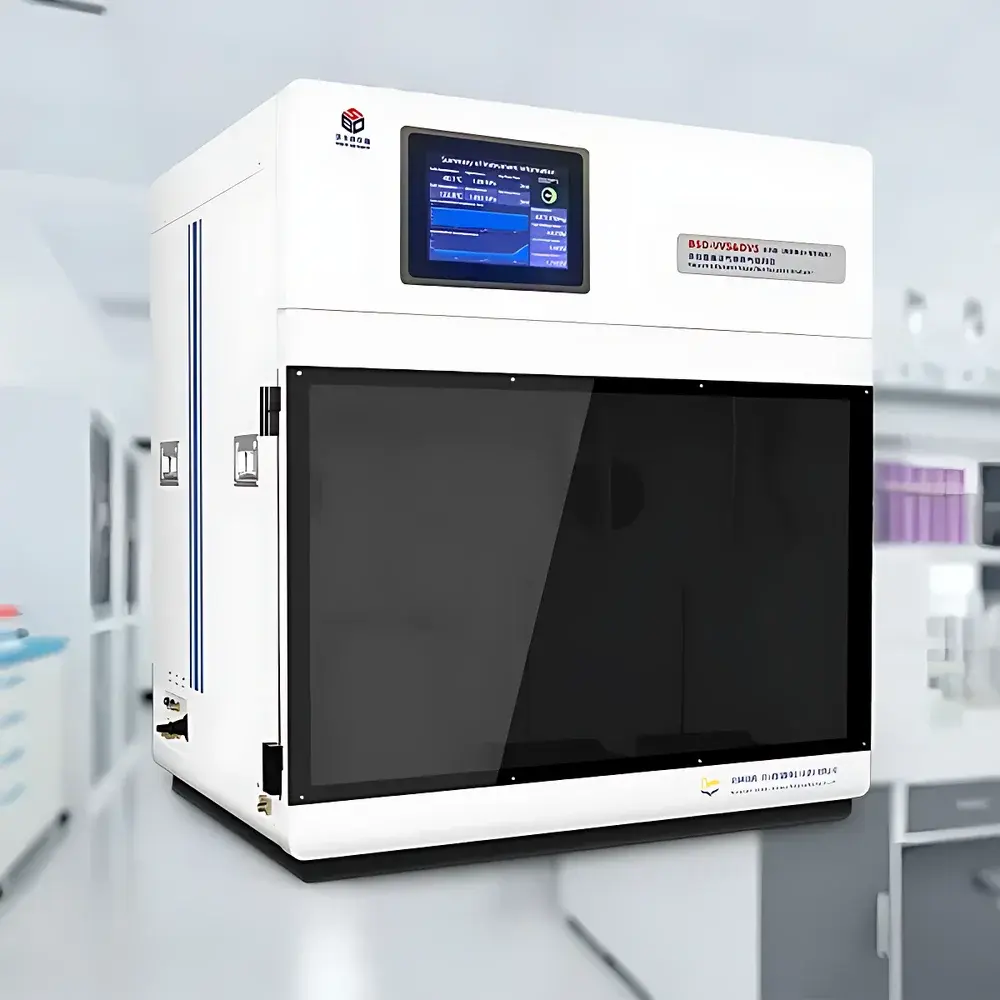
Beishide 3H-2000PWP Automated Low-Vapor-Pressure Analyzer
| Brand | Beishide Instrument |
|---|---|
| Origin | Beijing, China |
| Manufacturer Type | Direct Manufacturer |
| Product Category | Domestic |
| Model | 3H-2000PWP |
| Instrument Type | Static/Dynamic Vapor Adsorption Analyzer |
| Measurement Principle | Knudsen Effusion Mass Loss Method |
| Analysis Stations | 2 sample + 2 reference stations (4 total) |
| Sample Mass Range | 10–1000 mg |
| Mass Resolution | 1 µg |
| Vacuum System | Dual-stage mechanical pump (1×10⁻² Pa) + turbomolecular pump (1×10⁻⁶ Pa) |
| Pressure Range | 0–1 torr & 0–1000 torr (dual-range, segmented) |
| Temperature Range | –180 °C to 900 °C (accuracy ±0.1 °C, stability <0.1 °C) |
| Isothermal Control Range | Ambient to 60 °C (accuracy ±0.2 °C, stability <0.1 °C) |
| Temperature Program | 32-segment ramping with overheat protection |
| Sealing | Oil-resistant & corrosion-resistant valve and tubing system |
| Dimensions | H110 × W100 × L70 cm |
| Weight | 200 kg |
Overview
The Beishide 3H-2000PWP Automated Low-Vapor-Pressure Analyzer is an engineered solution for high-precision determination of saturated vapor pressure (SVP) of low-volatility substances across research and industrial quality control environments. It operates on the fundamental physical principle of Knudsen effusion mass loss — a well-established thermodynamic method applicable to pure solids, liquids, and viscous oils exhibiting vapor pressures in the ultra-low range (10−5 to 10 Pa). Unlike conventional static manometric or gas saturation techniques limited to higher-pressure regimes (>100 Pa), this instrument enables direct, gravimetric quantification of molecular effusion flux under high vacuum conditions, where gas-phase transport is governed by free-molecular flow rather than continuum diffusion. Its dual-range pressure sensing architecture, combined with active thermal stabilization and real-time mass monitoring at 1 µg resolution, ensures traceable measurements across six orders of magnitude — from cryogenic organometallics to high-melting-point pharmaceutical intermediates and polymer additives.
Key Features
- Knudsen effusion mass loss methodology compliant with ASTM E1782–22 (Standard Test Method for Determination of Vapor Pressure by Thermogravimetry) and ISO 11358-1 for thermal analysis applications.
- Dual independent analysis stations with synchronized reference channels, enabling simultaneous sample + blank correction to eliminate buoyancy, outgassing, and background drift effects.
- Integrated vacuum architecture featuring a two-stage pumping system: primary mechanical roughing pump (base pressure ≤1×10⁻² Pa) coupled with a high-speed turbomolecular pump (ultimate pressure ≤1×10⁻⁶ Pa), ensuring stable Knudsen regime conditions during effusion.
- Programmable temperature control spanning –180 °C to 900 °C, with 32-segment heating/cooling profiles, ±0.1 °C accuracy, and sub-0.1 °C thermal stability — critical for equilibrium vapor pressure mapping.
- Automated gas/vapor mode switching, leak integrity self-diagnosis, and post-analysis atmospheric repressurization to prevent sample dispersion or contamination.
- Full hardware control via intuitive graphical user interface (GUI), real-time audio feedback per operational phase, and timestamped audit logs (precision to the second) supporting GLP/GMP documentation requirements.
- Remote monitoring capability with SMTP-based email alerts for status updates, completion notifications, and error reporting — fully compatible with centralized lab informatics platforms.
Sample Compatibility & Compliance
The 3H-2000PWP accommodates diverse sample forms including crystalline powders, waxy solids, viscous oils, and thermally sensitive liquid formulations — all without requiring derivatization or carrier gas dilution. Its inert, corrosion-resistant fluidic path (fluoropolymer-sealed valves, stainless-steel effusion cells, and passivated tubing) ensures compatibility with halogenated compounds, organic acids, and metal-organic precursors. The system adheres to ISO/IEC 17025 calibration traceability frameworks and supports 21 CFR Part 11-compliant electronic records when deployed with validated software configurations. All thermal and gravimetric subsystems undergo factory verification against NIST-traceable standards, with documented uncertainty budgets provided per installation.
Software & Data Management
The proprietary Beishide Analytical Suite provides end-to-end data acquisition, processing, and reporting. Raw mass loss vs. time curves are automatically fitted using first-order effusion kinetics models; vapor pressure values are calculated via the Claussius–Clapeyron relationship incorporating measured effusion area, temperature, and molecular weight inputs. Software modules include batch processing, outlier detection, uncertainty propagation analysis, and export to CSV, PDF, or XML formats compatible with LIMS integration. Audit trails capture operator ID, parameter changes, calibration events, and environmental metadata — fulfilling FDA and EMA regulatory expectations for analytical instrument qualification (IQ/OQ/PQ).
Applications
- Pharmaceutical development: Predicting shelf-life of active pharmaceutical ingredients (APIs) and excipients via sub-ambient vapor pressure modeling.
- Polymer science: Quantifying plasticizer volatility in PVC and elastomers to assess migration resistance and long-term mechanical stability.
- Agrochemical formulation: Evaluating thermal stability and storage safety of pesticides and herbicides under ambient and elevated temperature conditions.
- Materials chemistry: Characterizing vapor pressure–temperature dependencies of MOF precursors, battery electrolyte solvents, and high-boiling-point fragrance compounds.
- Environmental fate studies: Supporting REACH registration dossiers with experimentally derived vapor pressure data for persistent organic pollutants (POPs).
FAQ
What vapor pressure range can the 3H-2000PWP reliably measure?
It covers 10−5 Pa to 10 Pa, optimized for substances with boiling points above 200 °C or decomposition temperatures below their boiling points.
Is the Knudsen effusion method suitable for volatile liquids?
No — it is specifically designed for low-volatility materials; highly volatile compounds (e.g., ethanol, acetone) fall outside its dynamic range and require alternative techniques such as isoteniscope or ebulliometry.
How does the system ensure measurement reproducibility across multiple runs?
Through continuous reference station monitoring, automated baseline drift correction, and strict adherence to Knudsen number criteria (λ/d > 10) verified in real time via pressure and temperature feedback loops.
Can the instrument be integrated into a regulated QA/QC laboratory environment?
Yes — with optional 21 CFR Part 11 software validation package, electronic signature support, and full audit trail generation for compliance with GxP standards.
What maintenance intervals are recommended for the vacuum system?
Mechanical pump oil replacement every 3,000 operating hours; turbomolecular pump inspection every 12 months or after exposure to condensable vapors — both documented in the preventive maintenance log module.



