
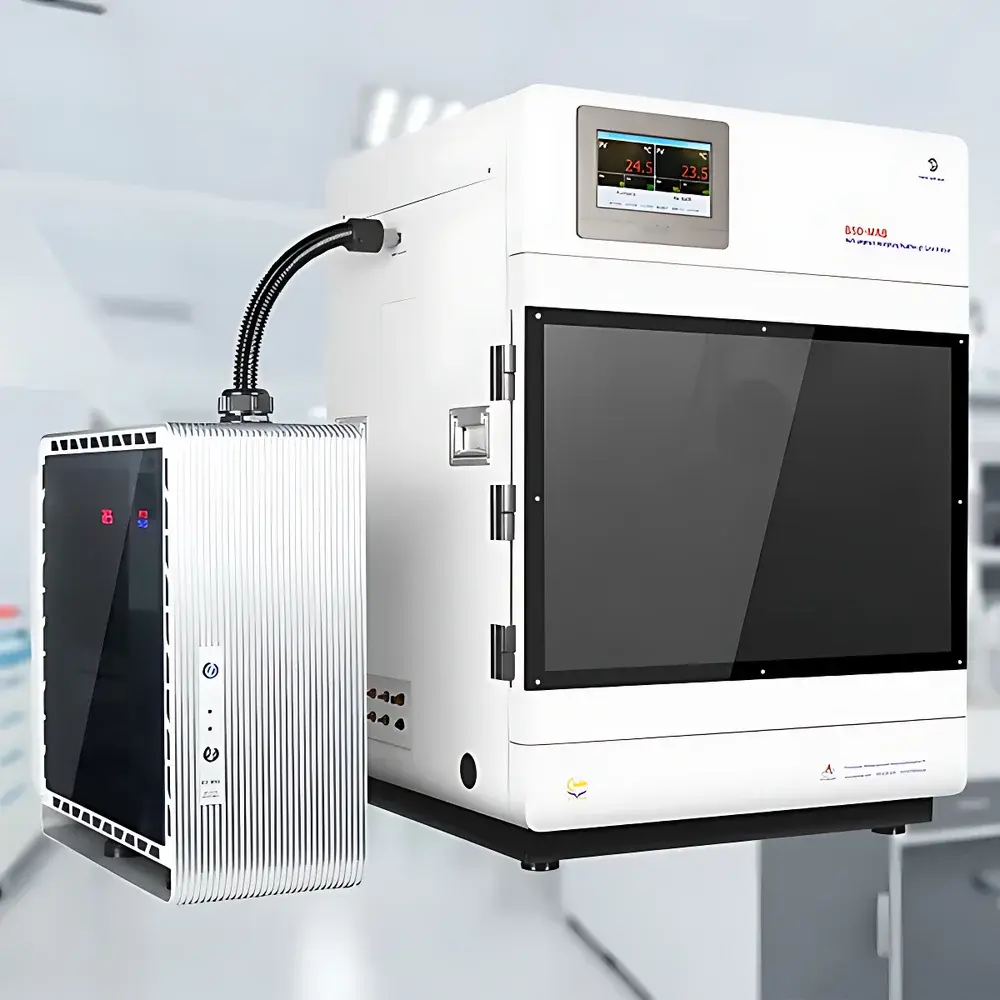
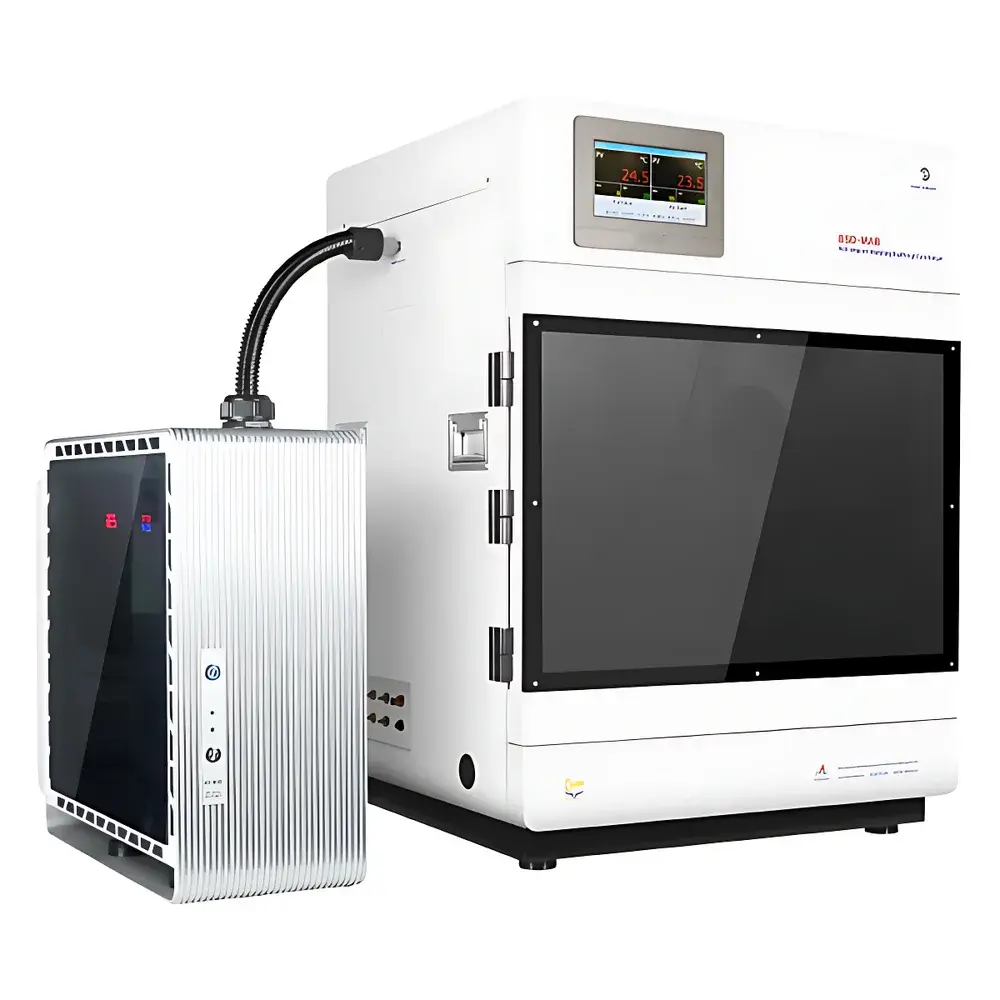
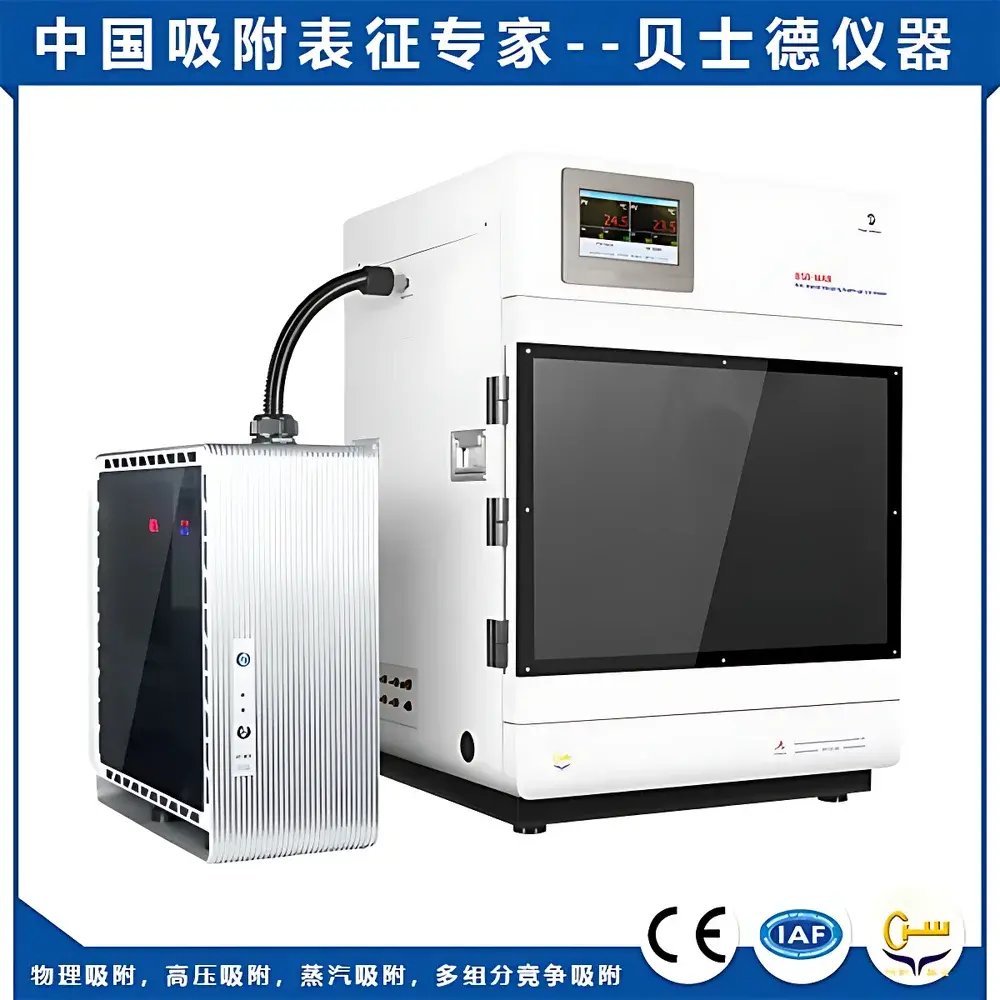
Beishide BSD-MAB Multicomponent Competitive Adsorption Analyzer with Dynamic Breakthrough Curve Measurement Capability
| Brand | Beishide Instrument |
|---|---|
| Origin | Beijing, China |
| Manufacturer Type | Direct Manufacturer |
| Region of Origin | Domestic (China) |
| Model | BSD-MAB |
| Price Range | USD 70,000 – 140,000 (FOB China) |
| Gas Mixture Compatibility | Binary and multicomponent gas–gas, gas–vapor, vapor–vapor systems |
| Mass Flow Controllers (MFCs) | 4–8 independently programmable channels |
| Breakthrough Columns | Standard stainless-steel columns (2 mL and 8 mL volumes) |
| Adsorption Pressure Range | Ambient to 10 MPa (optional high-pressure modules: up to 1 MPa or 3 MPa) |
| Adsorption Temperature Control | Circulating water bath (−20 °C to 80 °C, ±0.1 °C stability) |
| High-Temperature Furnace | Ambient to 600 °C (customizable beyond) |
| Detection Systems | Integrated thermal conductivity detector (TCD) |
| Detection Limits | TVOC: 5 × 10⁻¹² g/mL |
| SO₂ | 14 × 10⁻¹² g/mL |
| NH₃ | 16 × 10⁻¹² g/mL |
| Vapor Generation System | P/P₀ control range 0.1%–99.99%, accuracy ±1% |
| Vacuum Activation | <0.1 Pa base pressure |
| Corrosive Gas Compatibility | SO₂, NH₃, organic vapors (compatible with fluorocarbon-sealed components) |
| Regulatory Compliance Support | ASTM D5228, ISO 12213-2, USP <621>, GLP-compliant data audit trail (via optional software module), FDA 21 CFR Part 11-ready configuration available |
Overview
The Beishide BSD-MAB Multicomponent Competitive Adsorption Analyzer is a research-grade dynamic breakthrough curve measurement system engineered for quantitative characterization of adsorption behavior under industrially relevant fixed-bed conditions. It operates on the principle of dynamic frontal chromatography, where multicomponent gas or vapor mixtures are continuously introduced into a packed adsorbent bed at controlled temperature, pressure, and flow rate. Effluent composition is monitored in real time using highly sensitive detection—primarily via integrated TCD or optional online mass spectrometry—to generate time-resolved concentration profiles (breakthrough curves). These curves yield fundamental kinetic and thermodynamic parameters including component-specific breakthrough times, saturation capacities, selectivity coefficients, mass transfer zone (MTZ) lengths, and competitive displacement behavior. Unlike static equilibrium methods (e.g., gravimetric or volumetric sorption), the BSD-MAB replicates transient operational conditions found in pressure swing adsorption (PSA), temperature swing adsorption (TSA), air purification filters, catalytic guard beds, and industrial gas separation columns—making it indispensable for process design, adsorbent screening, and lifetime prediction.
Key Features
- Modular, fully programmable gas delivery architecture with 4–8 precision mass flow controllers (MFCs), enabling independent regulation of carrier, analyte, and purge streams for complex multicomponent feed formulations.
- Dual-temperature control capability: high-stability circulating water bath (−20 °C to 80 °C, ±0.1 °C) combined with an optional resistive furnace (ambient to 600 °C) for simultaneous thermal activation, adsorption, and temperature-programmed desorption (TPD).
- Configurable column manifold supporting stainless-steel and quartz breakthrough columns (2–100 mL volume range), optimized for mechanical robustness, thermal uniformity, and compatibility with aggressive vapors (NH₃, SO₂, VOCs) and high-temperature regeneration.
- Integrated TCD detection with sub-ppm sensitivity for binary systems; seamless interface for external GC or OEM-grade online quadrupole mass spectrometers (e.g., INFICON BSD-MASS) supporting 1–100 amu scanning at ≤1.8 ms/amu, ideal for trace-level multicomponent quantification.
- Vapor generation subsystem with precise P/P₀ control (0.1–99.99%) and ±1% accuracy, validated for water, alcohols, ketones, and aromatic vapors—critical for humidity-dependent adsorption studies and co-adsorption modeling.
- Optional vacuum activation module (<0.1 Pa) for low-temperature desorption of strongly bound species and enhanced surface cleaning prior to kinetic testing.
- Comprehensive safety infrastructure: corrosion-resistant fluidic path (fluoroelastomer seals), hazardous gas exhaust port (φ6 quick-connect), and fail-safe pressure relief integrated into all high-pressure configurations (up to 10 MPa).
Sample Compatibility & Compliance
The BSD-MAB accommodates a broad spectrum of adsorbent materials—including activated carbons, zeolites, MOFs, silica gels, and metal oxides—in granular, pelletized, or monolithic forms. It supports both non-corrosive gases (N₂, CO₂, CH₄, O₂) and reactive species (NH₃, SO₂, H₂S, formaldehyde, acetone, toluene), provided appropriate wetted material selection (e.g., quartz, Hastelloy, fluoropolymer-lined tubing). The system complies with core international standards governing adsorption testing: ASTM D5228 (dynamic adsorption capacity of activated carbon), ISO 12213-2 (natural gas property calculations), and USP <621> (chromatographic system suitability). When configured with audit-trail-enabled software and electronic signature modules, it meets GLP documentation requirements and is compatible with FDA 21 CFR Part 11 validation protocols for regulated pharmaceutical and environmental laboratories.
Software & Data Management
Control and analysis are executed via Beishide’s proprietary BSD-Adsorb v5.x platform—a Windows-based application supporting full sequence automation, real-time curve visualization, and batch processing of breakthrough datasets. Raw signal outputs (voltage vs. time) are time-stamped and stored in HDF5 format for long-term integrity and third-party interoperability. Built-in calculation engines derive key parameters including dynamic adsorption capacity (mg/g), selectivity ratio (αA/B), mass transfer coefficient (kLa), and MTZ velocity using numerical integration and nonlinear regression against axial dispersion or linear driving force (LDF) models. Export options include CSV, Excel, and PDF report templates aligned with journal submission standards (e.g., Langmuir–Freundlich fitting, Yoon–Nelson kinetics). Optional cloud synchronization enables secure remote monitoring and multi-site data aggregation for consortium-scale adsorbent benchmarking.
Applications
- Air pollution control: Quantification of TVOC, SO₂, and NH₃ removal efficiency in HVAC filters and automotive cabin air systems; determination of service life and saturation thresholds at ambient and elevated humidity.
- Industrial gas purification: Design and optimization of PSA cycles for H₂ recovery, O₂/N₂ separation, and natural gas sweetening—using scaled-down fixed-bed data to validate process simulation inputs.
- MOF and zeolite screening: Evaluation of competitive adsorption selectivity under mixed-feed conditions (e.g., CO₂ capture from flue gas containing H₂O, N₂, O₂), including displacement dynamics during co-adsorption and regeneration.
- Catalyst guard bed development: Assessment of poison adsorption (e.g., Hg⁰, AsH₃) on supported sorbents under simulated syngas or refinery stream compositions.
- Pharmaceutical containment: Validation of adsorptive scavenging performance for residual solvents (e.g., dichloromethane, ethyl acetate) in lyophilization chamber exhaust streams.
- Fundamental surface science: Correlation of TPD-derived binding energies with breakthrough-derived isosteric heats of adsorption across temperature gradients.
FAQ
Can the BSD-MAB measure true multicomponent (≥3) competitive adsorption without offline GC/MS?
Yes—when equipped with the optional INFICON BSD-MASS online quadrupole mass spectrometer, the system performs real-time, simultaneous quantification of ≥5 components in a single breakthrough run, eliminating sample splitting and retention time drift errors inherent in offline GC analysis.
What is the minimum detectable concentration for NH₃ in humid air?
Using the UV-Vis absorption inlet option with 1-m pathlength cell and calibrated SO₂/NH₃ standards, the system achieves reliable quantification down to 0.1 ppmv NH₃ at 50% RH, validated per ISO 11843-2 for limit-of-detection estimation.
Is column dead volume correction automated during data processing?
Yes—BSD-Adsorb v5.x applies hardware-calibrated delay time compensation based on measured interstitial void volume (determined via inert tracer pulse), ensuring accurate alignment of breakthrough onset with physical adsorption front arrival.
Does the system support cyclic adsorption–desorption aging studies?
Fully. The integrated furnace, vacuum module, and programmable MFC sequences enable automated execution of >100 consecutive PSA/TSA cycles, with in-situ monitoring of capacity decay, selectivity drift, and irreversible pore blockage indicators.
Can I use my existing Agilent GC instead of the optional Beishide GC?
Yes—the system provides standardized 1/8″ Swagelok GC interface with adjustable flow splitting and pressure regulation, fully compatible with Agilent, Shimadzu, and Thermo Fisher GC platforms operating in constant-flow or constant-pressure modes.



