
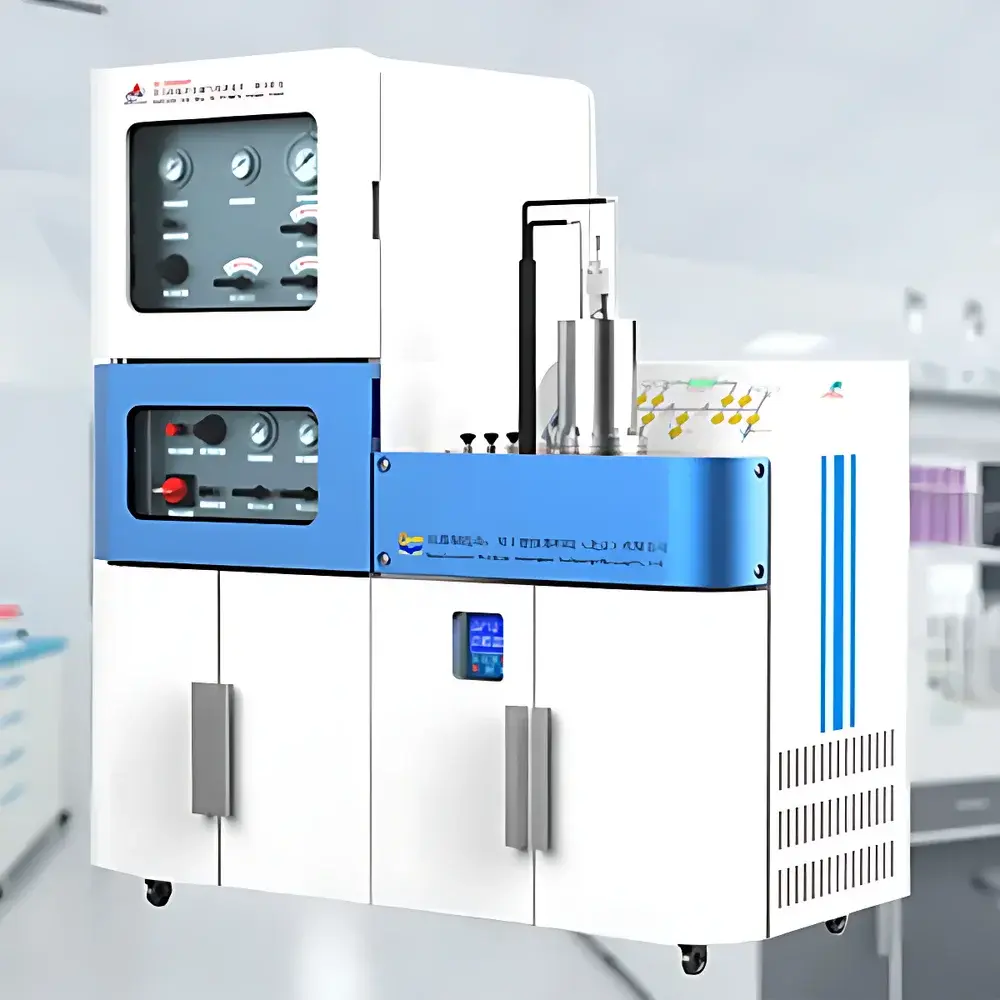
Beishide BSD-PHC Cladding Pressure High Pressure Gas Sorption Analyzer
| Brand | Beishide Instrument |
|---|---|
| Origin | Beijing, China |
| Manufacturer Type | Manufacturer |
| Product Category | Domestic |
| Model | BSD-PHC |
| Pricing Range | USD 70,000 – 140,000 (FOB) |
| Measurement Method | Static Volumetric Method |
| Temperature Range | Ambient to 80 °C (standard) |
| Pressure Range | Adsorption: 0–20 MPa (standard), 0–50 MPa / 0–69 MPa (optional) |
| Confining (Cladding) Pressure | 0–50 MPa / 0–70 MPa (optional) |
| Ultimate Vacuum | <1×10⁻⁶ mbar (equivalent to full-scale 690 bar operation) |
Overview
The Beishide BSD-PHC Cladding Pressure High Pressure Gas Sorption Analyzer is an engineered research platform designed for quantitative characterization of gas adsorption behavior in geomechanically constrained solid matrices—specifically intact rock cores and coal cores—under simulated in-situ stress conditions. Unlike conventional high-pressure sorption analyzers that operate on powdered or granular samples under isotropic pressure, the BSD-PHC integrates dual-axis (axial + radial) mechanical loading capability with static volumetric gas dosing and high-precision pressure–volume–temperature (PVT) measurement. Its core principle relies on the static volumetric method: after helium pycnometry for dead volume calibration, incremental doses of target gases (e.g., CH₄, CO₂, N₂, H₂) are introduced into a temperature-controlled sample cell containing a confined core specimen; equilibrium pressures are recorded to compute absolute adsorbed phase density via ideal/non-ideal gas equations of state (e.g., Peng–Robinson). The cladding pressure system enables independent application of confining stress—up to 70 MPa—while maintaining precise control over adsorption gas pressure (up to 69 MPa), thereby replicating subsurface lithostatic and pore-pressure gradients critical for accurate shale gas, coalbed methane (CBM), and CO₂ sequestration capacity evaluation.
Key Features
- Dual-axis mechanical loading system: independently adjustable axial and radial confining pressure (0–50 MPa or 0–70 MPa options), enabling true triaxial stress simulation for intact core specimens.
- Static volumetric sorption measurement compliant with ASTM D7830–19 (Standard Test Method for Determination of Methane Sorption Capacity of Coal) and ISO 19277:2018 (Petroleum and natural gas industries — Determination of gas adsorption on shale).
- High-fidelity PVT instrumentation: imported high-stability pressure transducers (0.01% FS accuracy, long-term drift ≤0.025% FS), calibrated volumetric dosing valves, and temperature-controlled sample chamber (ambient to 80 °C standard; optional extensions to −196 °C or 1100 °C).
- Integrated safety architecture: ASME BPVC Section VIII-compliant pressure vessel design, internal hydrostatic proof testing at 1.5× maximum operating pressure, built-in combustible gas detection with optional interlocked venting.
- Automated workflow: fully programmable sequence for helium calibration, multi-step gas dosing, equilibrium dwell, desorption, and purge cycles—enabling unattended overnight operation with audit-trail logging per FDA 21 CFR Part 11 requirements.
Sample Compatibility & Compliance
The BSD-PHC accepts cylindrical core samples up to Ø50 mm × 100 mm (customizable), including whole shale, sandstone, coal, and synthetic porous media. It accommodates both dry and moisture-equilibrated cores, supporting protocols aligned with USGS methodologies for CBM resource assessment and IEA-GHG guidelines for CO₂–shale interaction studies. All hardware and software comply with IEC 61000-6-2/6-4 (EMC), CE Machinery Directive 2006/42/EC, and ATEX Zone 2 classification for non-hazardous area use. Data integrity meets GLP/GMP documentation standards, with timestamped, user-authenticated raw data files (.csv, .xlsx) and metadata-enriched reports traceable to instrument calibration certificates (NIST-traceable pressure and temperature references).
Software & Data Management
The proprietary SorptionMaster™ v5.2 software provides real-time visualization of PCT (pressure–composition–temperature) isotherms, Langmuir/Freundlich parameter fitting, isosteric heat of adsorption (via Clausius–Clapeyron analysis), and IAST-based multicomponent selectivity prediction. It supports automated generation of industry-standard deliverables: adsorption capacity vs. pressure curves, excess/absolute adsorption plots, hysteresis quantification, and stress-dependent adsorption strain modeling. Audit trails record every operator action, parameter change, and calibration event—including digital signatures and time-stamped electronic records—ensuring compliance with 21 CFR Part 11 for regulated laboratories. Export modules support direct integration with Petrel®, TOUGH2, and CMG-STARS reservoir simulators via ASCII and HDF5 formats.
Applications
- Quantitative evaluation of methane and CO₂ storage capacity in intact shale and coal cores under geologically realistic stress–strain conditions.
- Stress-dependent adsorption isotherm mapping for reservoir simulation input (e.g., dual-porosity/dual-permeability models).
- Investigation of matrix–fracture coupling effects on gas transport kinetics during depressurization.
- Validation of molecular dynamics (MD) and density functional theory (DFT) predictions of adsorption enthalpy under confinement.
- Support for regulatory submissions to the U.S. EIA, Canada’s NEB, and China’s Ministry of Natural Resources in unconventional resource assessments.
FAQ
What distinguishes the BSD-PHC from standard high-pressure sorption analyzers?
The BSD-PHC uniquely combines static volumetric gas sorption measurement with independent axial and radial confining pressure application—enabling direct measurement of adsorption behavior in intact cores under triaxial stress, rather than extrapolating from crushed-sample data.
Can the BSD-PHC perform multi-gas competitive adsorption tests?
No—the BSD-PHC is optimized for single-gas adsorption under mechanical confinement. For multicomponent competitive adsorption, the BSD-PHM Multi-component High Pressure Gas Sorption Analyzer is recommended.
Is liquid nitrogen cooling supported for cryogenic adsorption studies?
Yes—optional integration with the BSD-LNL liquid nitrogen level stabilization system and 3 L Dewar enables stable 77 K operation with ±0.1 K thermal control, essential for hydrogen physisorption characterization.
How is data traceability ensured for regulatory audits?
All measurements are logged with immutable timestamps, operator IDs, calibration status flags, and digital signatures; raw data files are cryptographically hashed and archived in accordance with ALCOA+ principles (Attributable, Legible, Contemporaneous, Original, Accurate, Complete, Consistent, Enduring, Available).
What safety certifications does the BSD-PHC hold?
The system conforms to ASME BPVC Section VIII Div. 1 for pressure boundary components, carries CE marking under Machinery Directive 2006/42/EC, and includes integrated combustible gas detection compliant with EN 60079-29-1 for Zone 2 environments.



