
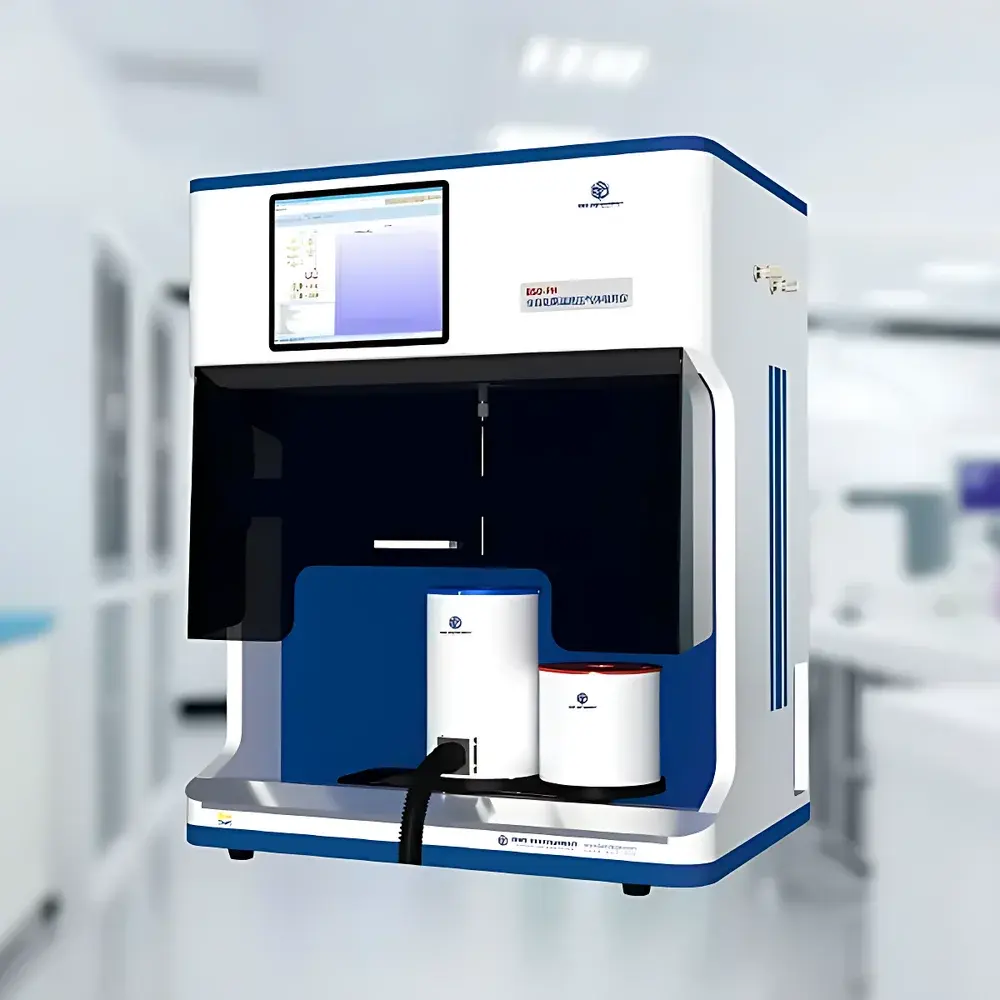
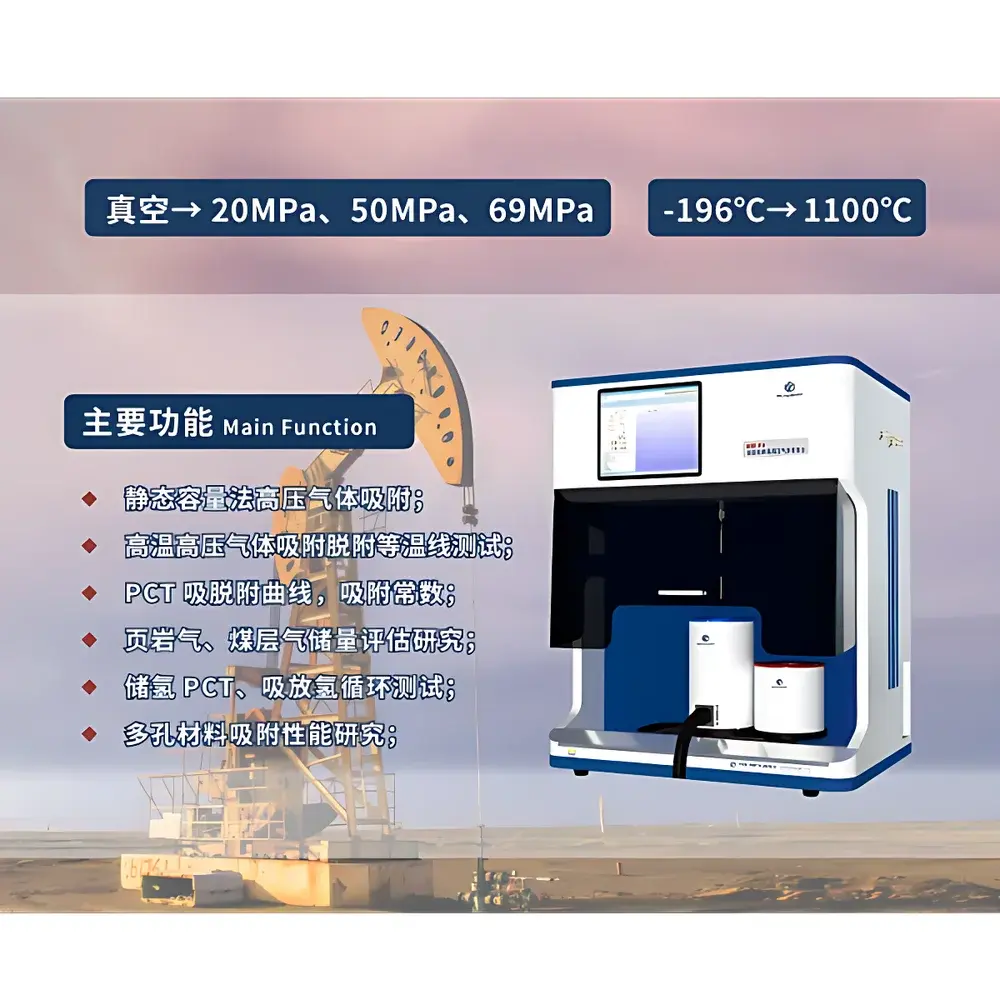
Beishide BSD-PHD High Pressure Gas Sorption Analyzer with Atmospheric Desorption Kinetics Capability
| Brand | Beishide Instrument |
|---|---|
| Origin | Beijing, China |
| Manufacturer Type | Manufacturer |
| Country of Origin | China |
| Model | BSD-PHD |
| Measurement Method | Volumetric (Static Capacity) Method |
| Temperature Range | –196 °C to 1100 °C |
| Pressure Range | 0–20 MPa |
| Ultimate Vacuum / Maximum Pressure | Up to 690 bar (69 MPa) |
| Repeatability Error | < ±2% |
| Pressure Sensor Accuracy | ±0.01% FS, Long-term Stability: ±0.025% FS |
| Air-Bath Temperature Control | 40.0 °C ±0.1 °C |
| Safety | Integrated combustible gas alarm, high-pressure integrity tested, optional alarm interlock system |
Overview
The Beishide BSD-PHD High Pressure Gas Sorption Analyzer with Atmospheric Desorption Kinetics Capability is an engineered volumetric (static capacity) instrument designed for quantitative characterization of gas–solid interactions under rigorously controlled thermodynamic conditions. It operates on the principle of precise pressure–volume–temperature (PVT) measurement in a calibrated, thermostatically stabilized sample cell, enabling determination of absolute adsorbed phase quantity via dead-volume correction and gas equation-of-state modeling (typically using real-gas virial or Peng–Robinson formulations). Unlike gravimetric methods, the BSD-PHD eliminates buoyancy artifacts and enables direct measurement of both high-pressure adsorption isotherms and atmospheric-pressure desorption kinetics—critical for evaluating hydrogen release behavior in metal hydrides, MOFs, and geological media. Its architecture supports operation from cryogenic temperatures (77 K via liquid nitrogen immersion) to elevated temperatures (up to 1100 °C with high-temperature furnace), and pressures spanning vacuum to 69 MPa (690 bar), making it suitable for ISO 15901-2, ASTM D3663, and USP <621> compliant sorption studies in energy storage, carbon capture, and reservoir engineering.
Key Features
- Volumetric static capacity method with helium pycnometry for accurate dead-volume calibration and sample skeletal density determination
- Dual-mode operation: high-pressure adsorption isotherm acquisition (0–20 MPa) followed by automated atmospheric-pressure desorption rate profiling (3–10 s initial rate resolution, full t–V desorption curve)
- Integrated programmable temperature control: standard air-bath (40.0 °C ±0.1 °C), optional cryogenic (77 K/87 K with LNL auto-refill), high-temp furnace (300–1100 °C), and solid–liquid bath compatibility (ice-water, dry ice, salt baths)
- High-fidelity pressure metrology: imported piezoresistive sensors with 0.01% full-scale accuracy and <0.025% FS long-term drift specification
- Full-system safety certification: ASME BPVC Section VIII compliant pressure containment, internal combustible gas detection, and optional emergency venting & alarm interlock integration
- Automated sequence execution: unattended multi-step protocols including degassing (with optional heating furnace), equilibration, dosing, desorption, and purge—all governed by time- and pressure-triggered logic
Sample Compatibility & Compliance
The BSD-PHD accommodates powdered, granular, and monolithic samples—including Mg-based alloys, TiFe intermetallics, rare-earth hydrides, MOFs/COFs/HOFs, activated carbons, coal cores, shale chips, and soil aggregates—in standard 6–12 mm OD quartz or stainless-steel sample tubes (gram- to kilogram-scale volume options available). Its design conforms to GLP/GMP data integrity requirements: audit-trail-enabled software logs all parameter changes, user actions, and instrument events per FDA 21 CFR Part 11. Data outputs support ISO 15901-2 (physisorption), ASTM D7845 (shale gas), and ISO 16078 (hydrogen storage materials) reporting formats. Pressure and temperature calibrations are traceable to NIST standards; vacuum integrity meets ISO 27893 specifications.
Software & Data Management
The proprietary SorptionMaster™ software provides end-to-end workflow automation—from method definition and hardware initialization to real-time PVT monitoring, equilibrium validation (pressure drift threshold <0.001 MPa/min), and model-based analysis. Built-in algorithms compute Langmuir, Freundlich, Sips, and Toth isotherm parameters; derive isosteric heats via Clausius–Clapeyron analysis; generate PCT (Pressure–Composition–Temperature) curves; and extract kinetic descriptors (e.g., Arrhenius activation energy from TPD/TPA ramps). All raw sensor data, intermediate calculations, and final reports are stored in encrypted SQLite databases with version-controlled backups. Export formats include CSV, PDF, and XML for LIMS integration and third-party modeling (e.g., IAST, DFT, Monte Carlo simulations).
Applications
- Hydrogen storage material qualification: PCT hysteresis analysis, absorption/desorption cycling stability, and rapid desorption kinetics at ambient pressure for fuel cell system response modeling
- Geological sequestration assessment: CH4/CO2 competitive adsorption on coal and shale under simulated in-situ stress (when coupled with BSD-PHC mechanical loading module)
- Porous material benchmarking: surface area (BET), micropore volume (t-plot, HK), and heterogeneity index derivation from subcritical isotherms at 77 K and 87 K
- Catalyst support characterization: metal dispersion estimation via H2/CO chemisorption at elevated temperatures (300–600 °C)
- Thermal management validation: TPD peak deconvolution to identify distinct hydride decomposition steps and corresponding enthalpies
FAQ
What distinguishes the BSD-PHD from conventional high-pressure adsorption analyzers?
The BSD-PHD uniquely integrates volumetric high-pressure adsorption with high-temporal-resolution atmospheric-pressure desorption kinetics—enabling quantification of initial desorption rates, plateau temperatures, and cumulative desorption fractions without switching instruments or manual intervention.
Can the BSD-PHD perform multi-component gas adsorption studies?
No—the BSD-PHD is optimized for single-gas adsorption and desorption kinetics. For competitive multi-component analysis, the BSD-PHM Multi-component High Pressure Gas Sorption Analyzer is recommended.
Is liquid nitrogen handling automated?
Yes—optional BSD-LNL liquid nitrogen level stabilization system maintains constant 77 K temperature within ±0.1 K over extended runs via feedback-controlled auto-refill into a 3 L Dewar.
What safety certifications apply to the BSD-PHD?
The system undergoes ASME Section VIII Div. 1 hydrostatic pressure testing at 1.5× maximum operating pressure; includes Class I, Division 1 combustible gas detection; and supports configurable emergency shutdown per IEC 61511.
How is data traceability ensured for regulatory submissions?
SorptionMaster™ enforces 21 CFR Part 11 compliance through electronic signatures, immutable audit trails, role-based access control, and encrypted database archiving with SHA-256 hash verification.
Related Products



