
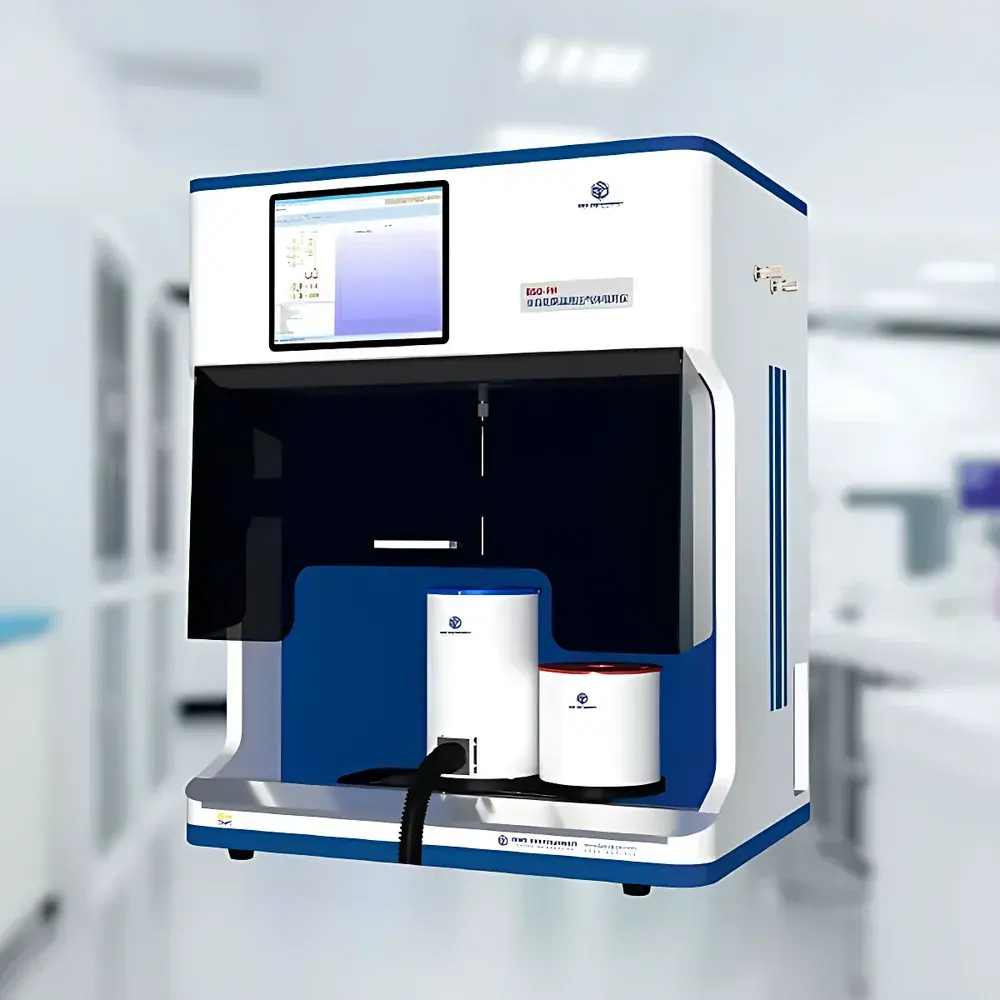
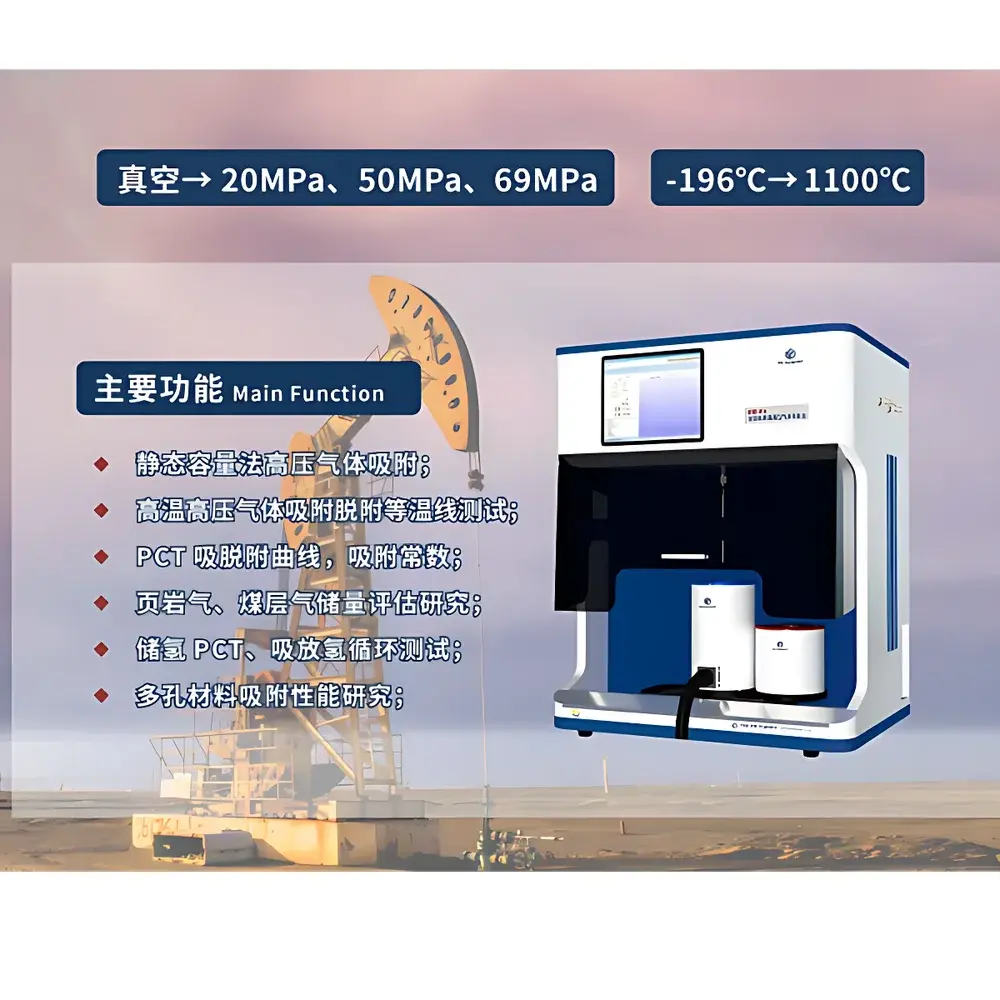
Beishide BSD-PHU Ultra High Pressure Gas Sorption Analyzer
| Brand | Beishide Instrument |
|---|---|
| Origin | Beijing, China |
| Manufacturer Type | Manufacturer |
| Country of Origin | Domestic (China) |
| Model | BSD-PHU |
| Testing Method | Static Volumetric Method |
| Temperature Range | –196 °C to 80 °C (standard) |
| Pressure Range | High vacuum to 700 bar (70 MPa) |
| Ultimate Vacuum | 1×10⁻² to 1×10⁻⁶ Pa |
Overview
The Beishide BSD-PHU Ultra High Pressure Gas Sorption Analyzer is a fully automated, static volumetric gas sorption system engineered for quantitative characterization of gas adsorption behavior under extreme pressure conditions—up to 700 bar (70 MPa). It operates on the principle of precise pressure decay and regeneration measurements within a calibrated, thermostatically controlled sample cell, enabling rigorous determination of absolute adsorbed phase quantities via ideal gas law corrections and dead volume calibration using inert probe gases (e.g., He). Designed specifically for research in energy storage, unconventional reservoir evaluation, and advanced porous materials science, the BSD-PHU delivers traceable, reproducible data for high-pressure isotherms (e.g., PCT, Langmuir, Freundlich), adsorption enthalpy (via Clausius–Clapeyron analysis), and kinetic profiles under constant-pressure conditions. Its architecture complies with fundamental requirements for GLP-compliant laboratory environments, supporting audit-ready operation through timestamped parameter logging and full system diagnostics.
Key Features
- Ultra-high pressure capability: Validated operation from high vacuum to 700 bar (70 MPa), among the highest rated fully automated volumetric sorption analyzers commercially available.
- Multi-range temperature control: Standard configuration supports –196 °C (liquid nitrogen) to +80 °C via integrated recirculating bath; optional upgrades include oil-immersion bath (±0.05 °C stability), high-temperature furnace (up to 900 °C), and liquid-nitrogen-level stabilization (LNL) system for cryogenic precision.
- Static volumetric methodology: Eliminates buoyancy artifacts inherent in gravimetric systems; enables accurate measurement of low-uptake materials (e.g., shales, coals, MOFs) at ultra-high pressures where mass sensitivity limits alternative techniques.
- Automated dead-volume calibration: In-situ helium pycnometry for precise determination of sample skeletal volume and free space prior to each adsorption cycle.
- Integrated safety architecture: All high-pressure components undergo hydrostatic proof testing per ISO 15848-1; includes redundant pressure relief valves, internal combustible gas detection (H₂/CH₄), and optional emergency venting interlock with external gas monitoring systems.
- High-fidelity pressure metrology: Dual-range, temperature-compensated piezoresistive sensors (0.01% FS accuracy, long-term drift <0.025% FS/year) certified to EN 61326-1 for electromagnetic compatibility in analytical labs.
Sample Compatibility & Compliance
The BSD-PHU accommodates powdered, granular, or monolithic samples—including metal hydrides (Mg-based, TiFe, LaNi₅), activated carbons, zeolites, MOFs/COFs, coal cores, and shale specimens—within standardized stainless-steel or quartz sample tubes (1–10 cm³ volume). For geomechanical studies, optional cladding pressure modules apply axial and radial stress (up to 50 MPa confining pressure) to intact core samples, simulating in-situ reservoir conditions per ASTM D3079 and ISO 11464 protocols. Data output conforms to ASTM D3663 (gas adsorption on activated carbon), ISO 15901-2 (high-pressure physisorption), and USP <641> (porosimetry). System validation documentation supports 21 CFR Part 11 compliance when paired with Beishide’s optional electronic signature and audit-trail software module.
Software & Data Management
The proprietary SorptionMaster™ v5.2 software provides end-to-end automation: sequence definition (isotherm, PCT, TPD, IAST), real-time pressure/temperature feedback control, automatic equilibrium detection (dP/dt thresholding), and model-based data reduction. Built-in algorithms compute Langmuir constants (a, b), Freundlich parameters (KF, n), isosteric heat of adsorption (Qst), and selectivity ratios using Ideal Adsorbed Solution Theory (IAST). Raw datasets are exported in CSV and HDF5 formats; metadata (instrument ID, operator, calibration logs, environmental conditions) is embedded per FAIR principles. Optional cloud synchronization enables remote monitoring and multi-site data harmonization across R&D networks.
Applications
- Hydrogen storage material qualification: PCT hysteresis analysis, hydride formation/decomposition thermodynamics, and cyclic stability assessment under 100–700 bar H₂.
- Unconventional hydrocarbon resource evaluation: CH₄ and CO₂ co-adsorption isotherms on shale and coal at reservoir-relevant pressures (30–60 MPa) and temperatures (40–90 °C).
- Porous material benchmarking: High-pressure N₂, Ar, and CO₂ uptake quantification for MOF screening, pore size distribution (DFT/NLDFT), and surface area estimation (BET extension to 100 bar).
- Carbon capture process design: Competitive adsorption modeling (IAST) for flue-gas mixtures (CO₂/N₂/O₂) under simulated post-combustion conditions.
- Geomechanical sorption coupling: Stress-dependent adsorption capacity mapping for reservoir simulation input (e.g., TOUGH+ECO2N integration).
FAQ
What pressure ranges are supported, and how is pressure accuracy ensured?
The BSD-PHU operates from high vacuum to 700 bar. Pressure accuracy is maintained via dual-calibrated, temperature-compensated sensors traceable to NIST standards, with factory verification at 10%, 50%, and 100% FS points.
Can the system perform multi-temperature isotherms automatically?
Yes—integrated temperature control allows sequential isotherm acquisition across user-defined setpoints (e.g., 25 °C, 50 °C, 75 °C) without manual intervention, with thermal equilibration verified prior to each pressure step.
Is IAST modeling included in standard software?
Yes—SorptionMaster™ includes native IAST implementation for binary and ternary gas mixtures, using pure-component isotherms as input to predict competitive adsorption selectivity.
How is dead volume calibrated, and how often is recalibration required?
Dead volume is determined in situ using helium expansion at each run start. Recalibration is recommended after sample cell replacement or major maintenance, but stable performance typically exceeds 6 months between validations.
Does the system support GLP/GMP documentation requirements?
With optional audit-trail and electronic signature modules, the BSD-PHU meets core GLP (OECD 170) and GMP (FDA 21 CFR Part 11) data integrity criteria, including immutable event logs and role-based access control.



